 T w e n t y S i d e d


This is the last post on the squad members in Mass Effect 2. Next time we will finally start talking about the plot. But now, I’ve saved the two bestUnless you think Mordin is the best. I’m cool with that. Or Garrus. Thane’s pretty cool too. I dunno. for last:
Tali
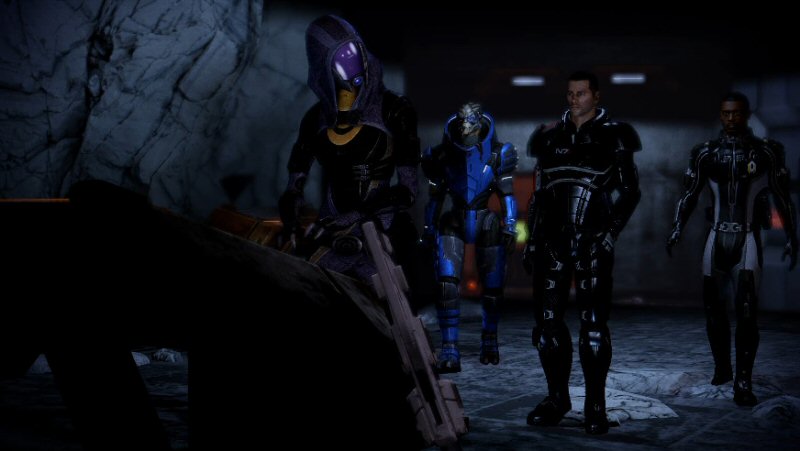
Tali’s recruitment mission has you rescuing her from a Geth attack during a research project. She’s studying a star that’s burning out too quickly because of mumble mumble dark energy space magic. According to lead Mass Effect 1 writer Drew Karpyshyn (who departed BioWare just before Mass Effect 2 was completed) this was supposed to lead in to the overall Reaper plot. PC Gamer has a transcript of a podcast where Karpyshyn discussed an early concept for the big Mass Effect 3 reveal:
Dark Energy was something that only organics could access because of various techno-science magic reasons we hadn’t decided on yet. Maybe using this Dark Energy was having a ripple effect on the space-time continuum.
Maybe the Reapers kept wiping out organic life because organics keep evolving to the state where they would use biotics and dark energy and that caused an entropic effect that would hasten the end of the universe. Being immortal beings, that’s something they wouldn’t want to see.
Then we thought, let’s take it to the next level. Maybe the Reapers are looking at a way to stop this. Maybe there’s an inevitable descent into the opposite of the Big Bang (the Big Crunch) and the Reapers realize that the only way they can stop it is by using biotics, but since they can’t use biotics they have to keep rebuilding society – as they try and find the perfect group to use biotics for this purpose. The Asari were close but they weren’t quite right, the Protheans were close as well.
Again it’s very vague and not fleshed out, it was something we considered but we ended up going in a different direction.
I’m a little wary of talking about this here, if only because it strays dangerously close to the blame-game stuff I’ve been trying to avoid. Also, it’s a little unfair to compare this half-baked idea to the Actual Ending, because this Dark Energy plot has a lot of blanks that need to be filled in. It’s entirely possible this idea would have fallen apart just as violently as the one we got.
Sure, it might sound like a promising ideaOr not. I dunno. A lot would depend on the execution. when Karpyshyn outlines it, but if you put this explanation in the mouth of the Star Child and offered a Red, Green, Blue ending-o-tron then it probably would have been just as big a disaster as the ending we got.
But I bring this up because this is the only part of the entire game that makes any effort at all to set something up for Mass Effect 3, and it sets up an idea they abandoned later. You don’t need to do some kind of “big mind-blowing reveal” at the end of the series. But if you are going to go that way, then you really need to set it up properly ahead of time. A big twist is more than just “unexpected information”.
Everyone points to the end of Mass Effect 3 as this point of failure, but I maintain the seeds of that eventual failure were planted much, much earlier. Yes, the eventual reveal of the purpose of the Reapers was awful, but it would have been easier to deliver a good ending if there had been something to build on here in Mass Effect 2.
Tali’s Trial

While stopping the Reapers (and later, stopping Cerberus) remains the overarching plot, the Mass Effect series also has two major sub-plots that cover all three games: The Quarian / Geth conflict, and the Genophage. While the Reaper / Cerberus plot eventually disintegrates into frustrating nonsense, the other two plots remain uniformly excellent. Mordin’s loyalty mission advances the Genophage plot, while Tali’s advances the Geth / Quarian plot.
Tali is called back to the flotilla and put on trial for smuggling live Geth onto their ships. Tali isn’t actually the one to blame. It was her father. But Tali wants to take the blame to protect the memory of her father. I just want to point out that last week on Spoiler Warning, we ran into that exact situation in KOTOR, where one Wookiee wanted to take the blame for another, to protect the honor of the dead. Everyone notices when BioWare re-uses the Towers of Hanoi puzzle, but little ideas like this often show up again and again without being noticed.
I’d love to know if the same person wrote both stories.
The entire quest is fantastic. You get to see the famous Quarian flotilla up close. (A payoff to something ME1 set up!) You get to meet the Quarian leadership. (Worldbuilding!) You get to participate in the trial and make some fairly weighty decisions that aren’t just lame paragon / renegade binaries. (Choices that matter and make sense!) You get to shoot some Geth and hear all their delightful robo-noises, which was one of the most aurally pleasant parts of Mass Effect 1Aside from the soundtrack..
Also, this quest introduces characters and ideas that will return in Mass Effect 3 for a large dramatic payoff. We get character development, story development, choices, worldbuilding, and continuity between games. It’s wonderful, but it also highlights how much the main plot failed to do these things.
Legion

Legion is a fan favorite. He made the rounds in the memes and comics when the game was fresh. Why do people like him so much? That cool voice? The fact that he’s a rare sci-fi robot that doesn’t suffer from Pinocchio Syndrome? Is it that intriguing N7 chestplate that the writers are smart enough to not explain?
Those are all good reasons, but I think an overlooked reason for Legion’s popularity is that he’s a character made almost entirely out of worldbuilding. Legion is a payoff to numerous questions posed in Mass Effect 1. His explanations about Geth existence, motivations, and behavior are all interesting. It expands on what we already know without rewriting existing lore or clashing tonally. Since the moment Tali explained their shared history, I’ve wanted to hear the Geth side of the story.
His recruitment takes place during a main story mission, so we’ll talk about it in a later entry. For now let’s talk about his loyalty mission, which poses the most interesting question of the entire Mass Effect series…
Link (YouTube) |
The Geth have broken into two factions: One believes that they should join with the Reapers, and the other believe they should remain independent. Legion is with the independants, and calls the other faction the “heretics”, (Which makes me wonder if the pro-Reaper Geth think of themselves as “normal Geth” and Legion’s faction as the heretics.) The two sides don’t openly war on each other, but they have broken contact and avoid one another.
So then Legion hits you will this conundrum: The pro-Reaper Geth have a base where they are developing a software virus. This virus will alter the anti-Reaper faction, making them pro-Reaper. This is a pretty big danger. The Geth are already a pretty formidable foeIgnoring the fact the Shepard destroys hundreds of them with only modest danger to himself, because this is a shooter and That’s How Shooters Work. The Geth are like stormtroopers: A massive danger to everyone but the heroes., and now you’re discovering you’re only facing some sub-section of them. So Legion asks for Shepard’s help in eliminating the threat that this base poses.
During the mission, Legion offers Shepard a choice: Blow up the base along with the virus, or turn the virus around and use it to convert the heretics to our side.
As Extra Credits describes it:
Imagine this Geth sect is you, and the belief in question is something you feel very strongly, or hold very dear. Now imagine someone could take that belief from you – say, the religion of your father, or the belief in the worth of your own individuality. Imagine they could do it without asking you, without you ever knowing, and without your volition at all. Imagine that they could wipe away your beliefs to thoroughly that if you met your former unaltered self, you would disagree so violently that you probably couldn’t stand each other. Now imagine that the only way to prevent that from happening was a struggle to the death.
It’s a shame the writers tried to map this decision to the paragon / renegade system. This question is much too nuanced for so crude a tool. On the other hand, leaving out paragon or renegade considerations would have felt wrong from a gameplay perspective.
Some people come at this from the practical approach: Which is best for the galaxy as a whole? Other people come at it from a moral perspective: If it were me on the receiving end, would I prefer death, or alteration? Or maybe you could view alteration using some sort of MAD doctrine: If you don’t want to be at risk of alteration, then don’t try to alter others. Since these Geth made the first move towards this kind of weapon, turning it on them might be an important lesson for the Geth. Then again, it might just break the taboo and cause the Geth to abandon all attempts at dialog and embrace “brainwashing-via-hotfix” as a means of debate.

You could argue that your decision doesn’t matter because the damage was already done when the heretics opted for this sort of solution. Up until now, Geth have always disagreed peacefully. But this virus demands aggression. No matter what you choose, this conflict makes them more like organics, who solve large conflicts by settling who has the best guns instead of who has the best ideas. This change in behavior might damage their intelligence and development in the long run.
This. This is why I love details-first sci-fi. The rules of a well-defined universe give us some frame of reference so we can examine this question in detail.In a drama-based universe where robots are just human-style personalities inside a metal body, it would be really awkward to slow the story down to ponder something like this and lay all the ground rules for what technology can and can’t do.
In a drama-based world, if someone reprogrammed C3P0 to hate Luke, the expectation would be that Luke could appeal to him as a friend to break the “spell”. Maybe right before he kills Luke, he would be reminded of some moment of friendship they shared, and he would realize his mistake at just the last second, proving that evil can’t win over good because love is true. Actually, since C3P0 is a comedy character, he’d probably be “fixed” by (say) hitting his head or being electrocuted. Or whatever. I’m sure you’ve heard that story before.
I’m not knocking those drama-based stories. They’re good. In Return of the Jedi, the good guys win because of love. Luke finds the strength to overcome Vader without resorting to the dark side because of his love for his sister. In turn, Vader betrays the dark side because of his love for his son. Han and Leia overcome the stormtroopers because of their love for each other, which Han finally professes right at a crucial moment. And the Ewoks overcome the Empire because of George Lucas’ love of merchandising.
The point I’m making is that while I enjoy having good drama pluck at my heart strings, sometimes what I really want is a challenging”Challenging” by the standards of mass-market entertainment. philosophical exercise within a properly framed hypothetical, and the question of what to do with the Heretic Geth is exactly that. The quandary is endlessly fascinating, and every time I think about it I find a new idea to play with or a question to ask.
Speaking of questions…
What do these guys argue about?

Legion makes it clear that this particular Geth conflict is the result of Reaper influence, but he also makes it sound like this is not their first disagreement. The Geth presumably have the same hardware, they begin discussions with the same priorities, and they spend the majority of the time loaded into massive server racks where they aren’t going to have divergent sensory experiences. So how is it that they have differing opinions?
Humans are wildly divergent. We’ve got different genes, different conditioning, different experiences, and different outputs of hormones resulting from different behaviors and diets. But in Geth? Where would these differences come from? They presumably run on the same hardware. They spend most of their existence downloaded into server farms, which means they’re not out in the world having different sensory experiences.
Let’s say uncle Bob would drag us kids out to the lake every summer and feed us burgers that were raw meat inside and scorched carbon outside, and we were all tormented by mosquitos while we ate them. The repeated negative experience has conditioned me to hate the entire grilling experience regardless of location or skill of the chef. This makes me a bit of an oddball in my culture, where people love grilling outdoors.
How would such a divergent opinion arise among the Geth? What would make any of them diverge? If the same hardware takes the same input and rates it according to the same priorities, then disagreement isn’t diversity, it’s a software bug.
All of this is an exhaustive way of asking: What do the Geth talk about all day?
I’m not saying that Mass Effect should have answered this question. I’m saying that the detailed framework provided by the worldbuilder has created a universe where we can play around with ideas like this. This sort of exploration of hypotheticals wouldn’t workOr wouldn’t be nearly as satisfying. in a schlock-based story where robots are just humans who are bad at idioms and have chrome skin.