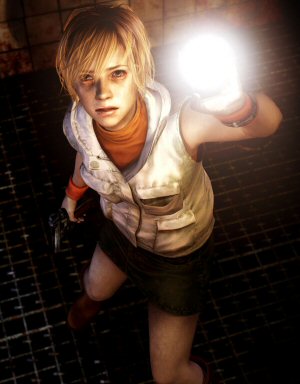
Dreamfall: Spooky Girl

By Shamus Posted Tuesday Oct 10, 2006

Filed under: Game Reviews 11 comments

Early in the game I ran into this strange little girl:

Dreamfall – Silent Hill Girl

One thing that struck me is how “Silent Hill” this girl is. Despite being a little girl, she’s very spooky and strange. She seems to be some sort of ghost. (I’m sure her nature will become clear as the game proceeds.) She’s powerful. Her dark hair hides her face. Your character speaks to her, and she speaks back, but the conversation is pretty one-way; you can’t get her to respond to you. She’s also very pale and she seems to be “mildewing” on the bottom. This is all stuff right out of the Silent Hill playbook.

Ragnar Tornquist mentions the Silent Hill games on his blog, and it’s pretty clear he must have really gotten into the game at some point. I think it’s cool to see how that influenced Dreamfall.


DM of the Rings XV:
Riddle me This

By Shamus Posted Monday Oct 9, 2006

Filed under: DM of the Rings 58 comments

Lord of the Rings, Moria, Mellon, Magic Door, Battering Ram, Riddle.

No matter how difficult or absurd you make a puzzle, your players will find an even more impossible and preposterous way of solving it.


The Beige Age

By Shamus Posted Monday Oct 9, 2006

Filed under: Rants 30 comments

Everyone knows how culture is supposed to work: You cherish the culture of your childhood, wrapping those memories in a warm blanket of nostalgia. Then you idolize the culture that exists as you become an adult, because your generation has obviously hit some sort of societal high note. Then you decry the culture that supplants it, since all these dang kids are messing things up.

But this isn’t what I’m seeing. The culture of my childhood was a wasteland. Television was rubbish. The music sucked. Things got much better in the 80’s, and have gradually improved since then. If I have any complaints about our current culture, it pales in comparison to my dislike for what things looked like then I was eight.

We tend to label things by decade, but of course the old culture isn’t thrown in the trash at the 10-year mark. When 1980 rolled around men didn’t suddenly shave off the Chuck Norris mustache, take down their blacklight / velvet wall hangings, and put on a clean shirt. It doesn’t really work that way. But that doesn’t stop us from trying to impose order on what is fundamentally a chaotic and ever-changing world. I will now carry on this tradition of pretending that culture can be measured and judged in neat, decade-sized portions.

Visually, I like the 50’s. It had class. The TV was bland, but polite and genial. I like the 60’s, when America stopped being such a stiff, and started thinking seriously about this civil rights thing and how that might be a good idea. The 80’s were ok, if a bit of a dork. The 90’s were filled with exciting technological and social changes – rising from the intertron web superhighway thing – and that was pretty great. The only decade I can’t stand is the one I’m supposed to cherish: The 70’s unambiguously sucked.

In the sixties, America loosened up, took of the tie, and cracked a smile. In the seventies it got drunk, took of its pants, and went streaking in the quad. The decade of loosening up gave way to the decade of coming unhinged, and the result was some of the most spectacularly awful culture the west has ever seen.

I’m not just talking about the music or attitudes: I’m talking about everything. The homes and buildings built in that era are dark, ugly bunkers. The clothing was an abominable smear of oddly shaped polyester clown suits which came in a broad mix of putrid earthtones. Women’s fashion seemed bent on making every woman look cheap and unkempt. Collars on men’s shirts became big enough to serve as an ersatz airfoil, and the most popular hair style for men was “Chewbacca”. The catchy tunes of the early 60’s faded away, and we were left with sulking musical misery, protest songs, and white guys who were bent on draining every last drop of soul out of rock music. The simple-living, smiling, friendly hippies were replaced with the sneering, angry, inarticulate stoner hippies. The cars – excepting a few nice muscle cars – were grotesque. The slang was stupid. The movies were bleak and bereft of entertainment value. Even the comedies – no, especially the comedies – were grim and joyless. I can laugh at funny movies made before that time, and I laugh at comedies made since then, but the humor of the 70’s eludes me. The television was rubbish, all the way to the core.

Stipulated: Star Wars was pretty great, and it came out in the 70’s. Of course, it was set in another galaxy, far away from the world where men’s pants ended mid-shin, and white people had afros. I think that was a lot of its appeal. Even so, when Luke and Han are onscreen I still struggle to supress the urge to shout “get a haircut!” at them.

What made the culture so unsavory? Was it the war? The economy? The rise of the baby boomers?

Who cares? I’m glad it’s over.

LATER: Looking back, I have no idea what prompted me to write this right now.


Dreamfall: Supersize

By Shamus Posted Sunday Oct 8, 2006

Filed under: Game Reviews 0 comments

Dreamfall
Dreamfall
Dreamfall
Dreamfall

A while back I mentioned the escalating cost of content creation in video games. Everything I said about the expense of developing content for first-person games goes double for adventure games. In contrast to action games, where the world passes by in a constant blur, adventure game scenery is usually sitting still and the object of much scrutiny. Objects in the game world aren’t just there to provide atmosphere – they are part of the game, and the player is going to look it over very closely in his or her search for clues about how to proceed. They will spend a lot more time looking at any given set, and so a lot of thought needs to go into what they will see, and the art needs to look very polished. In an adventure game, the reward for progress is the ability to move on to the next location. In an action game, the environment is where the rewards happen. In an adventure game, the environments are the reward.

So the main struggle in adventure games has been to fill the world with compelling scenery. To keep the player from cruising through and beating the game in an hour, the designer puts up challenges for them to overcome. Make the puzzles and challenges harder, and the game gets longer. Game design is usually a balancing act between game length and player frustration. The only way to have the best of both worlds (low frustration but a long and rewarding game) is to just add tons of content and scenery. That tends to get expensive.

But this is exactly what they did with Dreamfall. They dialed the puzzles down from “perplexing” to “amusements” and then just added endless miles of scenery and story. The gameworld is immense and richly detailed. How Ragnar Tornquist got the budget together to make an adventure game of this size is beyond me.

Dreamfall
Dreamfall
Dreamfall
Dreamfall

A side effect of this generosity of size and pace is that I brought a lot of my old adventure-gaming habits with me, and they are working against me. The old approach is to plow forward until you hit a roadblock. There is no need to examine a location in detail because you’ll be backtracking many times, and by the time you overcome the current challenge you will have seen everything and sundry. You’ll be sick of the place long before you can move on, so there is no point in digging deep on your first pass.

In Dreamfall, those roadblocks often do not exist. There are locations – huge, wonderfully detailed locations – which have not one puzzle. They are there for the sake of the story, and all you need to do to move on is have a conversation. I found myself rushing in and triggering that conversation before I’d looked around. I ended up being pulled through an area before I’d really had a chance to appreciate it. There are NPC’s I never spoke to – not because I didn’t want to, but because I expected I’d be obliged to at some point, so I ran past them. That never happened, and so they got overlooked.

This may be the first adventure game that has ever warranted an immediate replay from me. I must say this open style of gameplay is a welcome change, I just need to slow down and adjust to it. The story feels rushed right now, but I’m the one doing the rushing!

The world of video games is often likened to movies. Dreamfall is nothing like a movie. Instead, it comes very close to the experience of reading a book. An excellent book.


Arrogant Software

By Shamus Posted Saturday Oct 7, 2006

Filed under: Links 11 comments

Rabid Paladin has a rant on Arrogant Software. He mentions Adobe Acrobat, which I have picked on in the past. He also singles out Realplayer and iTunes as a couple of particularly onerous offenders.

It’s been almost a decade since I let Realplayer set foot on my computer. Occasionally I’m compelled to help a friend fix their screwy computer and I’ll see the Realplayer icon in the system tray. I still recoil at the sight of the thing, as if it was a flaming pentagram icon or Carrot Top.

My own experience with iTunes:

A while back Pepsi had a promotion where about half of their 12oz drinks had a “free song from iTunes”. This is what actually prompted me to download iTunes in the first place. I snagged a couple of songs. I liked the way you could browse, preview, and download songs. I redeemed a couple of these free songs before I noticed the catch: The songs come in iTunes-only format. Then I remembered a bunch of ranting on Slashdot about DRM when the iTunes service first opened and I realized this is what I was looking at. I didn’t care so much about the copy protection, but I didn’t like the fact that in order to play my songs I had to use their player. (Yeah, I know, that’s how it works, blah blah. I could care less.) Nobody could ever get away with selling cassette tapes that would only play on a Sony tape player, but iTunes is doing exactly that with digital music. Yech.

I wasn’t about to give up my beloved mp3 player of choice to use the bloated and slow-loading iTunes. The shopping interface was perfect, but the player interface was about as useful as a twenty-pound salad fork. I also wasn’t a fan of how iTunes tried to abstract my MP3’s into “collections” or whatever. I already have them carefully organized and labeled – the last thing I need is a program that tries to impose some other organizational system on top of that.

I suppose in some abstract way I still “own” the songs I downloaded, but I have no way of playing them. If I sold someone a television and then told them it would stay at my house and they could come over and watch their television anytime they wanted, I don’t think they would feel like they owned the TV. I don’t feel like I own these songs.

So yeah: iTunes is a jerk of a program, although unlike the other two it is partly so by design.

Hat Tip: The Rampant Coyote


GROW Tribute

By Shamus Posted Saturday Oct 7, 2006

Filed under: Game Reviews 2 comments

GROW CUBE
GROW: A game where careful experimentation and observation will allow you to create highly ordered nonsense.
Remember GROW? It was a strange little flash puzzle game that made the rounds a while back. I think I first found the link via Steven. The person who made that game is still at it, and has a bunch more games along those lines at his site, EYEMAZE.

These games are interesting for the way they blend intuition and logic. Using pure logic, it will take you many attempts to learn about what all of those mysterious doodads do and how they interact before you learn enough to take a shot at finding the ideal solution. However, with a little intuition you can reduce the number of attempts by discarding certain moves. Let’s see. I can add water or people to my cube-shaped world. People need water, so I should put water first. People make fire so fire should maybe come after people. The intuition isn’t usually as clear cut as in that example, (which I’m not even sure is correct, puzzle-wise) but it’s there and it’s a real part of the game. I don’t know how else to describe it. It’s like a logic puzzle for people who are more intuitive than logical.

Thinking back to my post on right brain vs. left brain – I wonder which type of person would fare better? No matter how you apprach the puzzle you will need a good memory.

Here is another worthy attempt, “Tribute to GROW“:

GROW GAME

Tribute isn’t as brain-tickling as the stuff at EYEMAZE, and the artwork isn’t as polished or as compelling, but this is still an interesting game.


Dreamfall: First Impressions

By Shamus Posted Friday Oct 6, 2006

Filed under: Game Reviews 11 comments

I’m currently playing Dreamfall, which is a decendant of the old-school adventure games like King’s Quest and Gabriel Knight. Talk to characters, find items, then use the knowledge and inventory to overcome challenges. This used to be a mainstay of PC gaming, but the genre fizzled out and died (or, if you prefer, self destructed) years ago, and adventure games are now few and very far between. I always had the feeling that adventure games weren’t living up to their potential. For the most part they were dull, tedious, and the puzzles employed demented logic designed to sell hint guides instead of tickle your brain. I always loved adventure games for what they could be.

The people behind Dreamfall evidently heard about how dissatisfied I was, because they managed to pull together a game that is everything I’ve always wanted. This is what an adventure game is supposed to be like. It’s epic. It’s witty. It has a rich palette of interesting characters. It has a complicated protagonist. It has technology, magic, fantasy worlds, and lots of mystery. The puzzles make sense and fit within the context of the game world.

There are so many wonderful images from the game it was hard to trim this selection of screencaps down to something reasonable. Just be aware that the following images barely scratch the surface of what the game has to show you.

Dreamfall

Dreamfall


Dreamfall
Dreamfall


Dreamfall

Dreamfall


Dreamfall
Dreamfall


Dreamfall
Dreamfall


Dreamfall
Dreamfall


One final note is that designer Ragnar Tornquist has his own blog, which keeps a very personal and down-to-earth tone. It makes for good reading.