Subtitle Obsession

By Shamus Posted Saturday Mar 25, 2006

Filed under: Anime 35 comments

From what I’ve gathered, most serious American Anime Otaku prefer to watch their Anime with subtitles, as opposed to watching the English dub. Steven Den Beste has been doing it for so long that he’s starting to learn some Japaneese.

But I can’t watch shows with subtitles on.

As soon as the words appear onscreen, my eyes jump down and read them. Then, my eyes stay there, waiting for the next line of text to appear. As long as words are at the bottom of the screen, my eyes are locked down there and ignore the action above. I have no idea why I do this. I have to make a mental effort to make my eyes go back up and watch the show after I’m done reading. As soon as I stop thinking about it, I go back to watching the text and not the images. So, I end up missing most of the images because I spend all my time staring at words I’ve already read. The only time I watch the show is when no dialogue is onscreen.

I don’t know why I’m wired this way. It doesn’t make a lot of sense and I don’t know of anyone else that has this problem. It’s very strange.


European Style

By Shamus Posted Saturday Mar 25, 2006

Filed under: Anime 4 comments

While watching Sugar, a Little Snow Fairy, I just noticed how much the town looks like the town of Glie in Haibane Renmei.

Both towns have a very “old Europe” look to them. Are there really places in Japan that look like this? I doubt it, but I could be wrong. Still, the narrow cobblestone streets and quasi-tudor houses in a lush green countryside just don’t look very Japanese to me.


Morality in GalCiv II

By Shamus Posted Friday Mar 24, 2006

Filed under: Game Reviews 16 comments

I’m nearly done posting about GalCiv II, but I have one more nitpickto add to the list I made the other day.

As you play, the game presents you with various moral challenges. For example, you find some planet with cave-men type creatures. Do you:

  • Leave them alone, even though they are taking up space you could put to use? (Good)
  • Put them on a reservation and keep the rest of the planet to yourself? (Neutral)
  • Enslave them? (Evil)

Good choices usually have a penalty. Neutral usually have little or no effect, and evil choices usually have some benefit.

There are two types of choices you must make:

  • Choices which benefit your empire (and thus your people), usually at the expense of other non-sentient lifeforms. Sometimes the choice is between your empire and an ideal, such as preserving a unique environment or ancient ruins.
  • Choices which benefit your empire at the expense of your people. For example, you may find a way to sacrifice the lives of your own people to gain some technology.

It’s the first type of choice that bugs me. Forcing your people to make sacrifices on behalf of other lifeforms is “good” in this game, but I think you can make the case that this is tyranny. If I force my people to give up awesome land because I don’t want to disturb the ruins of some long-gone race, I don’t thank that should count as a “good” decision. It’s all well and good to sit on a throne and feel smug that you are respecting the dead or preserving history (or whatever your rationale is) but it’s quite another if you’re the one living in a tiny house next to a spacious historical reserve. From that perspective, the leader, (the player) looks like an arrogant tyrant who forces their values (or the values of the programmers, really) on others.

If I have a choice of benefitting my own species or another species, I don’t think it’s evil to choose my own species.

It is possible to make choices throughout the game that contribute to the general comfort and prosperity of your people. Sometimes this will be at the expense of others (like booting cave-men off their land or killing dangerous creatures), sometimes at the expense of an ideal (tearing down aincent ruins to make room for your people) and sometimes at the expense of the empire as a whole (by spending money to save your people from some calamity). If you play this way you’ll usually end up with an “evil” alignment, which doesn’t make sense to me. A leader who forces his people to make some sacrifice on behalf of another group is, I think, a rotten leader. Your race is fighting for survival in this game, and I don’t think it is evil to fight to live, even if it means some lower species end up paying the price.

If you take this system where benefitting your race at the expense of lower lifeforms is wrong, and follow it to its logical conclusion, you end up with an all vegan race who refuse to use animals to assist with manual labor. Call me callous, but I don’t think our ancestors who ate beef and used oxen to plow the field were an evil bunch set on covering the world in darkness. They were just fighting for survival. Geeze, give an upright biped a break already.


IP Denial

By Shamus Posted Friday Mar 24, 2006

Filed under: Random 10 comments

I mentioned a while ago that I’ve started blocking traffic from a few places that were spamming me. I still get a couple of spams a day, but nothing like the hundreds I was getting before. Whenever I get more than one spam comment / trackback from the same address, I add them to the deny list. Something I noticed about the list:

213.33.239.9
85.140.58.133
212.193.63.1
85.64.93.115
85.64.64.66
85.64.25.197
204.15.134.196
85.64.88.226
85.64.244.243
85.64.111.186

What’s with all the 85.64.x.x entries? 60% of the IP addresses that spam me come from 85.64.x.x, which is odd. I wonder where that is. I googled around a bit, and there are several sites that will convert IP addresses into geographical locations, but they all want me to pay for and download software. Geeze. I don’t want to know that bad.

Here is another idle question: Why are IP addresses expressed in decimal and not hex? I can’t think of any reason to express them in base 10 as we do now. You don’t need to do math with these things. They are sort of like street addresses. You need them to be easy to remember. Changing them to base 16 would reduce the 12-digit number to 8 digits. In addition, the letters would make the thing more memorable. For example, which would you rather memorize: 204.15.134.196 or CC.F.86.C4? I suggest that the latter is a little more handy.


For the Children

By Shamus Posted Thursday Mar 23, 2006

Filed under: Rants 4 comments

Remember this bit I did a while back, where I talked about how people were going to ever more insane lengths to keep the children safe, because our kids rarely face any traditional dangers? Well, Evan Coyne Maloney has another ridiculous case in point.

Preposterous. Ten years ago, you could have suggested such a thing for a laugh, and now people are doing this with determination and a straight face.

Imagine, just imagine, what things will look like in another ten years.


Nostalgia++

By Shamus Posted Thursday Mar 23, 2006

Filed under: Personal 25 comments

The Rampant Coyote has this bit on his first computer, the Sinclair ZX80.

I was 8 years old when this machine hit the market. At the time I knew – on some primal level – that I needed to get my hands on a programmable personal computer. However, I had trouble explaining to the adults around me why I wanted it. I already had an Atari 2600, after all. Doesn’t that play the games you want? What I wanted was a computer that I could program. I wanted a machine that I could understand and eventually bend to my will, but I couldn’t get anyone to buy me such a thing.

I know it sounds insane; what sort of parent wouldn’t buy a computer for their kid? But you have to remember, this is 1979 we’re talking about here, and the utility of home computers wasn’t a universally recognized truth. For a kid living in a home with a blue-collar father and a mother who worked in an environment where “computer” meant big-iron mainframes operated by gnomes, a computer was a strange thing for me to ask for. It was like a kid asking for his own cement mixer or printing press. What on earth would I use that for? Computers were expensive, and a sensible adult would fear that it would just be treated like a puppy: obsessed over for a week and ignored thereafter.

I remember one Christmas my best friend got a TI-99/4A. I was sick with jealousy. From that point I couldn’t even remember what presents I’d gotten. He couldn’t possibly want such as thing as badly as I did. I felt the way Homer Hickum might have if he’d gotten a BB gun and his friend had gotten a home rocket-building kit. It seemed like a grave injustice. For him it was just an interesting toy, and for me this was a gift of infinite possibilities.

When I found my friend with his new computer, he was doing the unthinkable: He was typing in a program from a magazine. Someone else’s program?!? Why aren’t you learning how to write your own? This was like finding Merlin’s Spellbook and using it to prop up a crooked table leg. The secrets of the universe are in there, man! How can you be content typing in all these words and symbols without knowing what they mean? They demand understanding! Does their mystery not taunt you? At the time, I thought I was the only person who thought of computers this way. It would be many years before I met anyone else like myself.

(I had an uncle that was wired this way as well, but he was born about 30 years too soon. He spent his teens and twenties messing around with model trains and ham radio, which is what computer geeks did before computers were available. He went on to work on the Apollo program, which is nice enough, but doesn’t seem to make up for not having computers available for half his life.)

Eventually I stopped being such a crybaby and got a paper route. I saved my money for a few months until I had enough scratch to buy a Tandy MC-10:

Most people have a fondness for their first computer. You can still find fans of the TI-99/4A, the Commodore 64, the Amiga, and the Atari 800. It was not so for the MC10 and I. While I did grow attached to a few of the above systems, I never really liked the Tandy computers. This dislike grew into a resentment that I extend onto all of Radio Shack today.

As long as they were in the computer business (which lasted until sometime in the early 90’s) Tandy computers were dull and akward. As a programming platform they were difficult. Their hardware was bulky, ugly, and gave off the stench of obsolescence right out of the box. Imagine the proprietary nature of Apple combined with the asthetics-assulting early IBM clone hardware, and imbued with the clumsyness of Windows 3.1. Now regress that unholy union back to the days of sub-megahert CPU speeds and computers with 4k of memory. It wasn’t pretty. I wish there was a familiar object in the above photo to provide a sense of scale. The chiclet keyboard was horrible. Even for my 13-year-old hands, it felt a little crowded. I can’t imagine a grown man making use of it.

In the late 80’s / early 90’s, Tandy had their own line of quasi-IBM clones. They seemed to use similar architecture, but the machines were just a little different. Aside from costing more, they also required certain Tandy-specific parts. At the time I told people they had “compatiblity problems”, as if the Tandy engineers had trouble duplicating the mysterious IBM clone architecture. Looking back I can see the system for what it was: A very cynical attempt to take the large IBM clone market and make their own proprietary offshoot. Again, it was Apple-esque proprietary hardware and IBM / Microsoft uglyness, all for a higher price! Being known as “the computer guy” among my friends meant that I was the one people called when their computer went sideways. I always dreaded when a Tandy user called for help, because there wasn’t much I could do but shrug and blame Tandy. This was akward because it was also indirectly pointing the finger of blame back at the person asking for help, for buying such a machine in the first place.

During my high school years it became clear to the adults around me that this computer thing wasn’t just a phase I was going through, and that it was just the sort of thing that might make me useful in my adult life. I enjoyed quite a bit of support from parents and a couple of teachers during my high school years. For graduation, the uncle I mentioned earlier sold me his old machine, which was my first IBM clone. It was a 4mhz machine, but with the math co-processor he’d added it ran at at a supersonic 7mhz! It had 256k of memory, or 1/4000th of the memory of the machine I’m using now. However, it had a C compiler, which is what allowed me to escape COBOL and BASIC and learn a real programming language. From there, I was off and running.


RGB Color Cube

By Shamus Posted Thursday Mar 23, 2006

Filed under: Pictures 3 comments


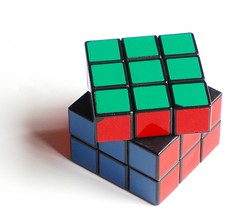
RGB Color Cube

My own Rubik’s cube. Somewhat worn but still loveable.

While we’re here, let’s dispell some myths…

  • The solution isn’t just a single sequence of moves that leads to the pieces falling into place by magic. It isn’t some secret combination of turns that you repeat over and over.
  • You cannot have just one piece out of place. You also cannot solve five sides. (Think about it)
  • There are eight corner pieces and twelve edge pieces, for a total of twenty pieces that move. The center pieces do not move relative to one another: They simply spin in place.
  • You don’t need to spend five minutes turning the thing to make sure it’s REALLY messed up. Once it’s scrambled, it’s scrambled, and any more random moves are superfluous.
  • The solution is not to solve for sides. People will sometimes get two (usually adjacent) sides, and then think they should naturally progress to three, four, and so on. Sometimes I have two adjacent sides completed, and I’m obliged to scramble one of them as I work on the rest of the cube. Sometimes the audience will laugh at me, “Ha ha! You had that one and messed it up!”

There is a tradeoff in solution methodology. Generally, you can have short (ish) sequences of moves that can be used over and over again to swap a couple of pieces. For example, if you have two corner pieces that need to trade places without disturbing the other six corner pieces, you might hold the cube so that the two corners in question are right in front of you, and then make a particular seven-move sequence. You could use this method over and over again to nudge all of the corners into place. However, you could also have a longer sequence that swaps four corners. You’ll need to memorize a few different variants of it, depending on how you want to re-arrange those four corners. But when you’re done, you’ll have four corners sorted instead of two. So, the simple method would require you memorize one seven-move sequence, and the faster method has you memorize several ten-move sequences. It continues to scale up like this, with longer and more complex chains getting more accomplished. I’m sure the masters have immense lists of moves for every situation. Pehaps they can arrange all eight corners in one set of moves, they just need to choose the right sequence of moves from the huge library they have memorized, and then perform it flawlessly.

Another danger of using long chains: If you mess up and make a wrong turn somewhere, it is far harder to recover. Generally if you make a mistake during a long chain you won’t know it until you’re nearly through with it, and by that time you’re in trouble. The last few errant moves have just been scrambling the cube. When this happens to me I have to start all over.

There are many solution methods that people use. Some are very tricky and optimized for speed. Mine is much simpler and quite slow. The best in the world can solve a cube in less than fifteen seconds. I’ve seen it done* , and it is very strange. Unlike the method I use, where I work on a layer at a time (top to bottom), these people seem to work on the entire cube at once. The cube looks scrambled right up until the last few moves when everything begins to fall into place. Conjecture: This method arranges the corners relative to one another, and then the edge pieces. I imagine they have huge lists of lengthy sequences for swapping groups of pieces as needed. I’d love to know how they develop such sequences.


* Who out there remembers the show “That’s Incredible!”? You do? Then you are clearly an aging codger like me. One episode featured various champions racing to solve the cube, and I remember quite a few people did so in under twenty seconds.