From tabletop to desktop

By Shamus Posted Monday Mar 6, 2006

Filed under: Game Design 29 comments

I admire the d20 system of gaming. I think it has survived for 30 years for a reason, and that reason is that it offers the right balance of fun and playability, while preserving the in-game metaphor of swordplay and sorcery. It works.

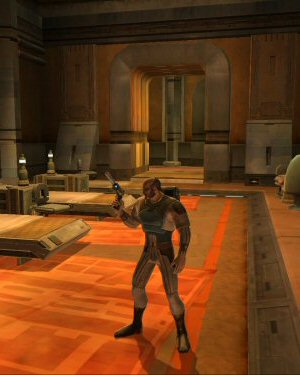
But a lot of video games have tried to adopt a d20 based system, and I’ve never been entirely happy with the result. KOTOR was a fantastic game, but it was hampered a great deal by the underlying d20 system. Official D&D games (such as Icewind Dale) also use this sytem, and in doing so they cripple what might otherwise be a great game with an akward combat system.

The d20 system is just ideal for tabletop gaming, but not for computer gaming. In a table game, each dice roll is an exciting moment. Let’s be honest: Rolling those colorful and oddly-shaped dice is fun. But even when the game is moving at a good pace, each attack takes about ten seconds. If something unexpected happens, you might spend almost a minute resolving a single attack. In a video game, attacks happen at least ten times that fast. On the computer, the excitment doesn’t come from individual attacks, but from the outcome of the battle as a whole. The battle is the event on the computer. Combat is much more common, much faster paced, and you can’t expect the player to get excited about dice rolls spewed out by a random number generator at the rate of once a second.

The d20 system is also designed to reduce complexity. You don’t want a bunch of paperwork to do with each attack, and so everything is simplified. For example, if my weight for encumbrance is 100lbs, then I can run around with 99lbs of stuff on my back with no penalty, but if I pick up a 1lb item, I suddenly start moving at half speed. This is done because you don’t want to be doing long division and cranking weights through some formula to figure out how fast you can move. To keep things simple, you want to add and subtract whole numbers. But on a computer, this is no problem. It can handle oddball movement speeds like 1.35 and having things like 23.41 hit points.

The d20 system allows for a lot of randomness. This is because, as I said before, each dice roll is an event, and you want each event to matter. You want suspense. Will I hit? Miss? Score a critical and lop this Orc’s head right off? Roll a one and fall on my butt? Lots of randomness means lots of variety and lots of suspense.

But on a computer, you don’t see the dice rolls. The randomness of the rolls makes the game itself feel random. I’ll fight one Orc and take no damage. I’ll fight another and nearly die. Since I’m not seeing the dice rolls, I don’t see that he got a critical hit. I don’t see that I “rolled” a one and dropped my sword. I just see that I fought the same monster twice and got very different results. The whole thing feels like a crapshoot. Because it is.

The other major problem with using a d20 system on the computer is that the game almost always assumes the player has a deep understanding of d20 mechanics. I can’t tell you how many times I’d find an item in KOTOR that said “+2 to all attack rolls”. Wow. Really? Um… is that good?

Or how about: “extra 2d6 + 2 to all damage rolls vs droids” Do the makers really think “2d6 + 2” means ANYTHING to non-D&D players?

Instead of, “+2 to attack rolls”, it should say, “+10% chance to hit”.

Instead of, “2d6 + 2 damage”, it should say, “4 to 14 damage”.

Instead of “+3 to all fortitude saving throws”, it should say… geeze. That’s hard to explain. I mean, in combat sometimes you have situations where your player might… ummm. Well, first let me explain how the CON attribute and fortitude are linked, and how that affects combat. If you look at page one of your character sheet…

You know what? Let’s toss this d20 system in favor of something that is easier to grasp. The computer is doing the legwork, so we don’t have to keep the math simple. We just need it to make sense.

I like the system used by Morrowwind, which was something entirely new. Every time you hit something with your sword, your “sword skill” meter went up. When the meter filled up, you gained another level of swordfighting skill. There was another one for using a bow. And wearing heavy armor. And bartering. And diplomacy. And using various kinds of magic. In short, the more you did something the better you got at it. The player is easily able to grasp this. There was a huge list of diverse skills in the game that worked this way. On paper, this would be impossible to use. Every battle would require stacks of paperwork. But on the computer the system is easy to understand and intuitive.

I’d like to see more RPG’s dump the d20 system and try to come up with something new and different. If they did, I’d be willing to pay $(2d20) + (1d4) for something like that, with a +1d4 chance to buy the sequel.


Trek Lighting

By Shamus Posted Saturday Mar 4, 2006

Filed under: Nerd Culture 3 comments

I’ve always laughed at the Enterprise of the original Star Trek and how the ship had bank after bank of blinking, flashing, unlabeled lights. The person who suffered from this insanity the most was poor Uhura…

…who had to operate the communications system using hundreds of little buttons, without so much as an LCD screen to guide her way. Other than her walkman-sized earbud the only input was little buttons, and the only output was little unlabeled lights. (Not to mention that the workstation isn’t ergonomic, and the person who designed her uniform needs to be sent to sensitivity training.)

At any rate, it’s fun to look back at these old shows and make fun of how ridiculous they are by 2006 standards.

Oh yeah, on a completely unrelated note that has nothing whatsoever to do with anything I mentioned above, I wanted show a cool picture I took the other day. I came into my home office in the early hours of the morning and before I flipped on the lights I saw this:


Click for larger view.

Note that many of the above lights flicker and blink. None of them are labeled. All of it looks so futuristic and cool.


My Space

By Shamus Posted Saturday Mar 4, 2006

Filed under: Pictures 4 comments


My Space


For the curious, here is my home office. Note that it is rare for someone to witness this tableau when it does not include the back of my head.


Anti-Junk mail chain letter spam

By Shamus Posted Friday Mar 3, 2006

Filed under: Nerd Culture 7 comments

Recently someone sent me some tips for dealing with telemarketing calls and junk mail, in the form of a chain letter. I find this to be both ironic and humorous. Like all chain letters, it takes something good, adds on a bunch of nonsense and flim-flam, and then begs people to spread it around. Let’s have a look:

Andy Rooney’s tips for telemarketers

Three Little Words That Work !! The three little words are: “Hold On, Please…” Saying this, while putting down your phone and walking off (instead of hanging-up immediately) would make each telemarketing call so much more time-consuming that boiler room sales would grind to a halt.

Then when you eventually hear the phone company’s “beep-beep-beep” tone, you know it’s time to go back and hang up your handset, which has efficiently completed its task. These three little words will help eliminate telephone soliciting.

I have no idea if this is really from Andy Rooney. Not that it matters. I don’t really consider Rooney to be some sort of techno-expert. He’s a guy on TV. He does what I do (communicate with people) except that he has to wear makeup. I can’t think of anyone less impressive to cite as a source. A common chain letter tactic is to attribute the contents to some authority, and I expect that is what has happened here.

In any case, this suggestion is brilliant. I will be doing this from now on.

One of the things I struggle with is that the people doing the actual calling are working for peanuts. While worthy of scorn, they are just reluctant henchmen serving a mastermind who is far beyond your reach. They are verbal punching bags, and no matter how much abuse you heap on them, none of it will make it back to the lothsome people running the show.

But by following this suggestion I can do something besides vent on some hapless drone. If I ask them to “hold on a second” and then walk away, I have not done anything to the sap on the other end. I’m sure he’d rather sit there in silence than read through his script for the fifty-third time today. More importantly, I’m clogging up the works. If I had implied that perhaps his mother was less virtuous than is normally expected of mothers and then hung up, he’d be interrupting someone else’s dinner by now. But instead he’s sitting there doing nothing, which is costing his employer (Calling Center Manager Plapatine) both time and money. Best of all, it doesn’t require any extra effort on my part. I was going to put the phone down and walk away anyhow. All I have to do is not hang up.

Do you ever get those annoying phone calls with no one on the other end?

This is a telemarketing technique where a machine makes phone calls and records the time of day when a person answers the phone. This technique is used to determine the best time of day for a “real” sales person to call back and get someone at home.

What you can do after answering, if you notice there is no one there, is to immediately start hitting your # button on the phone, 6 or 7 times, as quickly as possible. This confuses the machine that dialed the call and it kicks your number out of their system. Gosh, what a shame not to have your name in their system any longer !!!

I do get these hang-up calls from time to time. They usually preceed a real telemarketing call by an hour or so. When I get one of these, I know that odds are good I have a spam call coming in the next hour.

But I don’t think the suggested solution makes the slightest bit of sense. The machine is just seeing if you pick up. I hear the hang-up click the moment I say “hello”. I’m certain the machine isn’t listening beyond that point, even if it was possible to “confuse” it.

This is the sort of superstitious thing people come up with when they don’t understand how a computer works. The program only cares about one piece of input: You answering the phone. By the time you realize what you’re dealing with, it has that piece of info, and it would be senseless for the programmer to go to the extra trouble of having the thing listen beyond that point.

When you get “ads” enclosed with your phone or utility bill, return these “ads” with your payment. Let the sending companies throw their own junk mail away.

These things are opened by a human. As a rule, I don’t want to confuse this person when I’m paying my bill. The last thing I need is for them to see the ads and throw them away, along with my check. If a utility company wants to send me an ad with the bill, I don’t get too bent out of shape. This isn’t general spam sent blindly to everyone. These guys know who I am and we have an existing relationship.

When you get those “pre-approved” letters in the mail for everything from credit cards to 2nd mortgages and similar type junk, do not throw away the return envelope. Most of these come with postage-paid return envelopes, right?It costs them more than the regular 37 cents postage “IF” and when they receive them back.
It costs them nothing if you throw them away! The postage was around 50 cents before! the last increase and it is according to the weight. In that case, why not get rid of some of your other junk mail and put it in these cool little, postage-paid return envelopes.

Send an ad for your local chimney cleaner to American Express. Send a pizza coupon to Citibank. If you didn’t get anything else that day, then just send them their blank application back! If you want to remain anonymous, just make sure your name isn’t on anything you send them. You can even send the envelope back empty if you want to just to keep them guessing! It still costs them 37 cents.

I do this from time to time. If the ad makes me angry, I almost always make sure to send them some junk back. There are some credit card ads that are very sleazy and decietful, and those guys get to pay for me mailing them junk.

I don’t do this to ALL of them, because it’s just too much hassle. You’d have to really spend time on this if you wanted to get them all.

The banks and credit card companies are currently getting a lot of their own junk back in the mail, but folks, we need to OVERWHELM them. Let’s let them know what it’s like to get lots of junk mail, and best of all they’re paying for it…Twice! Let’s help keep our postal service busy since they are saying that e-mail is cutting into their business profits, and that’s why they need to increase postage costs again. You get the idea !

If enough people follow these tips, it will work—-

The postal service was having trouble long before the internet came along. Email is just a handy excuse. In any case, telling me that doing this will help out the postal service doesn’t really motivate me.

This tactic takes a little effort on my part. More effort than would be needed to simply throw the stuff away. Junk mail isn’t the worst problem we face, spam-wise. Unlike email spam, the sender does indeed have to pay for it. Unlike telemarketing calls, junk mail is only a slight annoyance.

I have been doing this for years, and I get very little junk mail anymore.

I seriously doubt that one person doing this can affect their own supply of junk mail. While it is true that if EVERYONE did it, it would no doubt impede the efforts of the junk-mailers, but remember how this works: This return mail is opened by someone working near minimum wage, opening envelopes and looking for completed applications / checks / sign-up forms or whatever else they want you to send back. That guy probably doesn’t have any power over who does and does not get junk mail. Even if he DID have the power to take you off the list, is he going to take that extra step because you sent him a fistful of coupons? This is assuming he even knows who you are. If the ONLY thing you send is coupons, then he’s not going to know who sent them, and thus cannot stop sending you junk mail.

And all of this just wouldn’t be complete without:

THIS JUST MIGHT BE ONE E-MAIL THAT YOU WILL WANT TO FORWARD TO YOUR FRIENDS

(rolling eyes.)

If you have a good idea, you will never need to beg people to spread it around. Great ideas are viral in nature. Typing in ALL CAPS only draws attention to the fact that this is the true goal of the email: not to combat solicitation, but to simply spread.

So, this email had one good idea, which is this: Ask telemarketers to hold and let them sit there. As I said at the beginning, it is a good idea wrapped in a bunch of nonsense.

In closing, please forward this link to all your friends. ;-)


Oblivion

By Shamus Posted Thursday Mar 2, 2006

Filed under: Game Reviews 13 comments

From the spamming shills at Gamespot, comes the news that Oblivion has gone gold.

I loved the previous game in this franchise, the unique and innovative Morrowwind. Now the sequel is due in stores March 20. Sadly, I won’t be getting it. My humble ‘lil PC just isn’t up to the task. I’m way below the minimum system specs for this thing. I’m sure I’ll upgrade my computer sometime this year, and then I expect I will pick this game up, probably used.

Here is an interesting fact: The PC version of this game is $50, and the XBox version is $60. Nice. This is a first-person game, which means it is far more suited to the PC, and looking around with the analog stick is going to be akward and frustrating. The PC version comes with the toolkit so you can add content to the game. You can add new NPC’s, quests, or entire towns and share them with your friends. The PC version will support the fantastic keyboard technology, which lets you type letters and symbols directly into the game instead of playing hunt-and-peck with the controller. Thats a lot of features to give up for $10 more.

I don’t get it. What’s the sense in charging more for the console version?