Our Next Game System

By Shamus Posted Monday Jan 28, 2008

Filed under: Tabletop Games 182 comments

rpg_books2.png
My gaming group is about to wrap up a campaign, our fourth and final in this setting. The homebrew setting I came up with three years ago is about to be retired for good. It’s been added onto as the setting changed hands. It started out with a group of level 1 characters working to save a small group of towns. Then escalated to saving an island, then the region, and finally – assuming we don’t all snuff it in the next couple of sessions – the world. I think it’s time to hang it up and begin a new tale.

But now the question comes: What do we play next? D&D 3.5 is all this particular group has ever played, although a couple of the members have played other games elsewhere. I’m not actually huge on the standard D&D fantasy setting. In fact, among the eight people in the group, only one of us prefers fantasy. The problem is, the rest of us all want something different. Star Wars. Pirates. Cyberpunk. Superheroes. The giant robot stuff. Vampires. Werewolves. Everyone has a different “favorite” that is despised by the rest of the group. We play in our homebrew fantasy world because it’s our only common ground.

If I had my choice I’d play some sort of space opera. It could be Star Wars, but it wouldn’t have to be. (Although if I ran a Star Wars game, I’d set it on my own made up worlds rather than dragging the party through the locales we keep visiting in the movies. Too often Lucas’ universe feels like a galaxy of a hundred million stars and eight planets. Sigh. I’d want to go somewhere new where we wouldn’t have Star Was canon dragging behind us like so much baggage.) Although for me, the game system itself is more important than setting. Great stories can take place in any genre. Great stories can’t take place if you spend all your time deciphering and fighting about The Rules.

So what should we play? What setting? What game system? It’s a tough call. We all have different goals and reasons for playing the game, so the challenge is to find some middle ground where we can all be content.

I’m at least as eccentric as the next guy, so I’m not going to pretend that this list is in any way reasonable. Having said that, in a perfect world my gaming system would have:

* Bell curve. I dislike the chaos encouraged by the flat d20 system. The bell curve formed by rolling two or more dice together appeals to me a great deal. It makes “special” events more special.

* Fun dice. I don’t like systems which rely on huge handfuls of boring old d6’s. The seven piece dice set is amusing and fun. There is a tactile appeal to using them. Yes, I realize that this conflicts with the previous item, as most bell-curve systems use two or three d6’s.

* Roleplaying over Strategy. Mechwarrior is not a bad thing, but it’s not for me. Any game where combat takes more than twenty minutes is a game where I’m going to get bored. I’m there to play a character and weave a story. If you want to play Risk, just say so and we can play Risk. But don’t ask me to develop a deep character and then funnel me through a series of long fights where the only use for my backstory is as a dice-rolling surface. Some players see the story as an excuse to chain a bunch of battles together, because that’s why they’re there. I see combat as a natural, emergent result of the goals of the player conflicting with the goals of NPC’s in the game. I can handle “arbitrary” fights in moderation, but if the fight isn’t directly related to the overall goal, I’m not going to be excited about it.

* Easy to learn rules. See also the Great Debate on Attacks of Opportunity. I can see why people write rules for grapple, overrun, AOO, etc. If you don’t have those rules, then the game will have lots of exploitable holes. A fighter will be able to run past a hedge of guards and attack the King in a single turn without risking harm, which doesn’t make sense. The problem is that plugging these holes requires twenty pages of rules, rolls, guidelines, and exceptions, which is just more crap to memorize and argue about. The whole system becomes an anchor around the neck of people who want to finish with the combat and get back to the game itself. I’d rather encourage players to respect the limits through in-game thinking rather than beating them into line with a bunch of pedantic regulations.

* Simple combat system. I can enjoy a system where I roll 1d20, and add my related skill modifier, then compare it to target number X. A system where I roll a die, add a modifier, then subtract some other modifiers, then divide by something and round up or down to hit a target number determined by the GM rolling the dice and doing similar calculations? This is not a game for me. It harkens back to the Mechwarrior players. Some people live for that number-crunching strategy. Nothing wrong with that, but I prefer to play that sort of thing on the computer and let the software handle the details for me. If I’m at the table with other human beings, I’m there to roleplay, dangit.

One player wants deep stratetgy. (Mechwarrior.) Another plays to amass loot and power, and prefers epic-level gaming. A couple of us really just want to play interesting characters in a compelling, believeable setting. Another one wants to be the strongest character in the group, and would really like to have PvP.

It’s amazing things go as smoothly as they do, considering our cross-purposes. The group is too big for my taste. It’s hard to roleplay in an eight-man gang. I’d suggest we split the group, but I don’t have time for two games at once, and since we meet at my house “splitting” the group would feel too much like “kicking some people out in favor of others”.

As tired as I am of D&D, it looks like it’s the only system that can be all things to all people. The other systems mostly specialize in ways that would alienate one or more players.


New Dice

By Shamus Posted Monday Jan 28, 2008

Filed under: Pictures 40 comments

Some people expressed an interest in seeing my new dice:

new_dice.jpg

This isn’t actually what they look like. If you were holding them in your hand you’d probably call them “maroon” colored, although the glossy finish made them look black in all the pictures. They’re maroon with purple running through it, and the different colors seem to have different specular values, which makes the light shift around on them when you turn them over in your hand. I love them, but they’re a devil to photograph.

Purple has always been my favorite color. (Actually, kind of a blue-purple. Like this: #9B00F4.) It’s kind of annoying that purple is seen as a “girly” or effeminate color. Mace Windu aside, guys don’t usually mess around with purple. Purple is awesome. It used to be the color of kingly royalty, and now it’s something ecstasy-addled teens wear to a rave. That’s just not right.


Fallout: Character System

By Shamus Posted Friday Jan 25, 2008

Filed under: Game Reviews 71 comments

The Fallout character screen.
The discussion on Eschalon’s character system was pretty interesting. Several people mentioned other game systems, some with numerous attributes that define your character, and some with very few. Opinions ranged from “you should only need mind / body / spirit” to “let’s track every possible aspect of your being using linked stats and floating-point numbers”.

Of all the (computer) RPG’s I’ve played over the years, my favorite character progression system is still the one found in the 1997 classic Fallout. Why I love this system:

It’s a classless system. You can be a “rogue” or a “melee fighter” or a “gunslinger”, but the particulars of doing so are up to you. You aren’t locked into choices where being good at fighting makes you bad at conversation, or being good at stealth implies you want to steal stuff. Being classless means it’s skill-based. When you level up, your skills improve, not the base attributes. I never liked games where you can become “smarter” or “more charismatic” by fighting and leveling up. Leveling up shouldn’t change your core attributes, (or at least, not by much) it should simply allow you to better use what you were born with.

You’re so SPECIAL.
You’re so SPECIAL.
There are seven core attributes in the game: Strength, Perception, Endurance, Charisma, Intelligence, Agility and Luck, which spell SPECIAL. That’s clever and makes them easy to remember. Seven is a lot of attributes, but they are clearly delineated and easy to understand. There aren’t any ambiguous stats, or stats which overlap. Nebulous, personality-driven concepts like wisdom are left off the list entirely. I’ve always disliked games where things which should be emergent during roleplaying end up assigned a hard numerical value. How “wise” or “foolish” I am should be determined by the choices I make in the game, not my character sheet.

Every attribute is meaningful for every character, and there aren’t any obvious “dump stats”. Creating a character is a matter of balancing tradeoffs, not min-maxing the crap out of your stats. You can if you want, but you will regret that 3 charisma or 2 intelligence before you get very far.

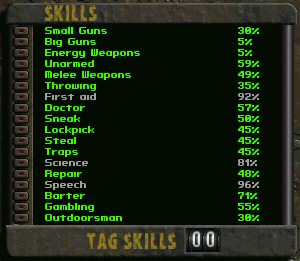
The list of in-game skills.
The skills aren’t quite as well-devised as the attributes. There is a large list of skills in the game (top right region) and you can pick any three to be “tag” skills. When you level up, you get a few points to spread around, raising any skills you like. Tag skills go up faster, but you can distribute the points wherever you need.

First aid and doctor skills overlap far too much. (How could I be a master doctor and yet be inept at first aid?) Likewise, the division of weapons into six different categories seems needless, and doesn’t really lead to any interesting choices in the game. “Bare handed” and “melee combat” should really have been merged into a single skill. Also, in all my many trips through the world of Fallout, I’ve never put points into thrown weapons. For the price of one grenade you can buy enough bullets to kill a dozen foes. Grenades aren’t really helpful until you sink a lot of precious skill points into them, and they are useless if a foe is right in your face – which happens pretty often. If your skills are low, you risk hurting allies or yourself.

Steal is a neat idea, but the majority of the people in the game don’t have much worth stealing. Gambling is also a neat idea, and at higher levels you can use your master gambling skills to make good money, but it’s probably faster and more useful to just put those same points into barter. Also, I don’t know how being “skilled” can help at roulette / craps, which is what most of the gambling dens in the game seem to feature. It does help, but it shouldn’t, from a realism / simulation standpoint.

Nitpicks aside, the skill system is still rewarding. Speech is genuinely useful, and neglecting this skill will eliminate a lot of interesting in-game opportunities. It’s even possible to win the game via dialog (instead of fighting the final boss) if you have the intelligence and speech skill to convince him his plans are fatally flawed.

This is the list of optional traits. You can pick any two of these at the start of the game.  Every three levels, you’ll be offered a list of perks to choose from. I’ve been through this game a lot of times, and I’ve still never seen them all.
This is the list of optional traits. You can pick any two of these at the start of the game. Every three levels, you’ll be offered a list of perks to choose from. I’ve been through this game a lot of times, and I’ve still never seen them all.
This is enough to make a great system, but it also has “perks” which your character can acquire, which roughly correlate to “feats” in D&D. Every three levels you get to pick a new perk. These are fun abilities that let you further customize your character as he or she develops. It adds a nice bit of spice to an already fun system, and really encourages you to replay the game with different character designs in order to check out the roads not taken your first time through.

The list of available perks changes based on your attributes. So, if your agility is high enough you might be offered a perk that lets you move more spaces during your combat turn, or if your intelligence is high enough you could get one that will aid you in using B.S. to get your way in conversations.

It’s an interesting, varied, robust, well-balanced system. I doubt we’ll ever see its like again. Bethesda is coming out with a new Fallout title. They’re keeping the SPECIAL system, but moving the combat to real-time. Since a great deal of the original system was built around turn-based combat using “action points”, a lot of the usefulness of the original attributes and perks will be lost. But hey, who needs depth and gameplay when you have OMG LOOKIT THE PRETTY PIXULS SWEET GRAFIX!!!!!!111!!

Sigh.

(To be fair, a turn-based game would be a fantastic gamble for them, while “Oblivion, but in a post-nuclear wasteland” is pretty much a slam-dunk. It’s not their fault my favorite gameplay mechanics are unpopular. Executive Producer Todd Howard is taking the game very seriously. He knows the game has big shoes to fill. Turn based or not, I know I’ll buy the game if they don’t put the thing out of my reach with outrageous system specs.)

A bit of frivolity below the fold. Continue reading ⟩⟩ “Fallout: Character System”


Eleven Years Ago Today

By Shamus Posted Friday Jan 25, 2008

Filed under: Personal 63 comments


She got me a book and a sexy new set of dice for our anniversary. I have a great wife.


Crysis Review

By Shamus Posted Wednesday Jan 23, 2008

Filed under: Links 39 comments

I was sent a link to an interesting article. It was on one of those sites that don’t offer a “back to the main page” link. I wanted to see what other stuff the website might have to offer, so I just started URL bashing. I never did find the front page of the site, but while browsing around the directory (note to webmasters: you really should turn off directory browsing or use default documents) I stumbled on a couple of gems.

This is probably the best game review I’ve read in ages. It tells you everything you need to know about Crysis. It’s pretty much what I expected. It’s Far Cry with More Better graphics, which is odd because I don’t think the graphics in Far Cry needed any work. The gameplay did. “Try to sneak up on a group of heavily armed, poorly voiced soldiers with telescopic eyesight and advanced paranoia, who all have nothing better to do than to peer into the jungle ceaslessly and shoot anything that moves.” Whee. The game has its fans, but I am not among them. I cheated my way through Far Cry and found that the game felt more like work than anything else.

Looks like Crysis is Far Cry, only more so. Still, the review was fun to read. I like the comic-book style approach. I’d be tempted to do the same thing, but the bandwidth costs would muder me.

On that same site I also found this gigantic, wonderfully drawn montage of videogames characters from the last 20 years. (Mildly NSFW.)


Who Needs Sleep?

By Shamus Posted Tuesday Jan 22, 2008

Filed under: Personal 45 comments

Ah! So here’s where I left my blog! I knew it was around here someplace.

This is the first time I’ve had a four-day gap on my blog in a long, long time. I realize this isn’t a big deal to most people, but not posting at this point feels really strange.

Part of the gap was caused by a week long stretch of strange sleep. My internal clock was convinced, with a zealous and unwavering certainty, that 9am was was the right and proper time for sleep. I was unable to to convince it otherwise during a miserable week-long struggle. I’d fight to stay awake during the day. Work hours were long stretches of bleary-eyed stumbling and staring. As soon as quitting time arrived, I’d run to my bed and pass out the moment I hit the pillow.

And then I’d wake up three hours later.

I’d find myself wide awake at 8pm, unable to sleep further. I’d shuffle around the house for the next twelve hours, feeling oddly tired but not sleepy. Once the sun rose, the hammer would fall and I’d be up against yet another day of fighting sleep, even harder than the preceeding one.

I tried exercise before sleep. No effect. I tried a sleeping pill before going to bed. Little effect. I tried the usual folk remedies involving food / showers / body temperature, regulating light intake, and the like. No measurable effect. By Thursday I was still getting four hours at a stretch, and by that point I needed ten or twelve just to catch up. My internal clock didn’t want me to sleep unless it was time for work. By Friday I found myself wishing that my internal clock was a physical object onto which I could visit my vigorous displeasure. Certainly if I owned a conventional clock that caused this much misery I would have smashed it to pieces by now.

My sleep is sort of fixed now. I go to bed at 4am and at 4pm, and on both occasions I sleep for four hours. This is stupid and inconvenient, but at least I’m getting enough sleep.

My boss was a really good sport about my low output last week, although I’m really pushing to make up for it now.

What a strange thing to have happen.


Eschalon Book I: Ending

By Shamus Posted Thursday Jan 17, 2008

Filed under: Game Reviews 32 comments

This game is more about stats than story, so I don’t have too much to say about the tale this game tells.

Spoilers follow. Click here to skip the spoilers and jump to my wrap-up thoughts.


Nice map.  Remember: The shortest distance between any two points goes right through the friggin’ enemy base.
Nice map. Remember: The shortest distance between any two points goes right through the friggin’ enemy base.
This is as much of the plot as I was able to sort out on my first-and-a-half trip through the game:

The plot centers on a gigantic gem called the “Crux of Ages”. It has magical powers, although its powers are of no direct use to you in the game. Its magic is intended to protect the king from external magical influences. A powerful Goblin wizard nicked it, which left the king open to his powers. The Goblin then proceeded to dominate the mind of the king, compelling him to launch a war with an otherwise harmless third party who live a good distance away.

The main character and his brother stole the Crux from the Goblin, but the Goblin could sort of see “through” the Crux to him. This vision wasn’t perfect. It was a very indirect sort of scrying, but it was impossible to remain hidden forever. His memories linked him to the Crux, and thus the wizard would eventually see where the protagonist had taken the Crux and what he was doing with it. As long as the main character knew where the Crux was, so would the Goblin.

THREE POUNDS? Well, that certainly limits us in where we can hide it. Ahem.
So he came up with a plan to hide the Crux and then erase his own memories. He stowed it in a safe place, left himself some clues, and then drank a potion of Plot Device. The game begins as you wake up and wonder where and who you are.

You then have to re-trace your steps, and re-claim the Crux. The erased memory created a break in continuity for the Goblin Wizard that he couldn’t follow. The upshot was that you could now safely own the Crux without him spying on you.

It was explained much better in the game. I’ve kind of butchered it by shaving it down to mere synopsis.

Once you reclaim the Crux you have to hammer your way deep into Goblin territory and confront the Goblin Wizard. There are a lot of ways this can play out, as the game gives you a number of choices.

Piss off, kid.  You’re not gettin’ into the castle until you complete your assigned quests.
Piss off, kid. You’re not gettin’ into the castle until you complete your assigned quests.
My major complaint is how you have to fight all the way to the heart of the Goblin fortress, kill their leader, and then use a teleport to get to the king’s castle, where you can return the Crux to its rightful place. The nearby castle is “impenetrable”, but the far-off Goblin fortress isn’t? This was too much of a stretch for me. It makes sense from a gameplay perspective, but I would have liked a better justification for storming the Goblin’s place. Considering that all you really need is to drop the Crux into its pedestal, it seems like walking up to the front gate and giving the guards a peek at the THREE POUND JEWEL OF MAGICAL AWESOME SPARKLE POWER should have been enough to get in the door. The Crux is famous, after all.

End spoilers.


I’m probably being unfair. Eschalon is designed to be old-school, and the old games were notoriously sloppy with justifications for doing all sorts of crazy stuff in the world. The classic “Gather up the Seven Magic Keys of Evil-Thwarting, which have been hidden for no good reason” was about par for the course back then, and Eschalon is miles ahead of that sort of thing.

I was a bit wary about the ending, since this is Echalon: Book I. I was worried we were going to get left at some wretched “buy the next game!” cliffhanger. But no, this game is self-contained and wraps things up nicely.

I had fun with the game. I’ll be looking forward to Eschalon: Book II.