Free Radical

By Shamus Posted Tuesday Mar 28, 2006

Filed under: Movies 3 comments

My self-indulgence apparently knows no bounds: I’m going to play Dream Cast with my own book.

My book is based on the 1994 video game System Shock. I hesitate to call my book fan fiction. To most people, “fan fiction” means stories where Councilor Troi and Princess Leigh team up with Harry Potter to solve a mystery and/or have sex. In other words, much of it is painful-to-read dreck. But I can’t pretend my book isn’t fan fiction just because fan fiction has a bad rap. That’s what the book is, and I’m still (mostly) proud of it.

While I was writing the book, I sometimes had famous actors in mind, if only as a point of reference. I have no illusions about the probability of the book ever becoming a movie. Heck, it’s never going to get published as a book, for crying out loud, so musing about a theoretical movie adaptation is even more preposterous. But preposterousness fits in well with the spirit of the game.

Characters marked with an asterisk* are characters that I came up with on my own, and who were not a part of the original story.

The Hacker

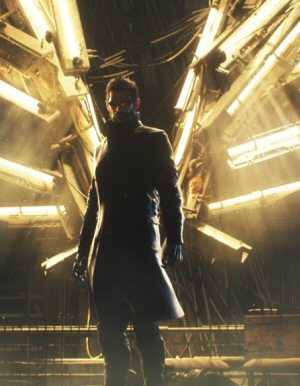
In the game, your character was faceless and nameless. One of the reasons I wrote the book is to explore who this guy was and why he did the things he did. The book describes Deckard Stephens as bald, with a box beard. Neal Stephenson (left) inspired this look, although I wouldn’t say this is what Deck looks like in the story. Take ten years and twenty pounds off that picture (Deck is very wirey) and you’ll have Deck more or less as I’ve pictured him.

We need someone thin, with dark hair and in their late twenties. I can’t think of any actors that look and sound just right for the part.

Nomen Nescio*

Nomen Nescio, the wise, calculating, and bald-headed mentor of Deck has always been played by Laurence Fishburne in my mind. I started the book in 2001, and the character of Morpheus from The Matrix had greatly influenced how this character developed.

Nomen is introduced in chapter 4, about a quarter of the way down.

Rebecca Lansing

The description of Rebecca in the book is that she’s in her mid/late twenties, with short black hair and an athletic build. That doesn’t really narrow things down by much when choosing an actress. I have a very clear perception of her personality, but I’ve never had a face to go with it.

So let’s start by listing who I wouldn’t cast in this part. Milla Jovovich, Charlize Theron, and Carrie-Anne Moss need not apply. This isn’t a part for an ass-kicking action actress. Rebecca has some combat training, but she’s level-headed and down-to-earth. I would look more towards the Sandra Bullock / Cameron Diaz end of the spectrum.

Dr. Victor Coffman*

David Hyde Pierce looks very much like I’ve always pictured Dr. Coffman. He appears in chapter 18, and has one of the key conversations in the story. This conversation and the ideas it puts forth about AI are one of the reasons I wrote the book.

I should note that while Pierce looks a great deal like Dr. Coffman, you should not think that Coffman is anything like Dr. Niles Crane, his most famous character. The two are very different men.

SHODAN

Terri Brosius did the voice of Shodan in the original System Shock game, and I can’t imagine anyone else doing it. In much the same way that the voice of HAL 9000 was believeable as that of an AI, Brosius as Shodan simply works.

The Suit*


The Suit was packed into his crisp tie and jacket like a shrink-wrapped anvil. His neck was thick and his shoulders were wide. It was a safe guess he spent his younger days either guarding or hurting people’s bodies for money. His face was a hard, square mask beneath his gray-streaked receding hairline. The deep lines on his face revealed that he had spent very little of the last forty years smiling. He was obviously running the show.

From the moment I came up with the character, I pictured him as being played by Michael Rooker. The photograph to the left is perfect: That’s exactly how I’ve always imagined him.

Edward Diego

I didn’t have anyone in particular in mind when I wrote Edward Diego, although this picture of Greg Kinnear is a really good fit. He looks smart and likeable, which is one of the reasons he’s so dangerous.

Marshal*

I didn’t have a specific actor in mind when I wrote the part of Marshal, but Daniel Cudmore looks about right. He played Colossus in the second X-men movie. It was a small part, but he got enough screen time for us to see that he is immense. He’s both tall and muscular, and yet doesn’t have that pro-wrestler steroid-pumped look about him. He looks like a decent guy. Just really, really big.


Thief 3

By Shamus Posted Monday Mar 27, 2006

Filed under: Game Reviews 9 comments

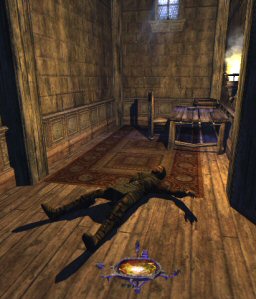
A while ago I talked about emergent gameplay and how its superior to older, more scripted games. Of course, even newer AI can have some pretty amusing screwups. In fact, the “smarter” the AI, the funnier it is when the whole thing flies apart. Over the weekend I was playing Thief 3, and ran into a situation that made me think about how truly tough it is to make even passable AI.


The head of your average citizen has terrible acoustics, but the gold in their pockets makes a fun jingling sound when you pick it up.

In the game, you can sneak up on anyone (servants, nobility, or guards) and whack them on the back of the head to knock them out. (You can also stab someone in the back, but that’s noisy and bloody, and why kill them when you can just knock them out?) Once they are knocked out, you usually need to hide them. If you leave them laying in the middle of the room or hallway, someone else is likely to come along and discover your work. When this happens, they always assume the victim is dead. Then they start with the running and the screaming and everyone searching for you.

This can be amusing. I was in a large manor, working my way through a sleeping area for servants. One of them was already asleep in the bunk beds, but a few others were still wandering around. I zonked one of them and placed the sleeping victim into one of the beds. I thought I was being clever. Another servant came in, saw their compatriot in the bed and exclaimed, “Dead!? But who could have killed him? I’ll go tell the guards!” Then he ran off.

Blast it all.


When you knock somebody out, you need to stow them someplace dark and out-of-the-way. This spot is definitely sub-optimal.

I should have known better. The AI was just looking for knocked-out people. It didn’t care where the body was. I was so into the game I stopped the metagame thinking about AI and started thinking about what I’d do in the given situation. In that situation, placing a zonked person in a bed made a lot more sense than dumping them in a corner. However, to the AI it was just a poorly hidden body. Sigh.

But fixing this problem would be tricky, and would involve a lot of extra work. The level designers would have to designate certain areas or objects as “beds”, and the programmers would need to make it so that bodies laying on beds rouse less suspicion than bodies found elsewhere. Then they would need to add some new dialog and behavior: If an NPC sees someone “sleeping” on a bed (most likely not in their own bed) while fully clothed and while they should be working, he shouldn’t ignore them, but he also shouldn’t run away screaming about murders and dead bodies. You need some new behavior along the lines of “try to wake someone up and then discover they have been knocked out”.


The city that never sleeps. At least, not until I run around and give everone their good-night donk on the head.

But even with that extra effort, you can still have some amusing failure modes. Placing a servant girl on a bed in the priest’s quarters or the barracks should raise some eyebrows. Likewise, stacking two or more people in the same bed should tip off guards and servants that something is amiss. It wouldn’t make sense for them to just assume they all decided to take a nap together.

It would be annoying to code in such a way that it works right. The programmer would probably need to take the victim’s position into account as well. If I just toss somebody on the bed so that their upper body hangs over the side and their head is resting on the floor, it’s going to look pretty stupid if someone comes along and assumes they’re asleep.

Also, it seems like the length of time since the NPC’s last saw each other should be taken into account as well. If you greet your fellow housekeeper, walk out of the room, and come back a few seconds later to find them motionless in someone else’s bed, you are not going to think they are sleeping.


I’m the sneaking, robbing, creeping, crawling, thump-you-on-the-head so you can get a good rest medicine.

The game can be funny if you think about it too much. There is one house in particular where I stop by each night and give the occupant his good-night blow to the head. I’ve already robbed him blind, so he doesn’t have anything left worth taking. I just like to stop by after dark, sneak in, creep up behind him, and blast him on the back of the head. What must life be like for this guy, waking up each morning on his floor, wondering what happened and why his head hurts? Does he blame booze? Narcolepsy? His ex-wife?


Morrowind: Bribery and Barbarism

By Shamus Posted Sunday Mar 26, 2006

Filed under: Game Reviews 9 comments

In the game Morrowind, it’s possible to change the opinion an NPC has of you by insulting them, flattering them, or bribing them. If you want to pick a fight but don’t want to be the one to start it, you can goad them with insults. If you want them to give up some item or information, you can bribe or flatter.

All of this is done by simply hitting the button and watching the “how much they like you” meter go up or down. The thing is, you can keep this up all day if you want to exercise your skills at bribery and insults. If you want to improve these skills, just walk up to some poor shmuck and heap on equal measures of insults and bribery while the meter jumps up and down.

It’s sort of amusing to imagine how this conversation would actually sound:

Welcome to our fair city, stranger.

Hi there! Looks like you’re the man I’m looking for.

What do you mean?

I was told to report to the uglyiest, stupidest, most useless man in town, and clearly you’re the guy.

What? Who told you this?

I mean, you are clearly far more ugly and stupid than anyone else in town.

Silence! You anger me!

Heck I think you’re a shoe-in for most useless in the entire country.

That does it! You shall taste my steel!

What? I’m sorry, did I upset you? Here, maybe ten bucks will make it better.

I… I don’t know what to say. You’re very kind stranger.

Don’t mention it, you festering, vile heap of Orcish dung.

What!?

You putrid, slimy curse on the face of the world. You great towering heap of offal.

Do you wish to risk my wrath?

You make me want to puke all over you, if only to cover your smell.

Insolence! You shall die for that!

Oh geeze. Did I offend? My bad, my bad. How’s ten bucks sound?

Money? For me? Why, thank you outlander. You’re very generous.

So’s your mum.

My mother?

Yeah, the half-orc woman with the dirty moustache. Your mother.

WHAT did you just say about her?!?!

I said she’s the most generous woman in the whorehouse.

I SHALL FEAST UPON YOUR HEART, YOU ARROGANT DOG!

I’m sorry, I didn’t mean it. Here you go. Buy yourself something nice.

I thank you for the coinage, kind stranger.

Sure thing. Maybe use it to buy something nice for your husband.

WHAT?!?

…and so on.


Subtitle Obsession

By Shamus Posted Saturday Mar 25, 2006

Filed under: Anime 35 comments

From what I’ve gathered, most serious American Anime Otaku prefer to watch their Anime with subtitles, as opposed to watching the English dub. Steven Den Beste has been doing it for so long that he’s starting to learn some Japaneese.

But I can’t watch shows with subtitles on.

As soon as the words appear onscreen, my eyes jump down and read them. Then, my eyes stay there, waiting for the next line of text to appear. As long as words are at the bottom of the screen, my eyes are locked down there and ignore the action above. I have no idea why I do this. I have to make a mental effort to make my eyes go back up and watch the show after I’m done reading. As soon as I stop thinking about it, I go back to watching the text and not the images. So, I end up missing most of the images because I spend all my time staring at words I’ve already read. The only time I watch the show is when no dialogue is onscreen.

I don’t know why I’m wired this way. It doesn’t make a lot of sense and I don’t know of anyone else that has this problem. It’s very strange.


European Style

By Shamus Posted Saturday Mar 25, 2006

Filed under: Anime 4 comments

While watching Sugar, a Little Snow Fairy, I just noticed how much the town looks like the town of Glie in Haibane Renmei.

Both towns have a very “old Europe” look to them. Are there really places in Japan that look like this? I doubt it, but I could be wrong. Still, the narrow cobblestone streets and quasi-tudor houses in a lush green countryside just don’t look very Japanese to me.


Morality in GalCiv II

By Shamus Posted Friday Mar 24, 2006

Filed under: Game Reviews 16 comments

I’m nearly done posting about GalCiv II, but I have one more nitpickto add to the list I made the other day.

As you play, the game presents you with various moral challenges. For example, you find some planet with cave-men type creatures. Do you:

  • Leave them alone, even though they are taking up space you could put to use? (Good)
  • Put them on a reservation and keep the rest of the planet to yourself? (Neutral)
  • Enslave them? (Evil)

Good choices usually have a penalty. Neutral usually have little or no effect, and evil choices usually have some benefit.

There are two types of choices you must make:

  • Choices which benefit your empire (and thus your people), usually at the expense of other non-sentient lifeforms. Sometimes the choice is between your empire and an ideal, such as preserving a unique environment or ancient ruins.
  • Choices which benefit your empire at the expense of your people. For example, you may find a way to sacrifice the lives of your own people to gain some technology.

It’s the first type of choice that bugs me. Forcing your people to make sacrifices on behalf of other lifeforms is “good” in this game, but I think you can make the case that this is tyranny. If I force my people to give up awesome land because I don’t want to disturb the ruins of some long-gone race, I don’t thank that should count as a “good” decision. It’s all well and good to sit on a throne and feel smug that you are respecting the dead or preserving history (or whatever your rationale is) but it’s quite another if you’re the one living in a tiny house next to a spacious historical reserve. From that perspective, the leader, (the player) looks like an arrogant tyrant who forces their values (or the values of the programmers, really) on others.

If I have a choice of benefitting my own species or another species, I don’t think it’s evil to choose my own species.

It is possible to make choices throughout the game that contribute to the general comfort and prosperity of your people. Sometimes this will be at the expense of others (like booting cave-men off their land or killing dangerous creatures), sometimes at the expense of an ideal (tearing down aincent ruins to make room for your people) and sometimes at the expense of the empire as a whole (by spending money to save your people from some calamity). If you play this way you’ll usually end up with an “evil” alignment, which doesn’t make sense to me. A leader who forces his people to make some sacrifice on behalf of another group is, I think, a rotten leader. Your race is fighting for survival in this game, and I don’t think it is evil to fight to live, even if it means some lower species end up paying the price.

If you take this system where benefitting your race at the expense of lower lifeforms is wrong, and follow it to its logical conclusion, you end up with an all vegan race who refuse to use animals to assist with manual labor. Call me callous, but I don’t think our ancestors who ate beef and used oxen to plow the field were an evil bunch set on covering the world in darkness. They were just fighting for survival. Geeze, give an upright biped a break already.


IP Denial

By Shamus Posted Friday Mar 24, 2006

Filed under: Random 10 comments

I mentioned a while ago that I’ve started blocking traffic from a few places that were spamming me. I still get a couple of spams a day, but nothing like the hundreds I was getting before. Whenever I get more than one spam comment / trackback from the same address, I add them to the deny list. Something I noticed about the list:

213.33.239.9
85.140.58.133
212.193.63.1
85.64.93.115
85.64.64.66
85.64.25.197
204.15.134.196
85.64.88.226
85.64.244.243
85.64.111.186

What’s with all the 85.64.x.x entries? 60% of the IP addresses that spam me come from 85.64.x.x, which is odd. I wonder where that is. I googled around a bit, and there are several sites that will convert IP addresses into geographical locations, but they all want me to pay for and download software. Geeze. I don’t want to know that bad.

Here is another idle question: Why are IP addresses expressed in decimal and not hex? I can’t think of any reason to express them in base 10 as we do now. You don’t need to do math with these things. They are sort of like street addresses. You need them to be easy to remember. Changing them to base 16 would reduce the 12-digit number to 8 digits. In addition, the letters would make the thing more memorable. For example, which would you rather memorize: 204.15.134.196 or CC.F.86.C4? I suggest that the latter is a little more handy.