Session 1, Part 3

By Shamus Posted Saturday Sep 17, 2005

Filed under: D&D Campaign 2 comments

The captain concludes the south has conquered the town. Their only hope is to sail around the north end of the island and head for the city of Breakshore. If the city still stands they may buy the weapons in the hold, or at least allow port and re-supply.

Inorem reminds him of the storm.

The captain replies that now the storm will work in their favor. Ships of the south may well pursue them if not for the bad weather.

They bring the ship about and make for the north. As they turned they see and hear the alarm being raised from the tower on shore. They can see men scurrying about on the shore, archers obviously standing to the ready should they come within range.

The captain orders that all the cargo be dumped overboard. They are too low in the water and too slow to have any hope of reaching Breakshore like this. Inorem protests. The Captain relents. The crew is ordered to empty only the Captains’ share of the cargo.

Beck meets the loaders in the cargo hold and suggests they “accidentally” dump some of Inorem’s stuff as well, since his stuff is towards the front and they will have to climb over and around it to get to the captain’s.

Hours pass. The ship rises out of the water as it gets lighter. The men are sweating and exhausted as they work steadily trying to get ahead of the oncoming storm.

Inorem is furious about the cargo being thrown over. Skeeve tries to calm him down. Inorem assumes it was the humans and dwarf who did it, though Skeeve helped with quite a bit.

The ship pushes west at a good clip.

A whistle blows, sounding general quarters. The party comes up on deck to see the sky a sick green. The air is still and quiet. The men look apprehensive. It is very warm and humid. The ship stops moving as there is no longer any wind.

The captain orders the men to secure the sails, and the officers and the party are called to the navigation room.

The captain explains the basics of weather navigation, heading into the wind, not worrying about where you’re going, just ride up one side of a wave and down the other, no sails, as the wind will push the ship over, OR the mast will snap like a twig.

The storm draws nearer. The temperature drops quickly. Suddenly it is wet and chilly. The sea begins to churn.

The sky grows black as the sun sets. Rain begins to fall. As the ship is buffeted by the storm, they begin to take on water. The ship is still riding low in the ocean. The captain sits by the wheel upon his barrel. Two stout men, Thordek and Thu’fir are sent to the wheel. The captain explains that the more they aim INTO the wind, the safer they are. The sails are tied up and everyone else is sent below.

Skeeve begins offering random spells he can do. None of them are “make the storm go away”, so the captain sends him belowdecks with the rest. Thordek and Thu’fir have no trouble keeping the ship on course.

Night falls. Inorem stands just inside the door and runs the damage control operation. At first he sets the men to bilge, but it is a lost cause. Water comes in too fast. He concludes they need to lift the ship up or they’ll sink. He orders all hands to begin hauling his weapons up from the hold, and shoving them out the door. He goes out and sets to pushing the crates overboard.

Beck is there to remind the party that they could have tossed Inorem’s stuff hours ago, made better time, and saved themselves a lot of trouble during the storm. Inorem’s greed has put them in greater danger.

Sailors (along with Eomer) work furiously to haul the heavy cargo out of the hold and get it overboard. Then, one of them loses his footing on the slick steps. The crate hits the deck and burst open, releasing an avalanche of broadswords down the steps. The hapless sailor is caught in the flow and sliced up as he falls downstairs in the pile of weapons. Eomer is right behind him, but quick enough to leap up and place his feet on the railings, holding himself above the steps as the swords and victim slid by beneath him.

As a Rogue, Eomer’s reflex saving throws are through the roof, so he always gets to make cool saves like this.

-Shamus

The steps are now coated with seawater, blood, and swords. Enoch is called. He grants healing to the injured man, while everyone else goes about the tricky job of gathering up the swords as they slide back and fourth on the rocking deck. The cargo unloading operation is delayed as all of this happens.

Continued in Part 4…


Session 1, Part 2

By Shamus Posted Saturday Sep 17, 2005

Filed under: D&D Campaign 6 comments

As soon as all are settled the ship sets sail. Eventually they make their way to the mess deck. An unshaven sailor wanders over to their table and joins them. Skeeve greets him as he sits, which is more than enough to loosen the sailor’s tongue. A man who enjoys his own voice, Nobert introduces himself as a member of the crew and cheerfully goes on to fill them in on all the ins and outs of the crew, wandering happily from subject to subject with little prompting from the party.


The Ocean’s Majesty
Click for larger view.

As it turns out, Endo was right in assuming that boxes coming from the blacksmith were likely war supplies. The ship is selling weapons to the northern states of Mar Tesaro, an island deep in some sort of civil war.

The conversation then turns to Inorem, whom according to Nobert, the crew dislikes. His rudeness and distaste for humans are more than enough to keep him from favor amongst the crew. Inorem used to sail on a much grander elven ship, but it was sunk in the battle of Bayhaven. He’d been forced to take this position on a human crew and he resents it. Half of the cargo hold is his, and he is free to use this ship until he can make enough to buy his own. He does this by stacking it to the rafters with weapons for sale at Mar Tesoro.

Nobert then goes on to explain that Beck used to be first mate, losing the title to Inorem when the Captain offered to help Inorem get funds for a new ship. The crew however misses Beck as such, liking him as much as they hate Inorem. The crew also is very fond of the captain, who they refer to as “Puffins” or “Puff”. He runs a loose ship, but his generosity with his pay make up for any faults.

Nobert rambles on about various things until he settles on his girl Talla in Bayhaven, and he how is looking forward to seeing her. He goes on to describe her many attributes, though none of them seem to be her looks. After some time the men manage to turn his conversation to Bayhaven. Bayhaven is fine, or was when the ship was last there. The old town has been repaired and there was a huge harvest that year up north. Their biggest problem is that goods are piling up on the docks because there aren’t enough ships to move everything. Several were lost in the battle of Bayhaven, and a few others to pirates before that. Other ships are floating goods for the war (which is more profitable) so Bayhaven just isn’t getting enough ships to move everything.

Nobert takes leave when he finishes eating, saying he is needed on deck. The others go to work for a bit then retire to their quarters for the night.

23rd of Suncrest, 1501dy

The next day is clear and bright. Around noon the party, all about their duties, hear a ruckus on the deck. There they see a big crowd gathered, a great conglomeration of sweaty sailors and noise. After some shoving the party manages to work their way towards the innards of the fray, only to find Beck and Nobert in the middle, preparing to fight. The party finally surmises that Nobert and Beck had each had a letter from their girl back home, only to find that she was one and the same AND pregnant. After further discussion the two decide to fight for her. The winner of the fight will get to stay a sailor, loser will get all the money and go back to Bayhaven to marry Talla.

Inorem quickly steps in trying to settle it, pointing out that “This is most certainly not how civilized people settle arguments and certainly not on my.. erm.. this ship.”

The captain however waves him aside with a brisk, “Go ahead, go ahead, lets see the outcome. This should be a good show.”

Both men quickly throw down their valuables in a pile as the mob of sailors crowds Inorem out of the way. It is no contest. Beck easily wins the fight, knocking Nobert out cold in less than a minute. Beck looks through his pockets, making sure he didn’t miss anything of value to give to Nobert. He goes below, looking sad.

Someone dumps a bucket of sea water over Nobert, who despite the numerous cuts, bruises, and one rather large lump upon the head, wakes immediately, grins a wide, toothy grin, and shouts, “Congratulate me boys, I’m getting married!” The crew all cheers.

24th of Suncrest, 1501dy

The next day arises, sleepy and full of sun. The seas sits calmly, gently rocking the old boat. The party assembles over their evening meal when they are approached by the man they had seen running from the smith. He introduces himself as Thu’fir, settles himself down amongst them and begins to talk. He likes to talk, mainly about himself and his pet sword. He goes on and on about the number of people he had killed with it, though when questioned they find that the number is rather smaller than his bragging implies (namely 11).

25th of Suncrest, 1501dy

The next day is rainy, a steady chill drizzle, in which the crew works steadily in alternating wind and rain.

Enoch, in his rambling about the ship (being a cleric, the crew will not let him help), discovers that there is another cleric aboard and decides to visit him the next day. The crew warns him that the other cleric is a bit of a joke, quite old, blind, and deaf.

Enoch makes his way below decks to the infirmary. There he finds Crolman, a human who looks to be a hundred years old and his attendant, a young sailor who tries continually to make sense of the old man’s mumblings, hoping for a hint at what the weather will be in the coming days. After some time and a bit of halting conversation with the sailor Enoch surmises that Crolman had once been a cleric but has now lost all his powers except for a gift of prophecizing the weather, which Crolman foretells in fits and starts amidst numerous comments on food and achy joints. While Enoch listenes, Crolman suggests that he is hungry, thirsty, uncomfortable, and that the weather will be fine for the next two days.

While Enoch visits the old cleric, Thordek looks for Beck. He finds him in the carpentry shop of the ship, practicing his sword fighting. Thordek watches as Beck’s sword slices through the air, looking as if it was drawing an elaborate picture inthe air as it flashes and swirles, cutting and slicing.

Skeeve decides to go practice his flying.

26th of Suncrest, 1501dy

The next day there is much talk amongst the sailors about Crolman as he seems to be very disturbed and more confused and upset than usual. Each has his own opinion about Crolman’s odd sayings that day. Enoch goes below deck to see what is going on.

In the infirmary he finds Crolman and his helper, Crolman going on, mostly about food but quite happily tossing in random, cryptic comments regarding the weather, and in all appearances quite disturbed. The sailor attending him is listening carefully to each word he says, attempting to get a straightforward answer out of him, so intently that he rather absentmidedly gets his food and drink and sets them down before him. Crolman, in his own little world, is quite oblivious to him. Crolman sits in his usual spot feeling around on the table before him obviously looking for his food, “Hungry!? …Thirsty?!”

Crolman mumbles, ” They won’t like us. Not gonna be happy. Not our friends.”

“Hungry!?” Crolman exclaimes as he feels around for his food. “Gonna rain. Big storm. The ocean’s gonna fall on our heads. Two days off, ” Crolman continues, still feeling around for his food, ” Watch the sail. Tie it fast. Don’t let it come loose!”

“Wet!” Crolman complains as he finds his food having put his hand in it as he felt for it.

Enoch then goes back on deck to tell the others about the latest, more complete news on the coming storm.

27th of Suncrest, 1501dy

The next morning the captain announces that they are drawing close to Fort Bolland, and should reach it by morning. There is a storm approaching, but they expect to reach shore well before it hit. The men need to work fast to secure the ship and get it unloaded before the storm hit. They need to get some of the dead weight (weapons) out of the hold so they will be less likely to sink with the high waves. Everyone needs to pitch in to make sure they are ready when the storm hit, or the ship risks being smashed into the docks.

The standing rule is no shore leave in Fort Bolland, due to the war. This is still the case, but the captain allows some of the crew to go ashore and seek lodgings, since there is no sense in sleeping on a ship in a storm at port. He asks for volunteers to stay up all night and watch over the ship.

At dawn they make ready to port.

An hour later the island draws near. The storm is a ways off yet. Everyone relaxes. It looks like they will port and unload well ahead of the storm. As they approach, the sailor in the crow’s nest sounds an alarm. They draw closer and see that the city is laid to waste. All has been burned. The lighthouse is dark, and the docks are smoking. A lone and crudely built watchtower had been built on the coast with a sign of an eye with a thorn through it.


This is the image on the flag seen flying over the city.

Fort Bolland has been defeated.

Continued in Part 3…


Session 1, Part 1

By Heather Posted Saturday Sep 17, 2005

Filed under: D&D Campaign 3 comments

22nd of Suncrest, 1501dy

The unlikely band of heroes waits impatiently at the inn, for what they do not know. The town, Golgotha, is swarming with mercenaries but as heroes the party finds that they do not need to pay for anything. All they want and more is at their fingertips, yet they itch to be gone. It has been months since they left Greymoor and some have unfinished business there awaiting their return.

The inn is nothing more than an abandoned house in view of the docks, the old inn having been destroyed in the battle three days earlier. Endo stands in the lobby watching the comings and goings; fighters, merchants, sailors, thieves, all can be seen walking along the road near the docks. The docks themselves are a flurry of excitement. A new ship, rickety and hardly sail worthy, looking to be on its last sails, is in the dock being stocked full of boxes from the blacksmith shop down the road.

Continue reading ⟩⟩ “Session 1, Part 1”


The Setting

By Shamus Posted Wednesday Sep 14, 2005

Filed under: D&D Campaign 8 comments

Before I became DM, the players were in a campaign run by a guy named Josh, whom I’ve never met. They parted ways with him and I ended up running the campaign. Josh was very much a freestyle DM, with no real shape to the game world. It was just town, woods, town, woods, in some non-specific country.

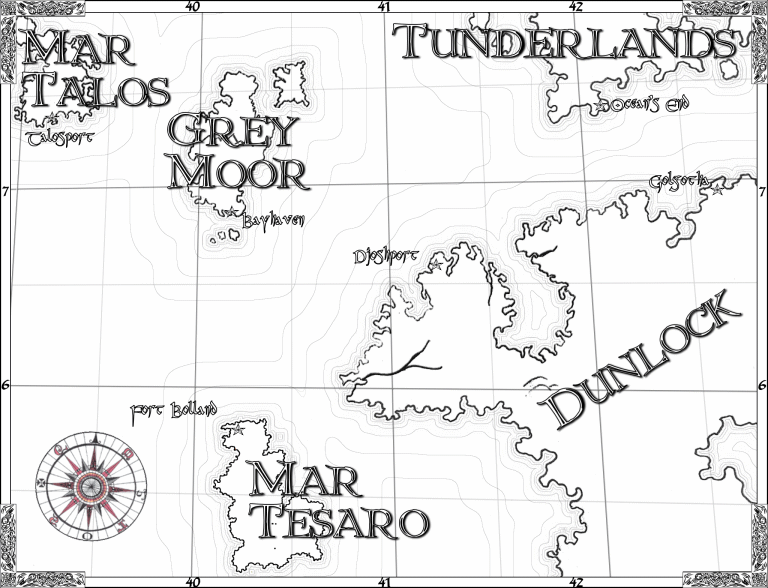
When I took over I wanted to keep a bit of continuity, but at the same time I needed to place them in some sort of structured world. I came up with the map you see below. I decided that they all came from “Dunlock”, and they were in the coastal town of Djoshport (named after their hapless former DM). In our first session I stuck them on a boat for Grey Moor, the site of our first campaign.

Our “world map” consists of the following:

  • Dunlock is the main landmass. The players “come from” here. The country doesn’t really have much in the way of detail, but serves as an anchor for the other lands in the game.
  • Grey Moor
  • Mar Tesaro
  • Mar Talos
  • The Tunderlands are inhabited, but the players have never been there. This land is open for future adventures.

In our first campain the players went to Grey Moor and broke an evil curse that was killing the crops and draining the land of life, and then joined in a battle to prevent a single greedy nobleman for siezing control of the Island. Along the way they teamed up with Eomer and Endo and attained level 3. The Elves of Mar Talos joined in the battle to keep the island free. This brought our first campaign to an end.

At this point one of the players (Joe) became the DM, and I joined the game as a normal player using Endo. Joe’s character stayed on Grey Moor, and the rest of us sailed to Golgotha in northern Dunlock. The party battled an army of the undead, saved the land, and made level 5. I became the DM again, keeping Endo as an NPC that travelled with the party. The party sailed for Mar Talos, but got shipwrecked on Mar Tesaro, which our third campaign is now taking place.


Energy-Based Magic System

By Shamus Posted Tuesday Sep 13, 2005

Filed under: Tabletop Games 41 comments

WARNING: The following rule-change is heresy to most D&D players. These changes are radical and will drive purists nuts. You’ve been warned.

This PvP strip pretty much sums up life as a low-level wizard in D&D.

I really hate the “prepare spells” system that D&D uses. The minor issue I have with it is the “materials required” for casting. This is a lot of needless paperwork and resource-gathering, and doesn’t really add anything fun to the game. Making the wizard actually carry around a huge list of goofy stuff like eye of newt and batwing and grave ash and all of the other ingredients seems silly. Wizards would look like hobos with their shopping cart / wagon full of random nasty things. I guess a lot of people just ignore this aspect of the rules, which makes sense to me. You can drop this from the game and it doesn’t change the balance or affect gameplay. It just eliminates a bunch of paperwork and shopping.

But the major problem is that you must prepare spells at the beginning of the day, without having any knowledge of what spells you may actually NEED during your adventure. What happens is players will stack their prepared list with combat spells. There is just no reason to prepare “whispering wind” instead of (say) flaming sphere. You’re about 100 times more likely to need the flaming sphere, and even if you suspect that the chances are roughly even, its way better to be without a whispering wind spell when you need it than to be without a flaming sphere when you need one. Not having a whispering wind might make a quest or task more difficult. Not having enough combat magic can get you killed.

So a lot of useful spells never get prepared. If you find you need one of the more esoteric spells, you spend the time (usually an hour or so, in-game) and prepare it. This is annoying and again, it doesn’t add anything to the game. If the situation doesn’t allow some spell prep time, you go without. A lot of the most interesting spells in the game get overlooked or underused, and casters end up using their magic mostly for combat instead of problem-solving.

The final issue is the constant paperwork of writing down and erasing spells over and over can make a mess of your prepared spells list on a busy day. Yuck. And more importantly: why?

So, I came up with an enrgy-based magic system more or less like what you would find in any computer-based RPG. I’m sure I’m not the first person to do this, but here is my system:

Spells use “energy” (or mana, whatever) which is replenished by resting. A full night of rest will replenish all of a character’s energy. The energy required to cast a spell is the spell level+1. So, level 0 spells take 1 point, level 1 spells take 2, etc. Players can cast any spell they know, provided they have enough energy. To determine a character’s max energy, use the chart below.

The net effect of this system is that a character will be able to cast far fewer spells per day, but will be able to cast any spell they know. The system is obvious, easy, and lets caster use their full library of spells.

Level Max Spell Level Base Energy (Ability Mod)
+0 +1 +2 +3 +4 +5
1 1 5 6 7 8 9 11
2 1 6 7 8 9 11 13
3 2 7 8 9 11 13 15
4 2 8 9 11 13 15 17
5 3 9 11 13 15 17 20
6 3 11 13 15 17 20 23
7 4 13 15 17 20 23 26
8 4 15 17 20 23 26 30
9 5 17 20 23 26 30 33
10 5 20 23 26 30 33 37
11 6 23 26 30 33 37 40
12 6 26 30 33 37 40 44
13 7 30 33 37 40 44 48
14 7 33 37 40 44 48 53
15 8 37 40 44 48 53 57
16 8 40 44 48 53 57 66
17 9 44 48 53 57 66 75
18 9 48 53 57 66 75 84
19 9 53 57 66 75 84 93
20 9 57 66 75 84 93 102

For ability mod, you use the attribute linked to the caster’s magic. For Clerics this is WIS, for wizards, you use INT, etc. So, a level 1 cleric with a wisdom of 13 (a +1 ability mod) would have a base energy of 6.

This system removes the major differences between Wizards and Sorcerers. In terms of combat they are now the same. Their differences are now amore a question of style, culture, and background.


Enoch

By Shamus Posted Monday Sep 12, 2005

Filed under: D&D Campaign 12 comments

Name: Enoch
Race: Human
Class: Cleric (serves Pelor)
Played By: Bogan

Backstory:
Bogan wrote a great backstory for this character way back during out first campaign. Since then I’ve managed to misplace it. I’ll update this once I find his story. It’s somewhere in my DM notes.

Bogan is quiet, and so Enoch ends up being pretty quiet in-game as well. He’s actually one of the most observant characters, and uses his spells wisely. He’s caught me off guard a few times with suddenly casting a lesser-known (read: non-combat) spell like “zone of truth” when I wasn’t expecting it. As a DM, I always find it rewarding when players come up with solutions I hadn’t thought of.


Create Food

By Shamus Posted Sunday Sep 11, 2005

Filed under: Tabletop Games 33 comments

Level 1 clerics usually have a spell, “create food”. The book has lots of rules for how much food weighs, how long it lasts, how long it takes to hunt for food, the effects of starvation on characters, and a host of other subjects that assume players will be buying food and carrying it around.

Nobody would go to all this trouble and expense when they have a guy that can just MAKE food and water at will, anytime. This would just turn clerics into holy vending machines. Even a level 1 party would be self-sufficient with a cleric around, which doesn’t seem to be a fun way to play.

The ability to create enough food and water for a large extended family seems like a REALLY powerful thing to be able to do. In terms of life in the middle ages, this is a lot more useful than (say) being able to walk on water, force people to speak the truth, or any number of much higher-level spells. If you take this spell and look at how it would affect life, you’d see that in many ways it would be more practical for farmers to simply become clerics. A man could feed his family (plus extra) every day for little or no effort, without land, animals, or expensive farming equipment. He would never worry about pests or blight or vermin or thieves. He would just pray for food and take the rest of the day off. (Or spend it doing something else to make money, like smithing)

None of this makes the slightest sense to me. I agree that creating food and water is an interesting spell, but it seems like it should be MUCH harder to obtain, or else everyone would get it. Level 10 seems like a good point to give this to players.