SOMA EP3: Creepy Messages

By Shamus Posted Friday Mar 25, 2016

Filed under: Spoiler Warning 74 comments


Link (YouTube)

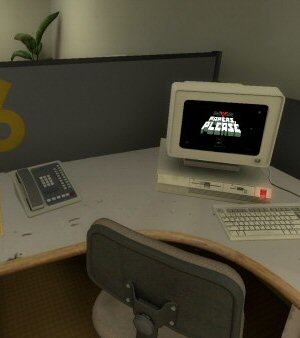
So it’s about 100 years in the future and computer security boils down to typing in the four-digit number that everyone wears openly on their nametag. I’d love to denounce this as ridiculously goofy and unrealistic, but… I’ve heard worse.

The com center has an interesting little activity for the player. You call all of these different stations. Sure, the game could just list them all is UNAVAILABLE or whatever, but instead the player is allowed to call each one in turn. This is the equivalent of the slow camera peek around the corner in a scary movie. Information is gradually revealed.

It’s the kind of thing that polarizes the experience. If you’re into it, the suspense, curiosity, and anticipation will heighten your enjoyment. On the other hand: If you’re not into it, it makes everything worse. If you know there’s no monster around the corner (because, being genre-savvy, you know this isn’t the right point in the movie for a reveal) then the agonizingly slow reveal of nothing will try your patience and make you want to shout snarky comments at the screen.

EDIT: This entire comment thread of psycho-analyzing Mumbles is some outrageous bullshit. It’s fine to say something makes you uncomfortable. It’s not fine to get judgmental. Comments closed.


Good Robot #46: Game Design Changes

By Arvind Raja Yadav Posted Friday Mar 25, 2016

Filed under: Good Robot 50 comments

It has been one year since Good Robot went up on Greenlight, and we are due to launch in about a week and a half. The game has evolved an immense amount in the intermediate time.

Top: Early alpha. Bottom: Current build. Click for full view.

Visual changes are easy to show using videos and screenshots. Game design changes, not so much â€" this is a process of formulating systems, talking to your team, tweaking your design based on feedback, convincing your team why a certain system is the right fit, and then overruling their complaints with an iron fist.

I thought the best way to show just how much Good Robot's design has evolved is to talk about some of the bigger changes in its design, from when Pyrodactyl started working on it to now. First, I'll describe the old system, then the problems with it, and then what we did to fix it. Here goes!

Note: Game design is a collaborative process, which is why I use “we” from here on out, even though I did all the work.

Continue reading ⟩⟩ “Good Robot #46: Game Design Changes”


SOMA EP2: The Save Sphincter

By Shamus Posted Thursday Mar 24, 2016

Filed under: Spoiler Warning 58 comments


Link (YouTube)

Let’s talk about these health sphincters. I think it’s really telling that 60% of the Spoiler Warning cast all came to the exact same wrong conclusion, and saw the healing icon as a D-pad symbol.

There are a lot of problems here. One is that you don’t have a health bar, so you can’t see any change when the device heals you. The only way you can tell if you’re injured is if the screen is glitching, which:

  1. At this early stage, it’s pretty unlikely that you’ve been injured. So you’re at full health when you encounter the first couple of healing stations. But even if you have been injured…
  2. At this point in the game, you don’t have any idea why your view would be “malfunctioning”. If I’m hurt, shouldn’t the screen turn red? If I’m going insane, shouldn’t I be seeing shadows? What does this glitch mean? Am I hurt, insane, or is this a stylized videogame-y way of telling me “monsters are near”? Or is this just a special effect just to set a “techno-future” mood, like bloom lighting is used to make things “dreamy”?

After using the device Simon remarks that he feels better. But again, if he wasn’t injured you might assume he’s talking about his emotional state. And that’s assuming the player chooses to interact with this huge writhing black sphincter dripping with scary black goo. It’s reasonable to imagine most players would stay clear of that thing. There’s certainly no in-universe reason for timid Simon to go jamming his digits into it.

Later revelations clear up what this thing is and what it does (sort of) but by then you’ve passed a half dozen of these gizmos. That’s pretty late in the game for it to finally get around to making the mechanics clear.

So the player doesn’t know what this thing is, or what it does, and it’s directly connected to player health, which is another system they don’t yet understand yet. The icon it uses is easily confused with standard interface symbols, which only makes things worse. I suppose it would help if the symbol was a fat green or red plus sign, and not the broken, narrow white symbol we see here.

The only reason this doesn’t ruin the game is because SOMA is usually pretty easy (especially in these early stages) and the player can still muddle through without understanding the health mechanics.

It’s not a serious problem with the game, but it is a pretty good illustration of a situation where things that seem obvious to the developer can be badly misinterpreted by the audience.


Mass Effect Retrospective 40: TIM Island

By Shamus Posted Thursday Mar 24, 2016

Filed under: Mass Effect 252 comments

Over the past few entries I’ve brought up the fact that Cerberus has, somehow, become a galactic superpower with armies armies and fleets.

Shamus, according to the Codex Cerberus has trillions of credits. And TIM has stolen the plans to all of the Alliance warships. So it’s totally explained and you can’t complain about it.

Okay. The hand-wave for money and intelligence are massively improbable and stretch my credulity to the limit. The codex mentioned Cerberus has corporations and “shell companies”, which makes them sound big and impressive, but it doesn’t actually justify their wealth or power. “Shell companies” is just financial technobabbleFinancialbabble? in this case and doesn’t begin to explain things.

Dude, don't you have a half dozen corporations to run? Doesn't that keep you too busy for galactic conquest?

Humans are still a small power on a galactic scale. (Or were, according to the earlier games.) Yes, Humans were doing well… for a newcomer. Humans were promising. They had potential. They weren’t gods.

The other races have multiple worlds with dense populations, while humans are mostly on Earth, with a few scattered colonies. On a galactic scale, the other races are the United States, China, and Germany, while Humans are (say) Iceland. Awesome, skilled, and empowered by good home resources, sure. But there’s no scenario where, over a single generation, Iceland becomes so powerful that a single fringe group within Iceland can become a standalone superpower capable of conquering the capital city of one of the major nations.

In any case, trillions of dollars of income are hard enough to conceal on their own. If you’re a ten-year-old you might imagine that companies just have all their money in a big vault like Scrooge McDuck. But the truth is that a great deal of time and effort goes into making sure the money is accounted for. Imagine if Apple and Google tried to team up and funnel billions of income into some extremely illicit and clandestine activity. Yes, they have billions of income, but they also have billions in expenses. Without that money to run your company, your business will suffer. Without that money to pay your shareholders, people will dump your stock. Also, governments like to collect taxes, which means they’re pretty damn good at figuring out where the money goes, because the people who PAY you money file taxes. And even if you can somehow hide all that income, it doesn’t do you any good unless you spend it. And I have no idea how you can secretly spend trillions of dollars.

But fine. Cerberus has limitless money and intel. I’ll humor the writer. Throughout this series, I’ve been talking about why the first game was so good at world building, why that was important, and how these latter games failed at it. As a way of illustrating the point, let’s take a break from talking about Mass Effect and do a little worldbuilding ourselves with this thought experiment:

Continue reading ⟩⟩ “Mass Effect Retrospective 40: TIM Island”


SOMA EP1: Oh, Canada?

By Shamus Posted Wednesday Mar 23, 2016

Filed under: Spoiler Warning 85 comments

We wanted to do something light and quick before we dive into Fallout 4, which will no doubt consume a big chunk of the year. So we’re going to run through SOMA, the follow-up to Amnesia from Frictional Games. Unlike that one time we treated Amnesia like a joke, we’re actually giving SOMA a full play-through and taking it seriously.


Link (YouTube)

I love the dream sequence here, which is something you almost never hear people say about any movie or game ever. Here is why this one succeeds where so many others have failed:

  1. It’s short. Just 30 seconds. Far too many games make a dream sequence that lingers for several minutes. This ends in one of two ways: Either the player figures it out right away, in which case they spend the entire rest of the sequence impatiently waiting for the story to Get On With It Already because none of this matters. Or the dream feels like reality, in which case the audience feels cheated that you wasted their time because they watched a mundane scene that didn’t matter and ended as soon as something interesting happened.
  2. It ACTS like a dream. Way too many storytellers seem to be under the impression that human beings dream in little expositional short films, complete with musical cues and establishing shots. But Simon’s dream really feels like dream logic. He’s driving his car, but he’s sort of aware that he’s about to be in a crash. But he’s already got the head injury from the crash. His head is bleeding, which is annoying instead of panic-inducing like it would be in real life. He’s having a conversation about the medicine he needs to take, which is a concern in his life now, long after the crash. This is the exact sort of casual continuity-bending nonsense that you only see in dreamsAnd Mass Effect 3..
  3. It LOOKS like a dream. Note how the camera stays in first-person, and is mostly hyper-focused on small details, leaving the rest of the scene vague. Contrary to what Hollywood thinks, we don’t usually dream in third-person widescreen HD1080p with Dolby Surround sound.
  4. It serves a purpose. These 30 seconds of screen time are packed with detail. We learn that Simon was in a crash. He injured his head, and possibly his brain. He had a girlfriend. The fact that she’s not part of his life when he wakes up is a pretty big hint that she probably died in the crash. We see the medicine and hear the name Dr. Munshi, introducing the elements the game will need in about 15 seconds. The writer uses the dream to bring us up to speed, while also conveying Simon’s ongoing unease and confusion.


Ruts vs. Battlespire CH2: The Eldark Scrouls

By Rutskarn Posted Wednesday Mar 23, 2016

Filed under: Lets Play 35 comments

Last week we genetically engineered three hundred pounds of magic-immune swordmeat. This week we try to force it through the grinder. We’re finally about to take a peek inside the Battlespire–and by extension, a dusty design document marinated in Taco Bell that begins each section with, “Because it Seemed Like a Good Idea at the Time.”

Let’s recap. The game’s framing device is that you’re enrolled in the academy to become an Imperial Battlemage and that this tower, literally called “the Battlespire,” is your “harmless” final exam. Makes sense. You remember how the midterm at the Snugglespire was a harrowing parade of horror and mutilation, so there’s a sort of internal logic. Now let’s check our inventory and see what we’ve been set up with:

Continue reading ⟩⟩ “Ruts vs. Battlespire CH2: The Eldark Scrouls”


Experienced Points: Microsoft’s UWP is Games for Windows Live 2.0

By Shamus Posted Monday Mar 21, 2016

Filed under: Column 74 comments

My column this week is about the Windows 10 Store. Sort of. I guess it’s really about trust of a company that’s has done – and continues to do – a lot of harm to PC gaming.

This comment at the Escapist is worth reading. It puts an asterisk on several of the points I made in my column. I’m not really inclined to take anything Microsoft says at face value, but the points are there for the curious.

I remember a lot of teeth-grinding frustrations with GFWL that never made it into blog posts or columns. At the time I thought, “Bah, nobody wants to read more GFWL ranting. I should pace myself.” Now I genuinely wish I’d posted them for purely historical purposes. I always link to the same two anecdotes, and I don’t want people to walk away with the impression that I just had two bad experiences with GFWL. These are the tip of the iceberg, not the full story.

And it’s not like GFWL went away:

It looks like Quantum Break is the first game to be leveraged as a Win 10 store exclusive on the PC. That’s ominous. Someday they might do this to a game I care about.