Knights of the Old Republic EP5: Canderous the Manderous

By Shamus Posted Thursday Sep 3, 2015

Filed under: Spoiler Warning 118 comments


Link (YouTube)

New games have spoiled us. There’s this unspoken assumption: If you change zones, have a cutscene, or pass through a loading screen, you get an auto-save. But in 2003, this was not a rule. We had all three of those things happen here without getting a save. Spoiler: This comes back to bite us in this episode.

If you want to know about this Invisible War game we were talking about, there’s an Errant Signal episode for that.

I find the comparison interesting because both of these games came out the same year and both were multiplatform releases, coming out on both Xbox and Windows. The original Xbox had just 64MB of ram. For comparison, Good Robot – the 2D side-scrolling indie game I’m helping to develop – currently eats about 200MB. To be fair, a lot of that bloat comes from the third-party libraries we’re using. Over the last 12 years, a lot of software has come along to relieve coders from the drudgery of making their own code for interfaces, audio code, rendering pipeline, controller input, and a dozen other things. That’s wonderful, inasmuch as it’s made the current surge in indie development possible for a whole generation of developers who would rather focus on gameplay than building complex technical frameworks. Sure, there’s a steep performance cost to doing things this way, but like I said in the column this week, Moore’s Law was pretty sweet while it lasted, and gave us so much extra power to spend on stuff like this.

Still, it’s amazing to think that my little game uses more than three times as much memory as KOTOR. Actually quite a bit more, since certainly the Xbox operating system would have eaten into that 64MB.

EDIT: Actually Good Robot only uses 132MB. I was looking at the numbers for the debug build when I wrote this post. So Good Robot is only twice the size of KOTOR, not three times the size.

I think one of the big technical blunders for Invisible War was moving to bump-mapping and bloom lighting. Those technologies were pretty new at the time. KOTOR doesn’t do any of those fancy tricks, and has a super-primitive lighting model. Going strictly by technology, KOTOR came out in 2003 but was using technology from 1999 or so. It’s also third-person, so the camera is further away from the scenery. Which means they can get away with low-resolution texture maps.

Not only were the texture maps in Invisible War larger, but they needed double the texture maps, because bump mapping / normal mapping requires another texture. The bloom lighting would have required an extra framebuffer, which would have eaten 3 precious megabytes all by itself.

EDIT: 3MB was based on the assumption that this game ran at 720p, but it was only 480p. So the bloom framebuffer would have been just under a megabyte. I still say that’s not the best use of resources in such a memory-starved situation, but not nearly as bad as 3MB.

By not blowing memory on fancy rendering tricks, BioWare was able to spend more of their meager memory budget on game space: Rooms and corridors and such. Yes, KOTOR looks pretty barren and could clearly use some furnishings here and there, but it’s still better than Invisible War and their closet-sized cities.


Mass Effect Retrospective 12: A Chat With Vigil

By Shamus Posted Thursday Sep 3, 2015

Filed under: Mass Effect 217 comments

Like I said last time, the conversation with Vigil is my favorite part of the game. That incredible music plays, you’ve got your two favorite companions with you, and Vigil lays it all out. He explains just how long the odds are, just how powerful the enemy is, but he also explains the little glimmer of hope you have.

Fridge Logic

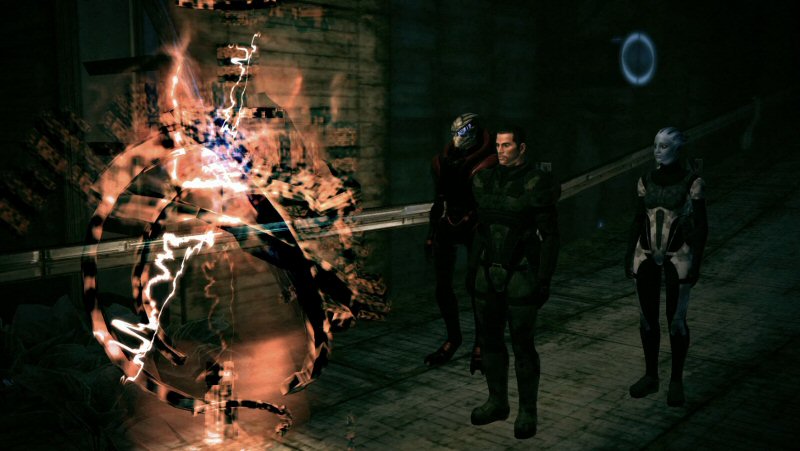
Shepard has trained his team to stand in 'triangle formation' during long conversations.

As much as I love this section, you knew we weren’t getting through it without a little nitpicking, didn’t you? Let’s paraphrase / summarize this conversation:

Continue reading ⟩⟩ “Mass Effect Retrospective 12: A Chat With Vigil”


Knights of the Old Republic EP4: A Bib, for Tuna

By Shamus Posted Wednesday Sep 2, 2015

Filed under: Spoiler Warning 126 comments


Link (YouTube)

It’s always a bit of a gamble when we select what game we’re going to play next on this show. When we begin covering a game, we’re committing to spending several months with it. We don’t want to get three weeks into a series and find we hate doing it and the audience has mostly stopped watching. That’s bad for our morale, bad for the show, and bad for everyone else.

For a while we were shy of games we hated, because we didn’t want to be “too negative”. We had a few series end badly for us and descend into a dull slog of repeating the same four complaints again and again for five hours. (BioShock is the biggest example of this, and for years we’d say, “Ugh. That game would just turn into another BioShock season” when discussing potential games.)

But eventually we realized it’s not negativity that hurts the show, it’s the repetition. It doesn’t matter if we love a game or hate a game, as long as we have lots to say about it. Hitman Absolution is a great example. It was a stupid game that we all disliked on one level or another, but the brokenness was so widespread that we always had something fresh to discuss.

By that standard, KOTOR might just be too good. There are so many facets to this game that we’re interrupting each other trying to cover it all. Consider…

Continue reading ⟩⟩ “Knights of the Old Republic EP4: A Bib, for Tuna”


Ten Years of Twenty Sided

By Shamus Posted Tuesday Sep 1, 2015

Filed under: Landmarks 136 comments

Today is September 8036, 1993. It’s also the ten-year anniversary of this site.

I thought for a long time what I should say to mark this occasion. This is a pretty big deal. Ten years ago I was 34 years old. I was half the programmer I am now and I didn’t think of myself as a writer at all.

Eventually I decided to write a post talking about the idyllic pre-colonial internet that existed before the Eternal September. I could talk a bit of internet history, which would dovetail nicely into personal history, and then bring it back around by talking about how this community is a lot like that long-lost world. I got a couple of paragraphs into this project when it started to seem very familiar. Did I already do a post on the Eternal September? Maybe somewhere deep in the archives there was an old post about this? Maybe I mentioned it in the Autoblography?

So I did a little search and found that yes, I have indeed written about the Eternal September before. But it wasn’t “deep” in the archives. It was one year ago. And the post was the nine-year anniversary of this site. So not only had I written on this topic, I’d actually done this exact same concept for a post, with the exact same through-line. It’s actually a pretty good post. Better than this one, at any rate.

From this, we can conclude four important facts:

Continue reading ⟩⟩ “Ten Years of Twenty Sided”


Experienced Points: What Does the End of Moore’s Law Mean for Gaming?

By Shamus Posted Monday Aug 31, 2015

Filed under: Column 122 comments

My column this week is described perfectly by its title. I always get nervous writing about hardware. I’m not a hardware guy and I’m more likely to make factual blunders in that area.

I didn’t get into it in the column, but it’s sort of unfortunate the consoles launched when they did. They’re just barely (in Moore’s terms) short of the power needed to handle 60fps games and VR. Another eighteen months might have fixed that problem. Then again, nobody realized 60fps was going to be a big(ish) deal, and it would be suicide to show up to the market 18 months after the competition. You don’t want to launch a next-gen console into a market where everyone already has a next-gen console and several games. You either want to launch at about the same time and at roughly the same power level, or you want to launch several years later when you can have a nice technical advantage.

Or you can do what Nintendo does and put out an “under-powered” console and focus on gameplay instead of technology. But that’s crazy talk.


Diecast #119: Until Dawn, Darkest Dungeons, Pillars of Eternity

By Shamus Posted Sunday Aug 30, 2015

Filed under: Diecast 130 comments


Hosts: Shamus, Josh, Rutskarn, Mumbles, Campster. Episode edited by Rachel.

Show notes: Continue reading ⟩⟩ “Diecast #119: Until Dawn, Darkest Dungeons, Pillars of Eternity”


Knights of the Old Republic EP3: Carth Blocked

By Shamus Posted Saturday Aug 29, 2015

Filed under: Spoiler Warning 109 comments


Link (YouTube)

That’s the OTHER reason people dislike Carth. If you stray from the light side, he gets sanctimonious and acts like he’s in charge. Okay, he kind of has a point, inasmuch as the “evil” choice is usually a blend of Zsasz-level sociopathy, Rimmer-level pettiness, and Doofenshmirtz-level stupidity. But it’s still a major killjoy when you’re trying to have some fun with the game and Carth cuts in like he’s your mom.

Of course, having him ignore your evil shenanigans wouldn’t work either. I think the problem here is that the writers gave you all of these idiotic villain choices in the part of the game where your only companion is a pushy boyscout with trust issues. If go go evil he’s a killjoy, and if you play it virtuously he’s still difficult. On top of that, he’s the only character available to pull exposition duty, so when he’s not judging you, he’s busy dumping exposition on you. He gets better later if you stick with him, but by then most people have started ignoring him and spending time with the rest of the team.

So I don’t personally hate Carth, but I do see why he gets a lot of hate from the fanbase. The deck is really stacked against him.