Mass Effect Retrospective 37: The Needs of the Menae

By Shamus Posted Thursday Mar 3, 2016

Filed under: Mass Effect 233 comments

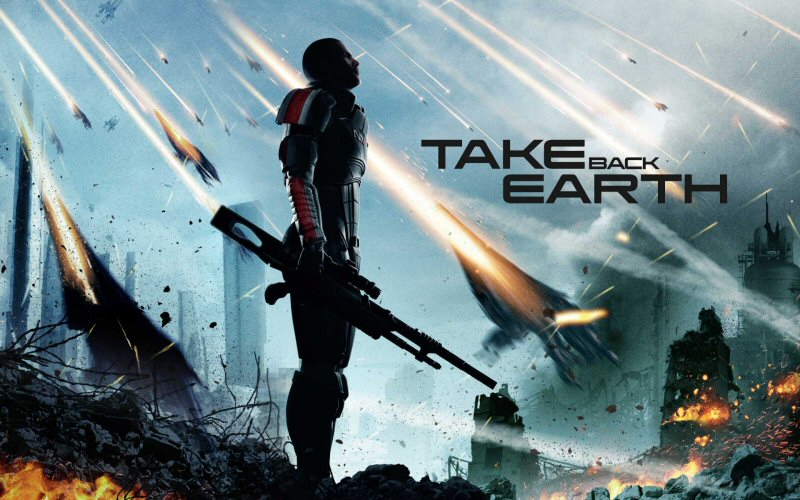
After the Council meeting, Udina and Shepard find themselves ranting about those stupid racist Aliens who won’t abandon their dumb homeworlds to come help Humans who are obviously the most important people in the galaxy. Yes, it’s absurd, but we just came from a meeting with the Galactic Council so it’s not even in the top five most absurd things said in the last six minutes.

A Turian comes in and offers a deal: One of the Turian worldsA moon, actually. has been overrun by Reapers. One of the Turian Primarchs is stuck there. He’s an important military guy. If Shepard rescues him, they’ll agree to send some forces to Earth. It sounds kind of implausible. How can one general be worth more than the fleets he commands? Particularly when you’re in a war with a foe that you can’t meaningfully oppose and the only thing you can do is buy your populace time with the lives of your military.
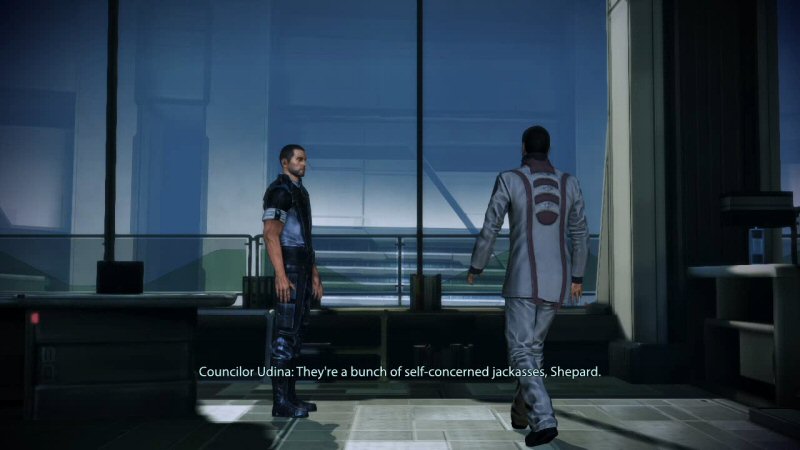
I'm pretty sure this is the most hypocritical line in the whole game.

But whatever. I actually have a hard time getting worked up about the little details at this point. Our overall quest is to round up fleets for Earth, which doesn’t make sense with what the game has told us about the Reapers. But the writer presents this as if Shepard’s plan makes sense. And Shepard’s plan does sort of work in the end. It’s just that he doesn’t have a good in-universe reason for believing in it. Which means we can’t really examine him or his motivations anymore. He’s just doing whatever is needed to move the plot forward. This plot hole is so big we crossed its event horizon in the first half hour of the game, and these half-assed motivations and quests can’t really do any more damage. It’s like punching fresh holes in the hull of a wreck at the bottom of the ocean.

Actually, it’s not fair to say that Shepard is just rounding up fleets for Earth. He’s sort of also looking for help building the Crucible. Or he will be, once that plot point is developed over the next chapter. But the story is really vague about it. Sometimes he’s talking about the Crucible project and sometimes he’s talking about Earth and it’s not until the end of the game when those two plans suddenly merge into a single plan. And even then, it’s only in response to the Reapers moving the Citadel to Earth. This means that Shepard’s current plans are nonsense until the Reapers do something unexpected much later.

As we leave the Citadel, we have the first of Shepard’s dream sequence / cutscene things, which features Shepard chasing Some Kid That Died through a spooky(?) forest. We get one of these at the end of each chapter. We’l talk more about them once we get closer to the end. For now let’s just get to…

Continue reading ⟩⟩ “Mass Effect Retrospective 37: The Needs of the Menae”


Knights of the Old Republic EP55: Non Mothma

By Shamus Posted Wednesday Mar 2, 2016

Filed under: Spoiler Warning 61 comments


Link (YouTube)

I’m starting to suspect this was a deliberate design choice for classic BioWare:

  1. Have a game of modest difficulty. After all, it’s “all about the story”!
  2. Give the player frequent auto saves.
  3. At the end, have a sequence of wall-to-wall combat for a solid hour.
  4. Remove 90% of the auto-saves.
  5. Throw in a couple of surprise difficulty spikes.
  6. LOL YOU DIED AND GET TO REPEAT THE LAST 15 MINUTES OF BORING COMBAT.

I’m convinced that stuff like this is how gamers end up with immersion-shattering, flow-breaking, OCD-driven quicksave habits.

The next episode will wrap this series up.


The Altered Scrolls: Q&A, Part 3

By Rutskarn Posted Wednesday Mar 2, 2016

Filed under: Elder Scrolls 43 comments

This is the second-to-last one of these. This weekend, we’ll polish it off and start bringing the series to its conclusion.

falselordzalzabar asked:

Ruts: you get the lead position and $100 million budget (just for nice round numbers) to remake/upgrade 1 Elder Scrolls game for the current console generation/computer level. Which game do you remake, and how do you spend your money?

My knee-jerk response is Morrowind, but lackluster combat aside, that game’s fine the way it is. The visuals and text aren’t harmed by their presentation. Revamping it would only make it accessible to a generation that a.) could play it anytime they want and b.) probably don’t care all that much.

The most commercially and artistically interesting avenue would be a modern and very selective updating of Daggerfall. The core principles would be preserved: a simulationist rather than theme-parky world, character builds that give a variety of tools the player has to find applications for, endless buffets of quests and dungeons. Most of the budget would be allocated to creating a procedural, appealing, varied, and plausible gameworld; only a few instances (walled cities, specific dungeons) would be individually crafted.

All being well, the end result would be a relaxing game experience rather than an actively engaging one; a tremendous natural wilderness full of peaceful, quiet little towns to stumble over and nooks and crannies to explore. With modern graphics and a budget bigger than Skyrim (hopefully enough to find applications for all the skills), the result would unquestionably surpass the original game and might be a neat understated take on the open world.

Continue reading ⟩⟩ “The Altered Scrolls: Q&A, Part 3”


Experienced Points: Undertale and Curly Braces

By Shamus Posted Monday Feb 29, 2016

Filed under: Column 182 comments

My column this week answers some reader questions about the public reaction to Undertale, the use of 2K textures in games, and to the use of curly braces in programming.

There’s a lot more that could be said about curly braces vs. indentation for denoting blocks of code. I wouldn’t be surprised if someone’s written a whole book on the subject. This is because code formatting isn’t a decision tree between “right” and “wrong” but instead a series of trade-offs to be managed.

A coder will spend more time reading code than writing code, so making readable code is more important than than making code convenient to write. Sometimes reading code involves analyzing each line and figuring out exactly what it does, and sometimes it means skimming quickly through pages of the stuff, looking for one particular thing. Ideally code should facilitate both types of reading.

But what makes something “readable”?

Maybe you want blank lines between code blocks, which serve roughly the same purpose as the blank space between the paragraphs in this post. It divides the thoughts on a conceptual level, while also giving you visual markers so you can keep track of your position. Or maybe you want to minimize the number of blank lines, because you want to fit as much code onto a single page as possible.

Once again, it comes down to domain. Some kinds of coding have huge blocks of dense math and you want to give the complexity some breathing room. Other code has lots of short, obvious actions and you want to pack as much of it together as you can. So you end up with a coder who writes simulations getting in an argument with someone who writes user interfaces, and a networking programmer will be sniping at both of them. All three people have very different code. When the simulation guy advocates giving code more room to breathe, the woman writing user interface code imagines the impact this policy would have on her already-sprawling code. They end up in a flame war, because they picture using the other person’s formatting on their own code.

This isn’t helped by our need to standardize. You want one set of rules for everyone to follow so your project isn’t a mishmash of different formatting styles. But that One Set of Rules will work better in some areas than others. And of course, once you’re used to a particular set of rules then it starts to look more “correct” out of simple familiarity.

It’s a tough problem to solve, and it doesn’t help that our projects keep getting bigger. More code, more different kinds of code, and more different programmers working on the same code. It could be that obsessing over spacing is just an awkward phase we’re going through, and what we really need are more tools for easing the burden of reading code. Maybe some sort of visual cues for code flow, or new ways of coloring code, or something else outlandish that hasn’t even been imagined yet. Maybe we need to write more robust comments not for ourselves, but for the benefit of some Google-esque code search engine. In the meantime, we’re going to be left haggling over stuff like spacing, because right now that’s all we’ve got.


Diecast #143: Oxenfree, Devil Daggers, SUPER HOT

By Shamus Posted Monday Feb 29, 2016

Filed under: Diecast 106 comments


Hosts: Josh, Rutskarn, Shamus, Campster, Mumbles.
Episode edited by Josh.

As we recorded this, Mumbles was getting over being sick. And while I didn’t know it at the time, I was just a few hours from becoming annoyingly sick myself.

Show notes: Continue reading ⟩⟩ “Diecast #143: Oxenfree, Devil Daggers, SUPER HOT”


Lord of the Rings Online #1: Lulzy Begins

By Shamus Posted Sunday Feb 28, 2016

Filed under: Shamus Plays 52 comments

Let’s Play Lord of the Rings Online, the popular MMO based on one of the greatest and most influential works of fiction of the 20th century. As the guy who wrote the DM of the Rings webcomic, I have a history with this material. I think the books are a beautiful work of fiction and a celebration of language itself. I’m also one of those strange abusive fans who expresses his appreciation through satire and mockery, which is the fanboy equivalent of being a wife beater.

If you’re curious what this series is all about, allow me to point you to my series on Champions Online, where I followed the adventures of superhero Star On Chest.

Note that this series originally ran at The Escapist back in 2010. I’m reposting it here because I wanted people to find it again. The Escapist is a news and culture site with at least half a dozen news articles a day. People don’t usually archive binge articles on those kinds of sites. On the other hand, the archives of this blog are a busy place, and people are still reading old content. With any luck, some new people will read and share this and the story will live on.

This series should be identical to the original run, except that I’m going to add mouseover text to the images, and maybe add some scattered footnotes in response to the nitpicks people sent me at the time.

Continue reading ⟩⟩ “Lord of the Rings Online #1: Lulzy Begins”


The Altered Scrolls: Q&A, Part 2

By Rutskarn Posted Saturday Feb 27, 2016

Filed under: Elder Scrolls 78 comments

Gilfareth asked:

What I'd like to know is how you think Bethesda approached dual-wielding when they finally put it in, given they weren't too excited about it by your reckoning. I'm also curious how else they might've implemented dual-wielding if they'd have added it at other points in the franchise (what would dual-wielding in Morrowind have looked like without a janky mod to do it?)

I have no idea if they were enthusiastic about it or not. I think it only became a design priority because there was significant and consistent fan investment in the idea, but that doesn’t mean the devs didn’t have fun with it.

Dual wielding would have been antithetical to Morrowind‘s combat–fighting in that game, with its predictable strokes and static footwork and and grounded aesthetic, wouldn’t have allowed for the round arcs and balanced twirls that give dual wielding its balletic appeal. What’s more–and you can trust me on this–both attacks would have been keyed to the primary mouse button in a continuation of Morrowind‘s firm “nothing should feel particularly good” policy.

I’d argue it wasn’t until Oblivion that the game felt up to having two weapons at a time, and once that happened, there was no particular reason not to besides the development effort involved. Tell me it’s impractical to attack with two swords at once and I’ll point out that swinging a mace at an unarmored man, wielding a battle-axe with a head as big as a pig, and bringing a dagger to an ogrefight are all choices that are ludicrous by conventional martial logic–and key to heroic fantasy. Dual wielding feels individualistic and cool, and therefore heroic, and therefore as though it should be effective. Why shouldn’t it be?

Da Mage asked:

Unlike almost most RPG series, The Elder Scrolls has never really had a morality scale, and apart from quests in Morrowind, most quests only ever have a single solution. Would the next Elder Scrolls game benefit from such a system? Even if it was just a system that forced some player-choice to be designed in quests.

If you’ll indulge an anecdote:

When Arvind first demoed our game Unrest at a convention, he had people play as Tanya the peasant girl. Her chapter presents a singular problem with no easy solution and a dozen nested complications: how should she react when betrothed to her childhood bully? In addressing the issue Tanya is presented not only with various perspectives, options, and appeals to safety–economic, social, and physical–but the reality that nothing she can choose is safe and nothing she can do will make everyone happy. Somebody has to be disappointed. Somebody may get hurt. And if she’s really unlucky, none of it might matter at all.

One player sat down and worked through the introductory dialogues with apparent interest. Upon coming to the first real choice–the first chance to express an opinion on what Tanya is going through–he stopped. He read the dialogue choices a few times. He seemed surprised. Then he said to Arvind, “All of these seem reasonable. Just tell me which one’s Paragon.”

I don’t like morality systems.

Continue reading ⟩⟩ “The Altered Scrolls: Q&A, Part 2”