Graphics Hardware is Killing PC Games

By Shamus Posted Thursday Feb 22, 2007

Filed under: Video Games 71 comments

“No you fools! You’ll destroy us all!”

That was my reaction to this story at ars technica (via) which talks about new “external” graphics cards. The idea is that users can buy lots of them and stack them high and wide and set up fancy cooling schemes that would not be practical within the confines of the average computer case. I can only conclude that this is some sort of sick scheme to eliminate PC gaming forever.

People made a big deal about the PS3 “sticker shock”.  You know, because the complete game system, including controllers and the blu-ray transmorg-matrix, cost $600.
People made a big deal about the PS3 “sticker shock”. You know, because the complete game system, including controllers and the blu-ray transmorg-matrix, cost $600.
Don’t get me wrong, I like getting fancy new hardware, as budget allows. This would be a nice development if this were something just for framerate junkies, but the way things work right now is that expensive new technology ends up appearing on the side of PC games under the words Minimum System Requirements about three weeks after it gets invented. ATI could come up with a graphics card that costs $10,000 and needs to be continually submersed in liquid nitrogen, and idiot developers would build their next-gen engine on top of it. Advances like this are things that hardcore gamers should be doing to get ahead, not things that average gamers should be doing just to keep up. Sadly, I’m sure that’s where this is going. The only thing more horrifying than seeing a PC game which requires a $500 graphics card is one that requires several of them.

And even if you do pour all that money into your PC, odds are the games will suck anyway, and run like a sick turtle. On an uphill grade. Against the wind. While, like, pulling some heavy stuff or something. You know: Slow.

Continue reading ⟩⟩ “Graphics Hardware is Killing PC Games”


Paving Eden

By Shamus Posted Thursday Feb 22, 2007

Filed under: Nerd Culture 14 comments

On Tuesday’s post about the dot-com spectacle, there were a few comments on “paving eden”, the time when the internet stopped being the domain of academics and became the spawning pool of e-business. I also learned about the Eternal September, which is an interesting bit of net-lore that I missed. Then Pixy said:

I was on Usenet as early as ‘85, and for me, the paving of Eden was one of the best things that ever happened.

Since I’ve earned my living working for a .com company for the last 13 years or so, I can’t argue with that at all. Although, I know almost nothing of what the ‘net was like before 1994.

But his comment does bring to mind the following:

In 1992 I had a friend who belonged to a Trek mailing list. He attended college and through whatever clanking machinery they used at the time he was able to access the internet. He would bring me the entire weekly summary of the list traffic as a hardcopy. I LOVED reading it. The people were articulate, thoughtful, and polite. I wanted to join, but I didn’t even know how to get ‘net access at the time. (I’m sure I wouldn’t have called it “net” access, either.) Reading the list was like listening to a group of friends discuss a common interest. It wasn’t even that I was that thrilled about Trek. It’s just that these were smart people and I enjoyed reading what they had to say.

In 1996 or so I remembered the list and decided to see if I could find such a group and join in the discussion. I’m sure you can imagine the results. I was mystified: Every list I joined was filled with condescending idiots, trolls, flamers, and endless armies of professional nitpickers. Unlike the 1992 list, almost everyone was anonymous and wrote under various childish nicknames. I think about half of them were named “admiral something”. I wondered why I couldn’t find that one, original list. Eventually I realized that it was gone. Not just that the list itself was no longer active, but that the environment in which it had thrived had long since ceased to exist. The internet had grown from a small town where everyone knew everyone else into a big city full of angry denizens giving each other the finger.

I actually think the net is much more civilized today than it was a decade ago. For a while the net was ugly, mean, brimming with scams, populated by frightening lunatics, and even the most innocent link could lead to a porn storm of popups. All of that stuff still exists, but it’s been ages since I had to worry about any of it. It’s not that there are less idiots, it’s just that we have better ways of filtering the idiots. In a lot of ways I’ve finally recaptured that “small town” dynamic in that 1992 Trek list via a few favorite blogs and the comments here on Twenty Sided. Things were raw for eight years or so, but eventually everyone got better tools for dealing with the larger population.

So paving Eden seems like a good move to me, it just took a while to learn to drive on it afterwards.


DM of the Rings LXVI:
Repaying the Advance

By Shamus Posted Wednesday Feb 21, 2007

Filed under: DM of the Rings 45 comments

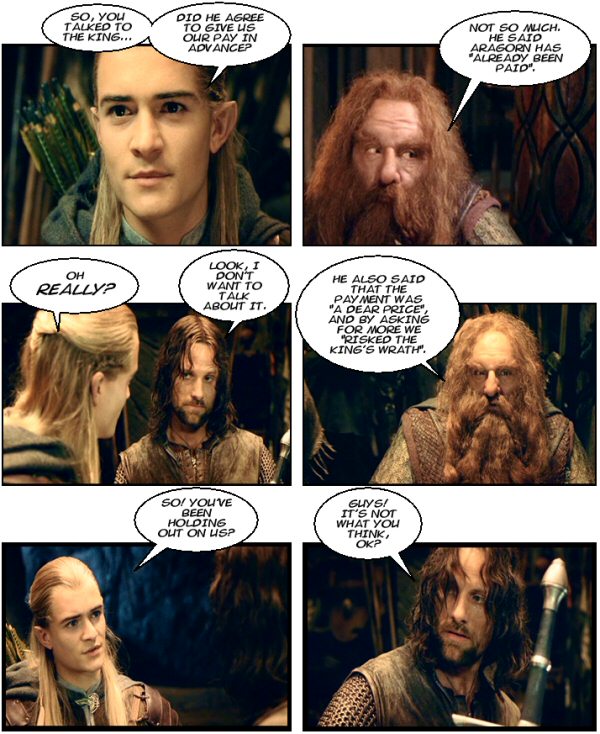
Aragorn has already been paid.

Aragorn got a rash from the king?

The consequences you impose on your players for poor choices should be directly proportional to how much those choices annoyed you at the time.


.Com

By Shamus Posted Tuesday Feb 20, 2007

Filed under: Random 14 comments

I remember a long time ago – back when computers were made from clanking iron gears and most web browsers were steam-powered – in the run-up to the dot-com boom people were marveling at the idea that you could put ads on your website and make money when visitors to your site clicked on those ads using their crudely-made wooden mice.

Continue reading ⟩⟩ “.Com”


Competitor vs. Builder

By Shamus Posted Tuesday Feb 20, 2007

Filed under: Game Design 25 comments

Looking at the comments on my previous posts regarding Eve Online, I see some of the fans enumerating the game’s strong points. Some of these points are things which I thought were the chief weaknesses of the game. This confirms what I’ve suspected for a while, which is that there are very different groups of people playing MMO games with entirely different expectations and motivations. I see two distinct types of players. Their desires are often at odds with one another, so that there isn’t really any way (that I can think of) to can please both groups.

The Competitor

These gamers appreciate the opportunity for risk. They seem to favor the PvP aspects of a MMO game, and see the single-player solo play as simply a means to the PvP end. They value conquest, overcoming enemies, amassing power, gaining prestige, and the thrill of victory. They approach these games the way other people might approach team sports.

These players are likely to keep an eye on the rankings (if the game has any) and they are going to take game-balance issues very seriously.

The Builder

On the opposite end of the spectrum are people like me, who don’t really need any of that. For me these games are about accomplishing goals and building things. Some people can maintain a garden, paint miniatures, or build a ship in a bottle, and they enjoy the process even though there is never any risk. They never worry about someone scuttling the ship or about their neighbors getting together and ganking the tomato patch. It’s a totally different experience.

The multiplayer aspect of the game is simply a way to share the experience with others. Building a model train with wonderful scenery is fun, but it’s even better when you have someone visit and see what you’ve made.

These two groups are fundamentally at odds with each other for what they want out of the game. If you gear the game towards competitors, then the builders are going to get very upset about how their project – their ingame persona – keeps getting destroyed or sustaining setbacks. It’s no fun building a sandcastle that gets kicked in every ten minutes by some sadistic jerk.

But if you favor the builder style of gameplay, then you’ll have a game with only minor or minimal setbacks, where players cannot get ahead at the expense of others. For competitors it will be like playing a sport without keeping score. What’s the point? If the game is built with no outlet for competitors, then they will struggle to find some other way to compete and conquer. This is probably where a large number of “grief” players come from: They are simply competitors trying to have fun in a world made for builders.

What is interesting is that within the context of an MMO game these two types of people are able to come together and have fun, more or less in spite of one another. I see a lot of different ways of trying to accommodate these two groups. In Eve Online, the best mining places are found in uncontrolled space, where players are free to blast each other at will. So, they put some prizes out there in PvP space so that builders will be tempted to go out there and be targets for competitors.

If you go into the forums of an MMO game, I predict that the most intense debates on gameplay and balance are really struggles between these two types of players, who each want to get more of what they like out of a game.


DM of the Rings LXV:
Gross Misallocation of Resources

By Shamus Posted Monday Feb 19, 2007

Filed under: DM of the Rings 76 comments

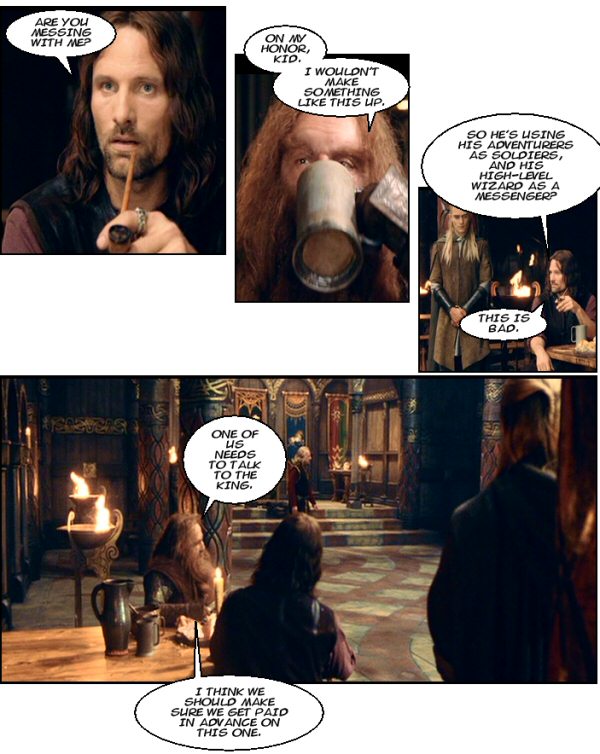
Thoden is terrible at strategy. Get paid in advance.

Thoden is terrible at strategy. Get paid in advance.

While often nothing the players do makes any sense at all within the contex of the gameworld, you can be sure they will fixate on any and all flaws in the thinking on the part of NPCs.