The White Chamber: Endings

By Shamus Posted Saturday Sep 29, 2007

Filed under: Game Reviews 31 comments

I thought I’d post some spoilers for The White Chamber. There are a lot of endings for the game, and you don’t really get a feel for the whole story until you see a couple of them. (And I really didn’t consider the game complete until I got the “good” ending.)

You should reach the end of the game at least once before reading more. (Actually, a lot of this won’t even make sense until you’ve taken a trip through the game.) Spoilers ahead. Duh.

Continue reading ⟩⟩ “The White Chamber: Endings”


Free Game: The White Chamber

By Shamus Posted Friday Sep 28, 2007

Filed under: Game Reviews 41 comments

Earlier in the week someone lamented the passing of the Adventure Game genre. Adventure games were how a lot of us 30 and 40-somethings were introduced to PC gaming. Adventure games once ruled the Earth, and now we’re lucky if we get one a year. (And we’re even more lucky if it actually tells a full story and not a suckerpunch “installment”.)

I think Erik of the now-defunct Old Man Murray pretty much cut to the heart of things with adventure games and what killed them. The genre was really polluted with stupid titles and awful puzzles. For every Full Throttle and Grim Fandango (both of which I sadly missed) we got a half dozen “Pixel Hunt VII: Maximum Save and Restore”. I loved the humor of both Leisure Suit Larry and Space Quest, but those games had some absurd “puzzles” and a penchant for offing your character every three or four clicks. Ugh. Games from LucasArts were better, but they just don’t make them like that anymore.

But here is an interesting nod to the good old days of LucasArts adventure games: The White Chamber, a sci-fi horror point and click adventure game. You can download the full and complete game for free.

The game makes a poor first impression. I was put off by the anime style (even though I like anime, go figure) and the initial room is exceedingly dull. The very first “puzzle” isn’t much to write home about, either. If you can get through the first five minutes, the game gets a lot better and a lot more interesting. I don’t want to say too much more. It’s good to go into this one cold, without knowing too much about the plot.

You can beat the game in under two hours, but the game is designed to be played multiple times. Experiment with how you answer questions and how you solve problems in order to get the different endings.

Very enjoyable.


Lord of the Warcraft

By Shamus Posted Friday Sep 28, 2007

Filed under: Nerd Culture 32 comments

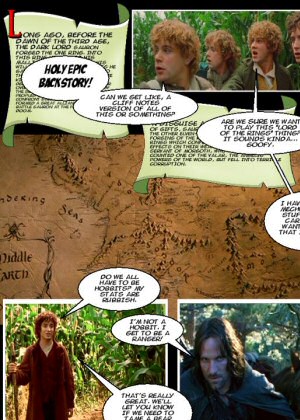
What would Lord of the Rings be like if the Tolkein used the names of actual World of Warcraft characters? Why, it would sound like this.

My brain hurts.


What Makes a Great RPG, Part III

By Shamus Posted Thursday Sep 27, 2007

Filed under: Game Design 81 comments

After screwing around for the last two posts, I’m actually going to try to tackle this question now. Actually, I can’t really say what makes an RPG “great”, but I can at least define what I like about RPGs. Which is almost like answering the question. Sort of.

This list is going to be very subjective. Opinions will vary. Lots of great answers were already given by readers in the previous post, and I can see that some people like things about RPGs which “ruin” the game for me. This only reinforces the idea that “RPG” is a term applied carelessly to many different games, some of which have opposing or conflicting goals.

1. I know I bring this up a lot, but RPG games should be self-balancing. Having foes “scale” to the player’s level is an abomination that defeats the entire purpose of leveling up in the first place. The same goes for arranging the game so that all players will have about the same relative strength at any given point in the game.

Let the player farm XP if they want to. Let them fight low level foes without penalty if they want to. This is not cheating. This is simply another way to play the game. Maybe the player is new to RPGs and needs the help. Maybe they would rather move more slowly and steamroll over foes instead of moving more quickly and occasionally dying or running away. It’s their character. Let them play it on their own terms.

2. There should be many choices, and they should be interesting. And by “interesting” I don’t mean you earn “good” or “evil” points.

Stupid: You meet a woman on the road who needs your help. Will you help, or murder her and steal her shoes?

Better: You meet a woman on the road who needs your help. If you help her you might anger the baron, which could lead to headaches down the road. However, NOT helping her will aid the baron, and he’s not a very nice guy.

Best: You meet a woman on the road who needs your help, but you sense she isn’t giving you the whole story. You’re not sure if you believe her, or the baron. You’re going to have to talk to some people and investigate a bit if you want to know what’s really going on. Both sides are likely full of flaws, and choosing a side should reveal something about the values or preferences of the player, or their character.

3. Randomized worlds are very good. If you can’t have random scenery, then at least the loot should be randomized. Having the exact same items in the exact same locations every time though the game just kills the replay value.

4. Interesting characters. Villains with no agenda outside of being evil jerks are tiresome and banal. Good characters without some quirks or flaws are usually pretty flat.

5. Skill-based leveling system. This Rampant Coyote post talks about skill-based vs. class-based systems. I’m a big fan of classless systems for sure. For me the ideal system was the one used in Fallout. It was deep, fun, and did a good job of portraying personal growth in the real world. In a good skill-based system you gain “knowledge”, not “intelligence”. You get better at using weapons, not more dexterous. This makes a lot more sense to me.

6. I want to play a character, not a gang. I prefer games where I’m alone. (I’m really put off by games where there IS no central character.) If I have to have some NPC’s with me, they had better be really interesting folks and should not break immersion. They should also manage themselves. I’m busy controlling my character, and I don’t have time to tell them what to do in a fight.

7. I want a good story. No, I don’t want to go on yet another epic quest to collect some stupid sword or bauble.

8. I’m really burned out on Fantasy settings. There’s nothing wrong with magic, wizards, dragons and treasure chests, but we’ve been there and done that a few times now.

9. I like large freeform worlds. I dislike when the “being on rails” metaphor extends to movement within the game world. If I can only go forward or back, then I’m going to get bored. Quickly.

10. “Character customization” does not mean deciding what hat I want to wear. I want to start by choosing age & gender, and end with deciding how I want to shape the bridge of my avatar’s nose.

These are not set in stone, and I’m willing to give up some if they go for broke on the others. For example, Jade Empire had a simplistic leveling system of little consequence, a one-dimensional path through the world, static scenery and loot, and no character customization to speak of. But Bioware hit gold with the story and characters, and so Jade Empire stands as one of my favorites.

Of course one person suggested that the game should just be as much like Fallout as possible. That’s a pretty good answer too.

EDIT:

Here is the follow-up post at Rampant Coyote.

Mr. Halbert has more thoughts on this as well.

Also I’d like to clarify my point #3. When I asked for “random loot”, I’m suggesting thatstuff in containers be nominally randomized at the start of the game. I agree with the comments below that totally random drops just kill versimilitude. An orc wielding an axe should not drop a bow when he dies, and a rat should not drop a longsword.


What Makes a Great RPG, Part II

By Shamus Posted Thursday Sep 27, 2007

Filed under: Game Design 51 comments

Yesterday I commented that I was having trouble figuring out what made an RPG “great”. Then I realized that an easy way to answer this question is to just look at the major RPG titles that have come out in the last few years. By looking at recent A-list titles, it’s pretty easy to see what makes RPGs great and which features are most important for success: Continue reading ⟩⟩ “What Makes a Great RPG, Part II”


What Makes a Great RPG?

By Shamus Posted Wednesday Sep 26, 2007

Filed under: Game Design 73 comments

The Rampant Coyote asks: What makes a (computer) RPG great?

This is a favorite subject of mine. I started to write a response last night, and it quickly turned into a long, rambling post that was all over the place. I’ve never been particularly into the whole brevity thing, but this post was quickly becoming an egregious wall of text so I had to abandon it.

I was trying to talk about character development, gameplay mechanics, presentation, immersion, and about a dozen other factors all at once. I don’t even know if I can give a sensible answer in a single post. Looking back, I think the big problem is that the term “RPG” is so hopelessly broad that it means almost nothing. Diablo, Jade Empire, Nethack, and Oblivion are all RPGs. How is Jade Empire an RPG but not Bully or GTA: San Andreas? How can Diablo be an RPG, when you don’t actually do any roleplaying? More importantly, how does one talk about what makes these games great, since they don’t really have anything meaningful in common?

It might be easier to come at this from the other direction and list the ways you can hinder or ruin an RPG.

I’m going to go back to the drawing board with that abandoned post, but in the meantime I’ll just sort of throw this out there for the less obsessive types to tackle: What makes “an RPG” great?

LATER: Don’t miss this excellent response over at Augury.


Bully: Quality over Quantity

By Shamus Posted Tuesday Sep 25, 2007

Filed under: Game Reviews 41 comments

Wow.  I’m five feet tall and sick of school.  It’s like junior high all over again, except this time I’ve got the strength to fight back when the bullies try to amuse themselves at my expense.
Wow. I’m five feet tall and sick of school. It’s like junior high all over again, except this time I’ve got the strength to fight back when the bullies try to amuse themselves at my expense.
Bully comes from Rockstar Games, the folks who brought us Grand Theft Auto. Here we have the same freeform roaming, the same style of motion-capped cutscenes, the same mission-based gameplay. But the game concept has undergone some sweeping changes, and these changes are almost universally for the better.

Bully replaces the thieving, cop-killing, gang-banging, hooker-punching, nihilistic attitude of Grand Theft Auto with bloodless fisticuffs, sports, pranks, and a little petty vandalism. These activities – while less spectacular – are more fun and engaging by virtue of them being less repulsive. If you ever got sick of the grotesque pointlessness of gang wars in GTA: San Andreas, then you know what I’m talking about.

Jimmy Hopkins is new kid in a tough school. His mother is a woman who is too busy getting remarried to deal with such tiresome tasks as raising her own son, so Jimmy is dropped off at Bullworth Academy, a private school that acts as a dumping ground for unwanted or unruly kids. The school is hopelessly defective, with alcoholic teachers, insular and combative cliques, a predatory coach, an indifferent headmaster, and rampant bullying.

Yes, you can scoop up some snow and pelt someone for a laugh. Jerk.
Bullworth is wonderfully realized. I don’t know what schools look like elsewhere in the country where buildings are newer, but I found the school perfectly captured the dreary institutional style I saw during my own junior high years. I could practically smell the place. I’m sure if I could peer behind the walls of lumpy lead paint I’d find asbestos and fifty-year-old electrical wiring.

As the game progresses the seasons change. People wear clothing appropriate for the weather. Holiday decorations come and go. This gives the place a healthy dose character. The town of Bullworth isn’t as large or a sprawling as Liberty City, but it’s more detailed and filled with purpose.

The students aren’t bunch of randomly generated pedestrians. Each one is unique. Each one has a name, and each one has his or her own look, sayings, and preferred hangouts. After a while you’ll get to the point where you can recognize them on sight. The student roster isn’t really big enough to fill up a campus this size (there are “only” 61 students in all) but the game does a good job of hiding this.

The boy’s dorm is unsupervised and so the already wild kids go almost feral in this setting.  The place is a cesspit of trash and vandalism.
The boy’s dorm is unsupervised and so the already wild kids go almost feral in this setting. The place is a cesspit of trash and vandalism.
Someone at Rockstar has apparently heard my cries and eased up on the punishing gameplay of earlier titles. Most missions were beatable on the first try. A few took two. Very rarely did a mission take three attempts. I never needed more than that. This will vary from player to player, but no matter how much trouble the game gives you, it’s way less of a jerk about missions than GTA, and a lot more willing to get out of your way and let you have some dang fun. This means that the game is significantly shorter, but all that’s really happened here is they’ve cut out the tiresome repetition.

So the game and the gameworld are smaller but with less filler. The missions have less repetition. The gameplay is just as robust. Bully is a box of Lucky Charms that leaves out the bland, tasteless cereal and lets you eat one bowl of marshmallows after another.