Making the Cut

By Shamus Posted Sunday Nov 5, 2006

Filed under: Random 15 comments

WordPress, the software that runs this blog, assigns each post a number in the order that they are written. For example, this is post #744. According to the admin page, I’ve published 615 posts.

When it comes to my longer essay style posts, I usually let them simmer for a few days. On Day 1 I’ll type some sentence fragments of the points I want to make. Day 2 I’ll gather some URL’s and toss them in. Day 3 I’ll try to hammer the thing into some sort of prose. Day 4 I’ll read it over and decide if I still like it. If I don’t I toss it. If I do, I clean up and post it, sometimes rembering to spell-check. Lots of essays never make the cut. Somewhere in the chain of events I’ll just abandon it, or decide I don’t care, or that the idea is boring.

I didn’t think this happened very often, but going by the numbers WordPress is giving me it looks like I throw away a little more than one out of every seven posts. I’ve tossed 129 posts so far. The casualty list is actually a bit longer than that, since I have a few dozen posts that I’ve abandoned but haven’t gotten around to deleting.

Since the essay posts are the ones that get killed before they mature (smaller posts get written and posted in a single sitting) and since most of my posts are “small” posts, I would say my essay survival rate is probably closer to two out of three.

In retrospect this seems a bit wierd. Anyone else do this? How do you blog?


Pencil and Paper vs. Pixels

By Shamus Posted Saturday Nov 4, 2006

Filed under: Game Design 17 comments

Jay Barnson is talking about using the Dungeons & Dragons roleplaying system on a computer. I just want to refer back to this bit I wrote a while back, where I pointed out that d20 gaming is great for pencil and paper but translates poorly to the computer.

Adding to my previous thoughts in that post, I would say another important concept to keep in mind when making roleplaying games for the PC is that the games ought to look for ways to make the character growth ladder as tall as possible.

The idea is that players love to get “power rewards” where they become stronger, usually by leveling up in some fashion. These rewards keep them playing, but you need to keep them coming at a steady rate if you don’t want the game to feel like a grind. You also need each power reward to matter. The player is not going to get excited if you give them an extra 0.001% damage and another half a hitpoint when they level up. They want real, tangible rewards that they can see in action. Finally, you’ll want lots of them, since the goal is to make games that are long.

The only way to do this – to have lots of meaningful rewards that go on for a long time – is to make the difference between the starting player and the end-game player be several orders of magnitude. Now, this isn’t exactly realistic, but it does make the game fun. The Final Fantasy usually works this way, where the player starts out at level one or two and maxes out at level 99. Yes, it’s funny when you travel back to the beginning of the game and find some monster with fifty hitpoints that used to give you so much trouble, and kill it with a single attack that delivers 9,999 damage. Not realistic, but funny. And rewarding.

A computer RPG doesn’t need to go quite that far, but it should look for ways to reward players more often than standard D&D. With only 20 levels, you just can’t give the player rewards very often.

Another issue is the time taken during level up. In D&D, leveling up is a big event. There is paperwork to do. Allocate skill points. Select a new feat. Perhaps select an attribute to improve. Roll up your new hit points. Add some spells to the spell book. There is a lot of screwing around to do and numbers to run and tradeoffs to consider. In the slow pace of a pencil and paper game this is fine, but in the context of a computer game this becomes quite an interruption. When using the d20 system on the computer, rewards are too rare, and when they do come they are too big and take too long. Better to re-work the system so that that one big step is broken in a few smaller ones.

And finally, a lot of stuff in D&D just doesn’t translate at all. D&D is a social game where real human beings have real conversations. On the computer, the game is focused more on combat, and if you’re talking to someone then you’re usually navigating a dialog tree. There are social skill and feats that just don’t work very well in this context, and some that are all but useless. (Gather information and sense motive are particularly tricky to convey in a game. I’m sure there are others that can’t be used at all on the computer.) Even if the designers went to the trouble to allow you to use social skills in a conversation, it isn’t nearly as satisfying to do so, and not as obvious that you are actually using those skill points when you do.

The more I think about it the more I’m convinced that d20 on a computer is a bad idea. This is not to say that Icewind Dale, Neverwinter Nights, or Planescape: Torment are bad games. There is a lot of fun to be had, but I think they are so in spite of their shortcomings. I think those same stories, built on a system geared more towards the computer, would be even better.

LATER: Many excellent thoughts from David V. S. here, as well as in the comments below. The post over at Maggid’s Musings is particularly brain-tickling if you’ve ever contemplated game systems and how they work (or do not work) and how they could be made better.

MORE LATERER: I like how my link to Maggid’s Musings said “Megid’s musings” for a whole day and nobody said anything. Makes me afraid of what other typos I’ve thrown up here and everyone just let slide.


8 out of 100

By Shamus Posted Friday Nov 3, 2006

Filed under: Nerd Culture 32 comments

beckyzoole has an interesting meme:

In 2005, Time magazine picked the 100 best English-language novels. Mark the selections you have read in bold. If you liked it, add a star (*) in front of the title, if you didn’t, give it a minus (-). [I’ve added, if you feel totally indifferent or just can’t remember, mark it with a question mark (?).] Then, put the total number of books you’ve read in the subject line.

I’m using red / green to denote disliked / liked for read books, because it seems to scan a little easier:

Continue reading ⟩⟩ “8 out of 100”


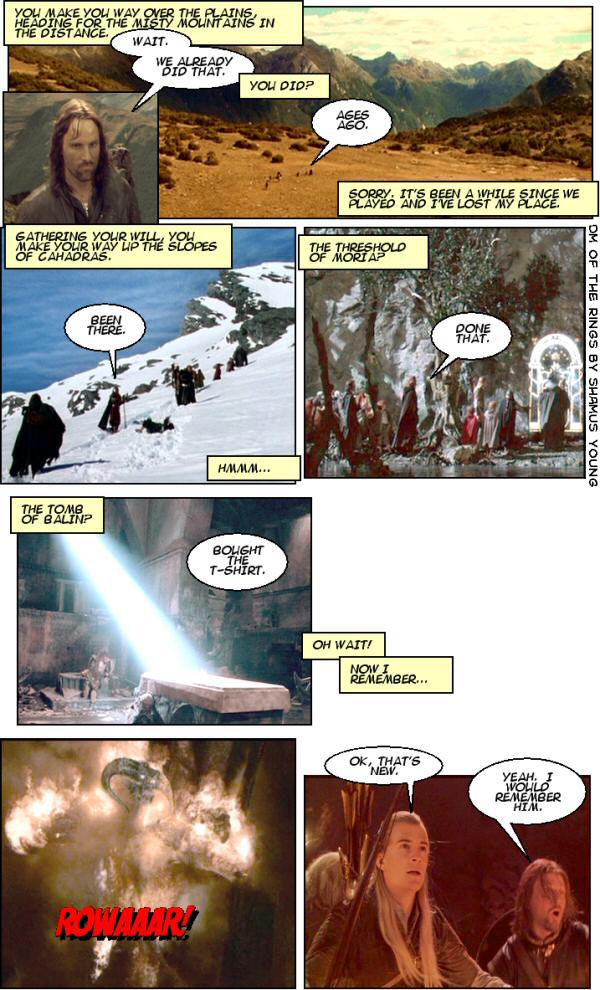
DM of the Rings XXV:
Where Are We Again?

By Shamus Posted Friday Nov 3, 2006

Filed under: DM of the Rings 29 comments

Cahadras, Moria, Tomb of Balin, Roleplaying, forgetful DM, Balrog

I had some witty comments to go along with this comic. They are in my notes… around here… somewhere. Ah yes! here they are:

D&D is a sort of simulation. A simulation of living in a fantasy world where fearless heroes and dreadful monsters clash daily in spectacular battles. A world where you are a great champion, and the creator of the universe is frequently disorganized, highly distractable, and alarmingly vague on the rules of the universe he's trying to run.

No, I already used that one. Dangit…


Virtual Villagers & Game Design

By Shamus Posted Friday Nov 3, 2006

Filed under: Game Design 8 comments

One of these days I hope to get the chance to make my own videogame. I don’t know if I would sell it, or ask for donations, or just give it away, I just know I want to write one if I get the chance. My Terrain Project was a result of me trying to scratch this particular itch.

I know I’ve got too much going on to make the attempt right now. This might end up being a “Mister Holland’s Opus” thing, but if it does happen it will probably deal with some sort of Sim or stats-building game. I like constructing simulations and inventing tech trees. The idea in Virtual Villagers has already been done, but I still enjoy toying with the concept in my head and thinking about how I might have done it differently. I just need to stay focused and resist the urge to go write some code. Or write a design document. I’m not kidding – it is taking real effort to not write down the technologies and gameplay dynamics that would drive a game like this. I have several files floating around on my hard drive along these lines, from when some game tickled the game-designer parts of my brain and I ended up mapping out a game just to get it out of my system.

After playing Virtual Villager for a couple of days, I can see there is a lot more this idea has to offer. You could take this same idea (guide a group of villagers to prosperity) and make it as a “Sim” sort thing, and end up with a very different game altogether. I keep looking at the tech ladder and picturing ways to make it into a tech tree, with the ability to pursue hunting / gathering / farming at different levels and with different tools.

I would also like to see a game along these lines where the player arranges marriages instead of arranging matings, which would give the thing a more tribal feel. There would also be a strategy element to it: As long as the player isn’t shy about a little low-tech eugenics, they could try to breed better hunters or better engineers…

Ah! I’m doing it. Okay, enough of this.

Virtual Villagers is amusing. A demo is available.


Virtual Villagers-Mating

By Shamus Posted Thursday Nov 2, 2006

Filed under: Game Reviews 24 comments

I’m thinking more about Virtual Villagers. It’s obvious that this is a cute, low-key game, with a lighthearted tone and very simple mechanics. Nevertheless, the obsessive Sim player inside of me can’t help tearing this thing apart and looking at it as an approximation of real-world behaviors. Which leads to the following observations…

One crazy aspect of the game is procreation, or (as the game puts it) breeding. You have to make them do it. If left alone, the villagers would never get busy, and would eventually die out. When you want them to reproduce, you grab one villager and drag them onto a villager of the opposite sex. They may reject the suggested union, in which case they run away from each other. This is no big deal, since it’s just based on a dice roll and you can keep trying until they click. Once they accept, they will head over to one particular hut and go inside for a few minutes. The hut is very small, but can be used by any number of couples at the same time. For some reason, they leave the door open. (Not that you can see in, it’s all black inside, but still.)

Virtual Villagers
To the left is the “research table”. On the right is the food bin. Just above that is the nookie hut, with the door that never closes.

If a pregancy ensues, the female will walk back out with a baby in her arms (if only it were that easy!) and will spend the next two years (about two hours of game time) caring for the child, unable to do any other work.

One odd thing about this is that neither gender will breed before age 18. Now, I understand why nobody would want to make a game that portrays underage teens mating, but this still bugs me when I’m playing. In a primitive society, you can’t afford to wait around that long. Life is short. You need to start having kids as soon as possible, and keep at it until menopause if you don’t want to go extinct.

As careful as the game is with underage procreation, it cares nothing at all about incest. It doesn’t keep track of who is related to whom, and any two people of opposite genders can attempt to have kids if they are over 18.

So what we have is a game that refuses to allow mating between people under 18, but has no problem with lots of immediate family members all mating in the same tiny hut at once. With the door open. Ew.

I think this is one of those aspects of the game you aren’t supposed to think about too much. I guess I just did.

Virtual Villagers – Babies!
Because I’m in a hurry, I usually pair up the villagers arbitrarilly and send them to mate en masse. Here several women emerge from the nookie hut with new babies.
I understand why, from a gameplay perspective, the game works like this. If you had to worry about family relations, then getting the population going from just six people would be quite a challenge, and if one or two of them died early it could doom the entire colony. Also, if the villagers simply had babies at a normal rate (and not at the players direction) then the women would spend a lot of time pregnant. The population would grow too fast and starve. The only way to cure that would be to introduce a realistic infant mortality rate, which would pretty much kill the fun of the game. Primitive societies had no contraception, began making babies at the onset of puberty, and yet the population was usually flat. Those numbers would make for a gruesome and bleak game if portrayed in any sort of realistic manner. Thankfully, the infant mortality rate is also unrealisticly low. (It’s nil, actually.)

Anyway, the fact that women leave the workforce for two years whenever they get pregnant has direct gameplay consequences. If you are very stupid and make your women farmers and your men do all the other stuff, then when someone gets pregnant you will suffer a drop in food production. Depending on your tech level, this can be really dangerous.


Ad Senseless

By Shamus Posted Thursday Nov 2, 2006

Filed under: Rants 9 comments

So I decided to try GoogleAds on this site. They are ugly, but small and easy to use.

Since last night the dang thing has been advertising zoot suits, stilts, and nutrition guides. What the heck? Is it that hard for them to figure out what my site is all about? Do the words Geek Culture, RolePlaying, anime, and Videogames not ring a bell? Those words are on every page, and every image is tagged accordingly. This site has a decent focus and there is just no reason the targeting should be so totally off.

I’ll give it another day or two, but if it’s still advertising random stuff nobody cares about then I’ll pull the ad. Since GA doesn’t offer any direct way to guide the content, the only thing it has to go on is the text on my site. If it can’t make sense of that, then the whole thing is useless.

I mean, z00t suits? Crimey.

LATER: They already have all of my text cached, so the content of the front page shouldn’t matter. But just in case it does, let’s see if this does anything:

Doom videogame Dreamfall Atari Rollercoaster Roleplaying Dice Cosplay Anime Geeks Oblivion. Dungeons & Dragons 3.5 edition Monster Manual Player’s Guide. Video game Gamecube Sony Playstation XBox 360 Nintendo DS and Mario. Gameplay Dual Shock Lord of the Rings, Fellowship of the Ring, The Two Towers, Return of the King. Manga comics. Spiderman and X-Man. Marvel comics. Videogame movie adaptations. Star Wars lightsabers and lightsaberbattles. The Phantom Menace, Attack of the Clones, and Harry Potter. Hitchhiker’s Guide to the Galaxy, books, movie, and radio series. Myst, Quake, Riven, Doom3, Bethesda, Warcraft and MMORPG. RTS games and first-person shooters. Diablo. World of Warcraft, Geek Dice, Roleplaying Dice, Colored Dice, metal dice, plastic dice, 20-sided dice. Wizards, Gnomes, Fighters, Clerics. Dork Tower and Penny Arcade. Optimus Rhyme. Otaku’s favorite anime series. Haibane Renmei and sometimes Cowboy Bebop. Chibi characters and harem comedies.

Wow. That was like having Geek Tourette’s Syndrome.

If it can’t find my target demographic from that then the thing isn’t worth the 28,800 pixels I’m letting it use on my page.