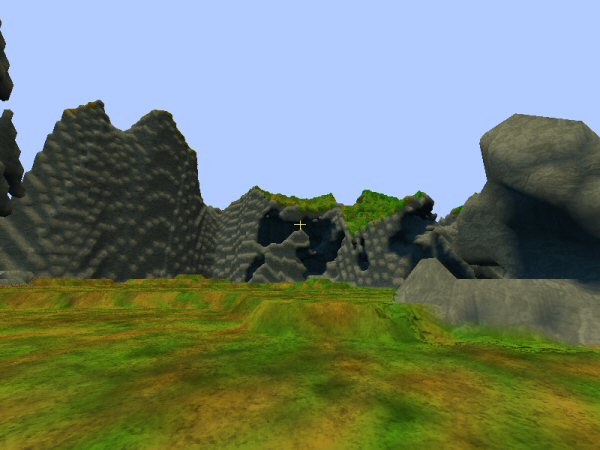
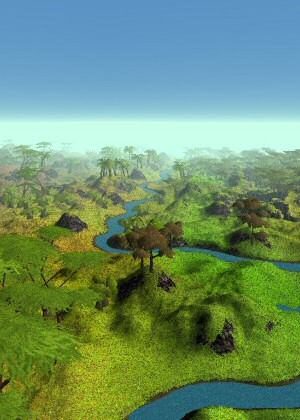
And now it is time to point and laugh at all the silly things that dum-dum Shamus has done over the past week or so. Let’s start with noise. Remember the image I ended with last week?
There’s something wrong here. Don’t get me wrong, that’s a cool canyon and all. I’m not knocking the canyon. The problem is that there is another canyon right next to this one, running in parallel. Defying all odds, there’s yet another one, very similar, just beyond that one. And another. And…
Yeah. My noise-generating system is broken. It’s not spewing out duplicate data. These canyons are unique. But we’re seeing patterns when we shouldn’t.
Also, the format of the noise makes it really annoying to use. It’s supposedly giving me values between zero and one. As I’ve plugged these numbers into my world-building system, I’ve noticed that it’s all kind of homogeneous. The possible range might be between zero and one, but the actual values it gives me are very, very rarely lower than 0.4 or higher than 0.6. This isn’t really a bug. This is how value noise works, actually. It’s just that it’s not very convenient like this.
So far I’ve designed my world-building code around this clunky mess, constantly re-scaling the noise and fudging the numbers until things look the way I want. But this makes for messy code. If I want mountains that range from zero to fifty, I’ll end up with code that looks like (noise - 0.4) * 250. Those are what programmers call “magic numbers”. They’re unexplained values floating around in source, and another programmer (probably future-Shamus, programming from the cockpit of his flying car) will look at this and say, “If you want mountains fifty meters high, why are you multiplying by 250? And subtract point four? What’s that all about? What idiot wrote this crap!?!”
So let’s calibrate:
Continue reading ⟩⟩ “Project Octant Part 13: Bug Hunt”
 Shamus Young is a programmer, an author, and nearly a composer. He works on this site full time. If you'd like to support him, you can do so via Patreon or PayPal.
 T w e n t y S i d e d