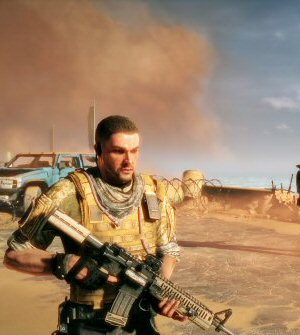
Quake 4: Plot and Characters

By Shamus Posted Sunday Sep 3, 2006

Filed under: Game Reviews 3 comments

I can’t think of another PC videogame franchise where the various titles are as unrelated as those in the Quake series:

The original Quake was mostly a technology demo. It was the impetus of online deathmatch, and it was a showcase for a new kind of graphics engine. The story was thin even by 1996 standards, and there were no characters at all. There was just the nameless player and miles of disjoined scenery. Some levels were arcane runic castles, some were military techno bases, and others were just rock tunnels. The game had no unifying theme or look. The story was a dead end.

Quake 2 was a bit deeper. They tossed out the “plot” of Quake and made something totally different. It was the story of the invasion of an alien homeworld. It seems the Strogg invaded Earth, ravaged it, and our only hope was to push them back and then cripple their capacity to make war on us. The player is part of the initial invasion force, but a mishap causes him to be seperated from the other soldiers and land some distance from the target. This is good, since an unknown anti-air defense sysem wipes out just about everyone else. The unexpected landing trajectory lets the player survive. He must then march through military bases, waste dumps, processing stations, and just about any other type of industrial setting you can imagine. At the end, he fights their leader and kills him. Game over. Not exactly Shakespeare, but it was a nice improvement over Quake.

Quake 3 was a multiplayer deathmatch and had nothing to do with either of the previous two games. So now we’re onto the third game in this franchise, and yet none of them are really sequals.

Quake 4 is a direct sequal to Quake 2. This is an interesting challenge. It’s been about nine years since the previous game, and the “lone soldier fights through the enemy robots and defeats the big boss” is now the plot of Gamecube titles for kids. Adult gamers expect something more now.

This is tough. They must make a sequal to the previous game, even though the plot – which worked well enough in 1997 – is now so stale and cliché that it would be viewed as a comedy if used today. So, instead of re-hashing the previous game they used it as a starting point. They mention that a lone marine assasinated the enemy leader without getting into too much detail. You do not play that lone marine. Instead you are (more reasonably) part of a large invasion force engaged in a straight-out ground war on the Strogg homeworld. This time around, there are lots of things going on and lots of characters to meet. As I mentioned before, the NPCs are now smart enough that they don’t ruin the game when they fight alongside you.

Continuing the tradition set by Doom 3, every fourth person you meet in Quake 4 is voiced by Steven J. Blum.

What I find odd is that he does many voices in both games, but doesn’t play any major characters. As the English voice of Spike Spiegel, you’d think they would hand him some real characters to play instead of a long list of unrelated lines for a dozen minor characters.

The rest of the voices in the game – including the extras – are also well cast and well performed. I think the days of programmers and level designers adopting preposterous accents and doing their own voice work are behind us at last.

With all of these posts about Quake 4 I suppose it must sound like I’m really into the game, which isn’t the case. The game is fun and diverting, and shows a lot of polish, but I’ve probably spent as much time writing about it as I have playing it. I picked it up for $19.95, and so I’m happy with what the game has to offer. If I’d paid full price I would probably have expected more and wound up disappointed.

I enjoy writing about these “hardcore” first-person shooter games a lot more than I enjoy playing them. My own passion lies elsewhere, but they are a good indicatior of where technology is headed and a nice peek at the latest graphics engines.


Quake 4: A World of Metal & Plastic

By Shamus Posted Friday Sep 1, 2006

Filed under: Game Reviews 6 comments

A few words about the visuals in Quake 4:

The graphics are good, but that’s a given. Saying a first-person game has good graphics is like trying to sell a guy on the idea of a blind date by telling him the girl doesn’t smell bad. Of course the graphics are good. These days, even the terrible games have awesome graphics.

I’m going to nitpick the engine a bit here, but let me start by saying that the Doom engine is a fantastic piece of technology. This is the second game I’ve seen that used it, and taken together the two games show us a lot about what the engine can and can’t do.

It’s interesting to see the Doom engine in another context. It turns out that a lot of the look of the world in Doom was the result of the engine, not artistic direction. The “everything made of dull metal and plastic” look remains, and I don’t think you can get the engine to do anything else. I’ve never seen it do wood, for example, and I can’t help but wonder how the engine would pull it off without making it look like formica.

Quake 4: Surface of the Strogg homeworld.
Here we are outside in broad daylight, but the ground directly underneath the bridge is pitch black.
One of my gripes with the engine is the way that a room can have a light source of sun-like luminance at the center and still be pitch black in the corners. There is no way around this: I’ve played with the editor and I can see that the wonderful unified lighting system (which is a real boon and great breakthrough for all sorts of technical reasons) has this one annoying limitation, which is that shadows are absolute. Imagine this: You are in direct sunlight, at high noon, out in the open. Now you have an awning sticking out from the side of a building. Using the Doom engine, you will need to use your flashlight to see stuff under that awning. This is obviously not realistic, but is the annoying result of those thechnological tradeoffs we keep making to make our videogames look pretty. Probably this will be resolved in the next-gen engine, but for now you’ll be giving your flashlight a lot of use. The reason for this is that light doesn’t bounce off of surfaces, so anything that isn’t directly illuminated will be pitch black.

Quake 4: You can’t have a planetary invasion without a whole mess of crates and barrels.
(Top) The similar lighting behavior on these objects makes it look like they are all made from the same stuff. (Bottom) The specular highlights have been circled just to show you what I’m talking about.
The other thing that surprised me was the uniform specular lighting. The problem is this: All of the shiny stuff in the world (which is almost everything you see that is not sky or dirt) has a bit of a gleam to it; a blob of light that serves as an approximation of a reflection of the light source. This is a common effect and is often called a “specular highlight”. If you want the object to appear to be very smooth (like crystal ball or a freshly waxed car) you make the gleam a very small, precise dot. If you want the object to still be shiny but have a coarse surface (like an upholstered couch or a stainless steel bowl) then you make the gleam a broad, fuzzy blob of light.

The problem with this iteration of the Doom engine is that all objects have the same level of “polish” or “smoothness”. You can adjust how bright the reflection is, but not how tight or diffuse the reflection is. There is just one universal setting for all objects. If they made this universal smoothness too smooth, then it would look like everything in the world was brand-new, wet, or had been given a fresh coat of wax. If they made it too diffuse it would have made everything too plain and the effect would be lost. So, they selected one global value somewhere in the middle and stuck with it. After a while the eye notices this. We’re used to seeing some objects with more shine than others, and seeing every single object and surface in the room give off the same exact specular highlight makes it feel like it’s all made from the same stuff. Even if one surface is painted to look like diamond-plate steel and another like plastic, their specular behavior tells our eyes they are just the same material in different colors. John Carmack mentioned after the release of Doom that he was working on this, but I guess the changes didn’t make it in time for Quake 4.

Quake 4: Who turned out the lights?
(Top) This is what the game normally looks like. How big is the room? What’s going on in here? (Bottom) After adding a few lights, we can see this place is kind of cool.
My biggest complaint about the game is the pervasive darkness. In Doom the place was relentlessly dark because the base lost power, but in Quake 4 you are ostensibly attacking an operational enemy location. Do the Strogg really fumble around in the dark like blind men? On three different occasions I blundered over a ledge and fell to my death because I couldn’t see where I was going. Darkness is fine if you want to create a sense of fear, but restraint is needed. Going into a dark room is frightening. Being in a dark room is frustrating and boring.

Using some cheat codes I was able to add some lights to the more difficult rooms and discovered that there is a lot of cool stuff hidden in the darkness. The place looked a lot more interesting and I was finally able to get a feel for the area, instead of peering at the world a little slice at a time through my flashlight beam. What is the point of artists making detailed rooms when we can’t see any of it? Might as well make the rooms simple empty cubes.

They did a wonderful job of preserving the original industrial feel of the Strogg homeworld established in Quake 2. The games are generations apart in terms of graphics engines, and I wondered how well the original would translate. By borrowing just a few sound effects and some architectural cues, they really managed to capture the gritty style of the original.

Five Months Later: Looks like I was wrong about how the engine worked: After a graphics card update, I see that the pitch-black areas are not pitch black any longer. Dark, sure. But the game doesn’t have the perfect shadows in broad daylight effect it had before. I assume this was a result of some wacky settings somewhere along the line.

The game is a lot more fun now.


Full Metal Panic, Disk 5

By Shamus Posted Friday Sep 1, 2006

Filed under: Anime 7 comments


Captian Testarossa and Kaname perform a musical number! Together!

Full Metal Panic! Tessa and Kaname sing!

With a light show!

Full Metal Panic! Tessa and Kaname dance!

With Sergeant Major Mao on keyboards!

Full Metal Panic! Sergeant Major Mao on keyboards!

In the auditorium flight deck!

Full Metal Panic! Tessa and Kaname sing!

On a submarine!

Full Metal Panic! Tessa and Kaname sing!


I wasn’t able to hear the words of the song over the sound of my own screams.

This. Never. Happened.


Twenty Sided Birthday

By Shamus Posted Friday Sep 1, 2006

Filed under: Notices 11 comments

Gundam Wing Birthday Party
The cast of Gundam Wing – having a birthday party? Disclaimer: I have never watched Gundam Wing, but pictures of %anime characters and birthday cakes are hard to come by and I can’t be picky. Aoi Sakuraba leaping out of a giant cake would be more suitable, but unless I’m going to learn to draw in the next hour this will just have to do. Geeze. You people and your relentless demands for authenticity!

This site is one year old today. “Birthday” doesn’t sound right, but calling it a “blogversary” just sounds like I’m trying to get the jocks to beat me up.


NPCs and Immersion

By Shamus Posted Thursday Aug 31, 2006

Filed under: Game Design 17 comments

Quake 4: Strogg Base
All alone: This place can be pretty unnerving. It would be much less so if I had an NPC following me around looking relaxed and staring into space. The best way to keep NPCs from messing with immersion is to leave them behind.
Immersion is that much-sought quality in videogames that will make the player think and act as if they were really there. Immersion is a prerequisite for any sort of emotional response. If a developer wants the player to be frightened by a situation, sad over the death of a character, angry about a turn of events, or excited about overcoming an obstacle, they first need to convince them that they are part of the game world.

Immersion is one of those qualities like creativity or morale: There is precious little you can do to enhance it, and a million ways you can kill it. If the player is terrified while crawling through the enemy base, fighting foes in dimly-lit corridors while the walls breathe steam and the machinery casts threatening shadows onto the walls, he’s immersed. Then let’s imagine that something stupid happens. Maybe he finds some critical item like a key or a weapon just laying around or (worse) on display and free for the taking. Suddenly he’s pulled out of the game and remembers that despite the steam and shadows, this is still more or less a tenth-generation copy of the original Wolfenstein formula of gunning down bad guys and rounding up their key[card]s.

The quickest way to kill immersion is with non-player characters: NPCs. Friends and allies and such. I mentioned before about how your companion in Resident Evil 4 was such a goofy distraction that she killed any sense of fear the game was trying to build.

If an enemy monster is stupid (because its “brain” is just a couple of hundred lines of computer code running on a personal computer that is busy doing a lot of other stuff) it isn’t too bad. Hey, it’s a monster. It’s not supposed to be smart. But when a human character shows up the player expects him or her to act like a human. Then when they walk into the player’s line of fire, get confused by doorways, get caught up on scenery, or utter the same phrase for the tenth time, they are exposed as a fraud and the illusion of the gameworld is broken. NPCs have so many ways they can break immersion that it’s difficult to enumerate them all. I’ve written about AI mishaps in the past and how simple things can go absurdly wrong, but you don’t need AI to go haywire to break immersion. When dealing with NPCs, immersion can be destroyed even when everything is working right.

Quake 4: Medic Lab
On display: Players might throw stuff at your NPC. Shove them. Stand in the middle of their conversation. If you want NPCs to fill in the game world but don’t want to deal with all of the strange things players might do to them, just stick your actors behind a glass wall and let them read their lines when the player strolls by.
Here is a challenging task: Have the NPC follow the player. The player character is a vortex of unpredictable actions and random behavior. What will they do? Crawl around in the dark looking for secrets? Climb over things trying to reach a high ledge? Start gunning down their own teammates? Shoot stuff at random? Use explosives to try and catapult themselves up to high ledges? Stand in place for five minutes while the player walks away from the computer and makes a sandwich? Even when the player is doing stuff that doesn’t make sense, they still expect those NPCs to react to their insane actions in a realistic way.

“Following” is one of those things that seems obvious but is maddeningly complex in implementation. In old games, the follower would always be four steps away, which was annoying. As you wandered around the NPC would hover over you, dogging your steps and staring at you. What it needed was to stop once it entered a room and stand nearby while the player explored. Fine. But this means NPC’s have to understand rooms and spaces, which is a tricky concept. I’ve seen implementations where the NPC will simply try to keep the player in view. If it can see you, it stands still, if you move out of sight, it will move to catch up. Good plan, but you also need to take other factors into account. If the player had to navigate through something dangerous to get where they are, the NPC probably shouldn’t attempt to follow. If the player jumps into a deep hole, the NPC needs some sort of justification for continuing to follow this suicidal idiot. Fine buddy, you wade through the slime and brave the jaws of that big stamping machine. I’m staying here.

But what does the NPC do while waiting for the player? Stand still? If you don’t want the NPC to seem like a complete jerk, it needs to sense when the player is trying to walk though and step out of the way. More importantly, if the NPC is going to stand around, what should it look at? Having them look at something exceedingly dull with their backs to interesting scenery is no good. (Like turning its back on a huge window with stunning scenery to look at an air vent or a wall. This looks odd and people notice.) The same goes for staring into a pitch dark corner. However, the logic needed to sort this out is very complex. It’s a lot of work to just figure out which way to look, which is just step 1 of solving this problem. When they aren’t busy, people tend to move around, fidget, make conversation, or find someplace to lean / sit / rest, so NPCs ought to do the same. This translates directly into the need for more detailed models, more animations, more voice acting, and more scripting.

But we’re not done yet. The NPC needs to run to the player’s side if a battle starts. They need to be able to make the subjective judgment about friendly fire: Did the player just shoot me by accident or on purpose? That’s tricky. And then the NPC needs a proper response for each.

Quake 4: Marines and signal flares
Strike a pose: Another danger of having NPCs hang around is that if you’re not careful they will all assume identical poses. This can be distracting when they are standing close to each other. It looks like these guys are about to lock arms and start kicking in unison like Rockettes.
Once you code all of this, you can have an NPC that will be able to perform the thrilling task of following a human being around without looking too stupid. After all of this work, it isn’t going to impress anyone. (Except geeks like me who obsess over this stuff.) The best you can hope for is to not have your NPCs make fools of themselves.

People ask why AI sucks so bad? This is why: It’s hard, it’s expensive, and when it’s working right people don’t notice because they only notice when the thing screws up. The developer can spend money making the gameworld bigger, or spend money adding lots of detail to some inconsequential NPC just so it doesn’t kill immersion.

Half-Life 2 did a pretty good job with NPCs, although there were many habits they had that I found annoying. Quake 4 is even better, with squads of men working together for prolonged periods of time, who have speaking parts, and who pull all of this off without making obvious fools of themselves.

It may seem like a small detail, but in my book it’s a big leap forward. My hat is off to the AI coders / scripters at Raven software. Nice one guys.


Eyes on the Prize

By Shamus Posted Thursday Aug 31, 2006

Filed under: Links 5 comments

Eyes on the Prize is a brand-new blog about anime, electronic gaming, and roleplaying. Wow. Can’t beat that. Looks like it was launched yesterday. Wisely, the author has already christened the site with fan service.

This follows the new blog Alex started a few days ago, which comes on the heels of a number of other new blogs I’ve seen pop up. Is this coincidence? Is this a back-to-school thing? Interestingly, this about when I launched this blog last year.


Meme: 25 Favorite TV Characters

By Shamus Posted Thursday Aug 31, 2006

Filed under: Nerd Culture 5 comments

After Mark mentioned that he found my blog via the “blond joke” meme, I’ve been thinking about memes a little differently. I would sometimes feel guilty when I joined in a meme, because I thought of them as a crutch for when I don’t have anything witty to say. But looking back, I see that I lot of my voyages into unknown blogs have been the result of following a meme. They are easy and fun and a good way to mix things up. Also, I need to lighten up.

Don found a good one: 25 Favorite TVelevision Characters.

As with Don, I’ll be dispensing with the “no cartoons” rule. In fact, this list is nearly all cartoon characters. I’m adding an additional qualifier that I can only use one character from each show, otherwise this this list would just be every major character, supporting character, minor character, and uncredited extra that ever appeared on Firefly, and that would have been even lamer than the following list of cartoon characters.

  1. Spiderman – My most favoritist of all superheroes
  2. Wash (Firefly)
  3. Aoi Sakuraba (Ai Yori Aoshi)
  4. Lionel Hardcastle (As time goes By)
  5. Phil (Sugar, a Little Snow Fairy)
  6. Chi (Chobits)
  7. Armstrong (Fullmetal Alchemist)
  8. Larry the Cucumber (Veggie Tales)
  9. Gromit (Wallace & Gromit)
  10. Radical Edward (Cowboy Bebop)
  11. Sosuke Sagura (Full Metal Panic)
  12. Frylock (Aqua Teen Hunger Force)
  13. Basil Fawlty (Fawlty Towers)
  14. Statler & Waldorf – The Hecklers (The Muppet Show)
  15. Reki (Haibane Renmei
  16. Sledge Hammer (Sledge Hammer!) I was 15, okay?
  17. Die Fledermaus (The Tick)
  18. Homer Simpson (The Simpsons)
  19. Whiz (Kidd Video) Again, I was 15.
  20. Bugs Bunny (Duh) The guy’s still funny after all these years.
  21. Max Headroom (Max Headroom) My first taste of cyberpunk.
  22. EMH Doctor (Star Trek: Voyager) A great character in a mediocre series.
  23. Ohjiro Mihara (Angelic Layer)
  24. Cosmo Kramer (Seinfeld)
  25. Less Nesman (WKRP)

A year ago I might have put someone from The Sopranos into this list, but that show lost its way a long time ago. It’s now in a rut so deep it could be more properly labeled a canyon. The story is just grinding along, having lots of stuff happen that never seems to lead anywhere. American television. Meh.

This was harder than I expected. It took me a long time to come up with 25 names. I think the problem is that in my 35 years I have not seen 25 shows that I really loved. I have Spiderman at the top of the list, but the truth is that while he’s one of my all-time favorite characters, the various television incarnations of him have not impressed me. I put Cosmo Kramer on the list because I think the character is funny, but I’ve only seen Seinfeld 4 times. If I had obeyed the “no cartoons” rule in the original meme, I could not have come up with 10 names, let alone 25.