 T w e n t y S i d e d

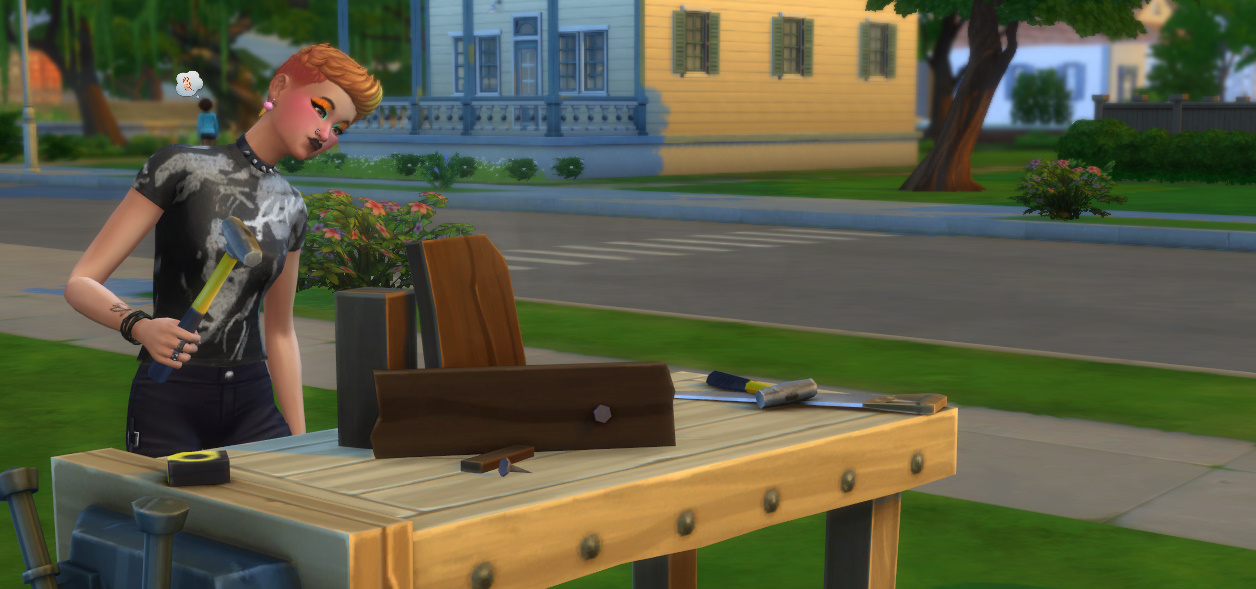
The year is 2020 and Logan is at college. His parents are doing their best to return to some sort of normalcy, but it’s strange without their son.
Logan comes to stay over weekends and is consistently met with the sort of thought out meals he’d usually think of as birthday dinners. There is no takeout to be seen, just roasted potatoes, homemade lasagnas, and everything else he knows his mom and dad can cook.
He doesn’t say anything, but what he really wants is basic takeout from their local Chinese restaurant. He knows it would hurt his parents feelings, but cold lo mein tastes a lot more like home than the brisket his mom made that one Easter four years ago. It isn’t a reflection of how ‘good’ his parents were that he thinks of pizza and sweet and sour chicken as home. They had better things to be doing than working in the kitchen all day. Hell, all he wants is to play their weird family mix of Monopoly and Clue and eat some bad pizza. People often associate takeout and quick foods as signs of the ‘hurry up and go’ families who don’t spend time together, but as valid as those families are, take-out families come in all shapes and sizes. Logan’s family happens to be a ‘hurry up and hang out together’ family, which doesn’t roll off the tongue as well.
He tells them about school and how things are going. He spends his Saturday with Mom and Dad, and spends most Sundays catching up with David. He helps out at the BookNook when they let him, and settles very comfortably into routine.
There’s talk about the new plague going around, but it’s mostly ignored by our family at first. There had been other talks about other plagues in the past and generally it had always been someone else’s circus and monkeys. They’d worry a bit, when it came up on the news in the 2012 era, and then it would come to nothing. They have no real reason to have learned that these things would effect them. Like bomb-strikes and shootings and war on the news, it’s not effecting their area of the world and it gets filtered out as white noise.
It’s not our family’s fault, although it seems sick and sad from an exterior or even an affected perspective. Someone who’d been part of the reality Kelly and Michael naturally filter out would accuse them of lacking empathy, but that isn’t what it is. If everyone felt every ten million deaths by cancer every year as proper grief, we’d be incapacitated. It’s simply how it has to be. Books and media can sometimes help us to understand for a moment what it’s like for someone else, but no one can be obligated to learn it. And maybe not everyone even should.
Kelly, Michael, and Logan dismiss the current plague as background static until suddenly it’s right on top of them. Logan’s collage announces they’re moving to remote learning, and suddenly he’s installing a program to allow him to view his professors on video call. Logan is coming home for ‘a few weeks’. He and his parents laugh because there is nothing else they can do, and Logan gets his wish of getting takeout every night. The BookNook closes its doors for the safety of its customer base, and everything suddenly feels very, very weird.

The Witch Watch
My first REAL published book, about a guy who comes back from the dead due to a misunderstanding.
Joker's Last Laugh

Did you anticipate the big plot twist of Batman: Arkham City? Here's all the ways the game hid that secret from you while also rubbing your nose in it.
Artless in Alderaan

People were so worried about the boring gameplay of The Old Republic they overlooked just how boring and amateur the art is.
Who Broke the In-Game Economy?
Why are RPG economies so bad? Why are shopkeepers so mercenary, why are the prices so crazy, and why do you always end up a gazillionaire by the end of the game? Can't we just have a sensible balanced economy?
Stolen Pixels
A screencap comic that poked fun at videogames and the industry. The comic has ended, but there's plenty of archives for you to binge on.
Thanks for the post!
Couple spelling corrections:
“They have no real reason to have learned that these things would effect them.” ->affect
“Logan’s collage announces” ->college
Man, thinking back on them, the early days of COVID were so crazy, weren’t they? Nobody really knew what was happening, everything was cobbled together and expected to be temporary, nobody had planned anything.
I’m sort of impressed if Logan’s school actually had an app and some kind of infrastructure for remote learning – a lot of schools, businesses, etc., were scrambling…
This interests me – when a few of us went to stay with a university friend in Riga (Latvia) after university, her family got Chinese, and I was surprised to realise it was ordered from a restaurant. At first I thought it was because they were quite a rich family (my friend put it aptly while we explored her house, “none of us will own a house like this in our lifetimes”), but apparently it was the standard there, even in their capital.
In the UK it is standard for even the smallest town or village to, if it has any shops at all, have a Chinese takeaway, dedicated only to collection and delivery (i.e. a kitchen, a counter, and no seating). In the same manner as a fish and chip ( kebab) shop. In fact I’ve come to learn that in the North West the two are usually combined. In a city or town one needn’t walk more than a few minutes in a residential area to find one on a street corner or next to a convenience shop. There aren’t many Chinese people here in general, but of the few who are, some seem to have spread out so that even the most parochial and natively ethnically homogeneous place has a “Chinese” (takeaway) – much like Indian doctors. In fact it would seem a serious flaw and impoverishment if one couldn’t get Chinese takeaway somewhere (regardless of affluence). For context, my village has about 5000 people and no actual village centre, but has (across two very small clusters of shops) a pharmacy, two convenience shops, an Indian restaurant, two fish and chip shops, couple of cafés, small garage, a supermarket… and an Indian takeaway and a Chinese takeaway.
Whereas we would have to go to the larger village a few miles up the road, or a nearby rural pub for an actual Chinese Restaurant – which it turned out do actually do takeaway too, I’d just not thought to find out because I’m so used to using the dedicated places, having lived in both big and small places.
I understand from my parents, that ordering from a restaurant was the method here before all the takeaways opened up, at some point in the past.
Yeah. I wonder how much of this is self-reinforcing cultural biases.
In the US, there aren’t a ton of pure takeout restaurants – even when I lived in New York, where space is incredibly expensive, the little pizza places always had some tables and seating, even if most of their business was takeout/delivery/by the slice.
I think a lot of this is that the spaces available to rent if you want to start cooking food are “restaurant” spaces that have seating, so if you’re starting up that’s what you can find. And people expect restaurants to have seating because that’s what they’re used to. So that’s what people build when they build new spaces. Sort of self-reinforcing.
I’m really interested to see what meal delivery services like GrubHub/Seamless do to this model in the US. It’s now possible to be a “delivery only” restaurant, which has lead to the rise of “ghost kitchens” – pseudo-restaurants that have no physical space of their own, but share a kitchen with an existing “real” restaurant that has more kitchen capacity than they need. Because (at least in the US), given how much of a movement there is towards delivery services, you don’t even really need your own takeout window anymore…
That was one reason I didn’t realise that there were other options where I am now – I’ve got so used to using JustEat / Deliveroo/ UberEats and other grouped takeaway websites etc. to find what is available rather than looking up the websites of local places.
That ghost kitchen thing rings true here too, when I lived somewhere a bit larger – again as you say with those sort of takeaway delivery websites. Deliveroo had various food places I’d never heard of in the list of places to order from, and then when I looked up the location it was the same address as a perfectly well known sit-in place. Some places were on there under their own name and had then a very slightly altered menu or restricted version, under a different name – presumably to try to get more custom by essentially tricking people into thinking it was a new place to try. Some even had three guises. But there was the occasional place that did slightly different food to what the restaurant itself served.
Our favourite place to eat at our previous place (in the Netherlands) gives a small rebate if you order directly instead of via Deliveroo or any of those other things because restaurants pay them for their “service”, and in return lots of people become blind to all the places they could order from, which means Deliveroo & Co. are inserting themselves between hungry people and the places who sell food, making it harder to find a takeaway directly (at least around here, if you search online for takeaways, you get aggregated search results from delivery companies, and have to scroll way down to find websites of the actual restaurants.
Also, that “take-away” was also a proper restaurant, at almost the same prices. Nothing fancy but always good for a nice meal out.
Going home every weekend seemed like a weird (and rather lame) thing to do at university which I never thought to do myself. But in hindsight at some point years after university I realised I’d only not done it because I didn’t really think about it properly, it just didn’t really cross my mind – in the same way that it was just a given that I obviously wouldn’t go to university in the same city that I grew up / parents live, for some reason. Either one would have made first-year a lot less pointlessly lonely!
It’s a challenge. On one hand, still spending time with your family is amazing, and it’s great to extend the time you spend together with them.
On the other hand, in addition to coursework, one thing that college/university helps teach is independence – how to live on your own, establish your own identity, and learn who you are. It’s hard to do that when you’re still spending a lot of time with your parents. I’m reminded of a conversation I had with a friend of mine back in our consulting days, when I was considering taking a 3-month temporary overseas assignment, but didn’t want to transfer permanently. He’d previously transferred to London where he stayed for 3 years, and he talked about having that foot still in the door is the difference between GOING somewhere and LIVING there – you have to jump in with both feet and commit to really be part of something new. I’m still not sure I agree with him, but I see his point (I wound up NOT transferring, but more because the opportunity went away before I had to make a firm decision).
On the gripping hand, this article was one of the more depressing things I’ve read and had backed up by actual math…
“It turns out that when I graduated from high school, I had already used up 93% of my in-person parent time. I’m now enjoying the last 5% of that time. We’re in the tail end.”
https://waitbutwhy.com/2015/12/the-tail-end.html
I went to a school about two hours away. Certainly too far to go home every weekend (and neither I nor my parents would have wanted that), but close enough to make the actual visits home for holidays pretty reasonable. I think we were just under the cutoff for me being able to have a car on campus, like your home needed to be at least three hours away or something. As a result, a two hour drive meant my mother was actually driving four hours to pick me up and bring me home.
Although I later dropped out and finished my degree at a university more focused on adult education (there were no dorms, fraternities, etc.), I do appreciate that experience of going to a traditional school to have that soft transition into adulthood.
Even so many years later of living in various places since university to be honest I always feel like I’m waiting to go back home, to where I belong. It may be just about wearing off now to some degree. Part and parcel of this era or having to rent practically forever perhaps. I think the working class have a much healthier approach, grow up and get a job and move out if relevant, but stay near the family and community. No need to arbitrarily go off on a pseudo-adulthood exile to ‘find oneself’ by getting drunk for a few years in a sanitised microcosm of the real world while treating another city as a residential holiday home. All that can be done at the weekends in the real real world. Middle-class Western life is so odd and I think we make up our own contrivances to justify it; it seems such a lonely way of life.
But yeah no way I’d be going home at weekends in second year and beyond once it got interesting, too much stuff to do with friends in the shared house haha. Before that it was just playing Prince of Persia 2008 and watching Scrubs in my room. Maybe if I’d gone home I’d have actually done some work!
“the working class” … I would not phrase it like that. Also, I know a few very “working class” people who’ve moved way further in life than I have.
I had a really hard time leaving home for university, and it took me a year or so to quite like the new place, but it took probably about 20 years, quite a few of them living abroad, to actually separate myself from some of the stuff I needed to let go. So, by the time we stranded at my parent’s place for 6 months, in 2020, I was my own person, with my own ideas, able to demand respect for that fact and also able to embrace who the rest of my family were (well mostly). That’s pretty much what it took to stop it with the “you’re doing it wrong” – “no, *you*’re doing it wrong!”
Wish this had worked out faster, but going away for some time is a time-honoured tradition, also for this reason. A few centuries ago in Germany, to learn a craft, apprentices had take their bundle and not set foot in their home town for a year and a day, while looking for masters of the craft to teach them. The idea was that this taught them to be self-reliant, get on with others, learn “how it’s done” elsewhere (well, at least in other parts of the country), form views, see stuff the people at home don’t know about … very very useful thing. Everyone should do this at some point.
“weird family mix of Monopoly and Clue”
Interesting – so I’m not the only one who tried a hand at the concept of “Scrabbleopoly”.
No Mattel did that as well. “Monopoly/Scrabble” – according to Tom Vassel from Dice Tower fame an aweful, aweful game that no one should play.
My initial reaction to The COVID was much the same as in the story: “Oh, it’s just another of those viral outbreaks that sound scary on the news, but never seem to actually affect life here in my neck of the woods. No big deal.”
And then it was (and still is!) a very big deal.
If I could make a single video game item into a working real-life object, I’d import a scroll of genocide from nethack and use it on The COVID. Enough is enough already.
Yeah. First it seemed like this faraway thing, indistinguishable from news of e.g. an earthquake in a distant country, where you feel bad for them, hope it’s dealt with competently, maybe donate if a relevant charity is put in front of you, and then go on with your day.
And then we turned around and it was right there.
Same. We heard about the cruise ship outbreaks, but it still had the vibe of “Oh, it’s another SARS or bird flu”.
The wake-up call for me was when the NBA cancelled their entire season and I realized that this was getting serious. I think a couple days afterwards, my mother gave me a call and said “You NEED to go to the grocery store right now and pick up food because the stores are getting hit hard”. Shortly afterwards, the price of gas cratered. I was working at an oil and gas company at the time, and the price for a barrel of oil actually went negative for a day to true up to the now very, very low price oil was expected to sell at since all travel ground to a halt.
Welcome to the Covid era.
“People associate takeout with HUAG families, but Logan’s was more of a HUAHOT.”