 T w e n t y S i d e d


This week I discovered Raycevick, a YouTube channel dedicated to retrospectives, primarily focused on shooters. I know some of you have nudged me in the past to check this guy out, but I didn’t get around to it until this week. I’m only about halfway through his catalog so far, but it’s really solid stuff.
Like Joseph Anderson, I often wish our tastes were more similar so I could get more out of his videos. Aside from Spec Ops: The Line (which he covered last summer) I haven’t really paid much attention to military shooters. Sure, I occasionally sampled them just to keep track of what the genre was doing, but I’ve never been a fan and to this day I still get the lineages and developers of the tentpole series confused. If someone mentions Battlefield, Call of Duty, Modern Warfare, Medal of Honor, Black Ops, Ghosts, Rainbow Six, Bad Company, Ghost Recon, Splinter Cell, or Infinite Warfare, I usually have to consult Wikipedia to remind myself which ones are core titles and which ones are spinoffs from which other onesAlso I tend to get Company of Heroes mixed up in there, even though that one is a strategy game.. But Raycevick knows his shooters and his videos offer a lot of great insights to the history and nuance of these games, even if they all tend to blur together for me.
The one video I want to highlight is Be Your Own Consumer:
Link (YouTube) |
I suppose this is another way to express the now-familiar tension between companies who make money to make games and companies who make games to make money. But it’s still an important point and the more people that make it the more I can enjoy my feeling of smug self-satisfaction and superiority over the suits at the major publishers. And you can’t put a price on self-satisfaction.
Footnotes:
[1] Also I tend to get Company of Heroes mixed up in there, even though that one is a strategy game.

Good to be the King?

Which would you rather be: A king in the middle ages, or a lower-income laborer in the 21st century?
Fixing Match 3

For one of the most popular casual games in existence, Match 3 is actually really broken. Until one developer fixed it.
Steam Summer Blues
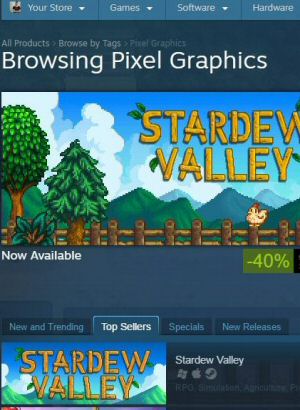
This mess of dross, confusion, and terrible UI design is the storefront the big publishers couldn't beat? Amazing.
The Loot Lottery

What makes the gameplay of Borderlands so addictive for some, and what does that have to do with slot machines?
Good Robot Dev Blog

An ongoing series where I work on making a 2D action game from scratch.
Huh… watching the embed, I’d never actually seen Marathon before. Heard of, yes, but not seen. Now I realise where Rooster Teeth got the bit in RvB where Church ends up far in the past talking to Gary, lol
Okay, no. The way it was marketed, there’s no way Company of Heroes isn’t a shoo…
Damn.
The way it’s marketed, I thought it was a war-time action/drama film.
I know what you mean. Also, it felt very 2013, didn’t it?
His Mass Effect videos are really excellent, deep dives into the production/ history of the games, with interview excerpts from developers, artists etc. Definitely worth watching
His Halo videos are my favorites. When it comes to Halo criticism I seem to always stumble upon people who are either overly dismissive of the whole series like Yahtzee, or fan boys who just want repeat how Halo “changed everything.” Raycevick is one of the first youtubers I’v seen who has done a fair, long and critical retrospective of the series; which I’ve been really yearning for because these games were my childhood, but they do not hold up for me in some areas. Probably the most enlightening section for myself was how he explained why the story was still engaging even though it was kinda dumb and didn’t make any sense.
“And you can’t put a price on self-satisfaction.”
There’s a Pornhub joke here, but I’m too lazy to make it.
Anyway, yeah, I have a similar problem. Most military shooters tend to blend in together for me. I certainly cannot tell one from another just from screenshots or even video clips. The sole difference here is Splinter Cell, which is a stealth game rather than a shooter (I think the last one was different, but I never played it).
I also remember the original Rainbow Six being more of a tactical game than a shooter, but there’s obviously no money in making anything other than multiplayer shooters these days.
Last one isn’t different. More day missions, but idea is still the same. Fifth (Conviction) was the bad one, and less Splinter Cell’y
Oh, I thought Conviction was the last one. Which one is it, then?
My issue with him is entirely tastes. He does a lot of shooter coverage, and I either dislike or don’t care about most shooters. He talks a lot about music, but the music he thinks is good is entirely different from mine. So that’s a bit of a barrier.
Still, I’ve seen stuff of his I really like. His retrospectives are nice and cover a good amount of the dev history as well as the game itself. I particularly liked his Mass Effect retrospectives and I thought the Max Payne ones were interesting too. I skip over the bits where he talks about the music though, hahah.
If you’ve got any interest in random videogame youtuber recommendations still, Turbo Button, TheGamingBritShow and HyperBitHero have all been ones I enjoyed recently.
TGBS is good, came across him a few months ago, for his 1h30 comprehensive comparison of Ratchet and Clank 2016 vs the original(s). Has pretty much completely put me off the new game :D
That video is my favorite of his. Unlike every other videogame youtuber I’ve seen, he’s got these editing chops and kind of writing/delivery where just watching it is entertaining to do. Is good video-feel a bad expression I can use to describe this? It’s just fun. I’ve watched that long video at least four times through just because it’s fun to do.
“Excellent UX design”.
Yes, there’s just something about it isn’t there, it’s so interesting to watch, despite being literally the length of a film. I’ve watched it at least 2 times I think
Their video on modding Stalker[1] is pretty good. It highlights how buggy that game trilogy was, how much potential it had, and how much potential it still has. Even with the mods that fix the weapon damage, allow for sandbox mode, or otherwise change the gameplay, the game is still buggy, has terrible AI, and a clunky interface and graphics. I suppose that’s why we’ve got zombie survival games, PUBG, and the Metro games. :)
[1] No, I’m not spelling it with the dots, or the subtitle…
I got into his videos after hearing about his essays on the Mass Effect trilogy. He’s amazing at breaking down everything going into the games he covers. His Orange Box video is incredible.
I liked that video a lot because he touched on something I noticed about HL2 the first time I played like 2 months ago which is that its kind of a shooter that isn’t really about the shooting. Or at least not at its core.
Well that’s what they get when they abandon the idea of “the customer is always right” in favor of “how much more can we plan to exploit the customers this fiscal year”.
What a coincidence. I just got done watching his Orange Box Retrospective. Just made me all the more mournful of Episode 3. But yeah he does some good stuff, especially like others have said his Mass Effect retrospectives.
What I like about him, he touches music in his videos. Great music must be praised.
And because of him, I finally played Call od Duty, up to Modern Warfare 2. Was fun thing to do
Game music can be so underrated sometimes. They say the best game music is the kind you never notice while your playing, and while that can be true, an epic score at the right cues can elevate an otherwise decent game into greatness. This is all the more the case with strategy games and other titles with minimalist story elements. There’s a reason that the merits of Richard Beddow vs Jeff van Dyke is such an everlasting debate among fans of the Total War series.
The soundtrack of Metal Gear Rising is about 60% of what convinced me to buy it.
I love Company of Heroes.
I really disagree with his “Be your own consumer” video.
I think the video presents several nebulous concepts, but basically boils down to two ideas:
– Developers should rely less on hard data and more on their experience as gamers when making decisions.
– Publishers would be more successful if they didn’t push mercantile techniques so hard in their games (DLCs, unlockable skins, etc).
I think both ideas are highly debatable and/or flawed. How exactly to balance personal experience and hard numbers in decision making is a hard problem, and the video doesn’t really give any solution to this problem, it only advocates the “experience and feelings” side without giving any evidence that developers should rely on those more than they already do (on average).
As for the second… look, game publishers are money-makers. Their exact goals vary, but fundamentally, if you need a non-indie amount of money to make a game, then the people giving you that money expect both return on their investment and a share of the decision-making to make sure these returns are as high as possible. Maybe you think the system sucks, but raging against bad incentives isn’t the same as solving them.
Would all the games Raycevick shows be better with micro-transaction? Probably. Would they make more money? Not unless you believe in karma. If the amount of money lost to people annoyed by micro-transactions were higher than the money made by them, then publishers would stop micro-transactions. You can say that maybe video games executive don’t know what they’re doing or are too conservative or something, but I think that’s wishful thinking. I think the more likely scenario is simply that they’re following incentives that we don’t like, and making money in the process.
The first premise is not what he suggested.Instead its for developers to make games for themselves FIRST,and then focus on other data(for polish and such).
As for the second,you can make money without pursuing just the immediate profit.In fact,Id argue that really successful companies play for long game,steadily increasing their profits over decades,while the ones that rely only on milking as much money as they can before they brew up a shit storm that makes their profit get a negative trend are unsuccessful ones.
“As for the second… look, game publishers are money-makers. Their exact goals vary, but fundamentally, if you need a non-indie amount of money to make a game, then the people giving you that money expect both return on their investment and a share of the decision-making to make sure these returns are as high as possible.”
See, the problem here is that there’s a fundamental difference between making “a quick buck” and making lots of money. These kind of practices bring a lot of cash but they affect the company negatively in the long run by losing customers. What’s better, make a million today and none after or make half a million today, another half tomorrow and another half the day after? Sure, if you only focus on today it looks like you’re making less, but if you’re securing your future profits will improve.
I mean, we all know companies want to make money (man, I really wish people stopped acting like that’s some kind of major revelation). The issue is: are they making money efficiently?
That one. That’s literally what is taught in business schools- prioritize short term gains over long term gains. I’m not joking nor am I being glib.
There’s a whole lot of reasons that go into it. At it’s root, the reason is game theory and the classic prisoner’s dilemma. It is nowhere close to the optimal result. It is still the best option given all other actors acting rationally. (BTW Other actors include people who want your job.)
So why are then companies making consoles,the very definition of “lose money now,gain double that money later”?And why are so many companies,not just video game ones,but movie and toy ones,investing so much money in expensive franchises instead of doing low cost one offs?
Why do companies make loss leaders? Because they are loss leaders.
Because market data exists for a franchise. Making it less risky. “Risk” in this sense is ‘deviation from expected.’ Expensive franchises are easier to quantify.
Jesus, where did you go to business school, Gotham?
I’d argue that he idea that Evil is more profitable short-term, but Good is more profitable long-term is still wishful thinking.
The average mainstream consumer doesn’t really care which editor is producing which game. Even people who hate Ubisoft will grit their teeth and buy a good-looking Ubisoft game, even if last year they were complaining about Watch Dogs and Uplay.
Besides, game franchises don’t stay popular forever. If we suppose that Activision made the Call of Duty franchise die out twice faster than it would otherwise had, but made 10 times more money on each game with DLCs and loot crates and a cheap development cycle, then they chose the right strategy.
I don’t know what the real numbers are, but I’d bet real money that the accumulated short term benefits of loot-crate-style mercantilism outweighs the long term losses of support for the franchise by several orders of magnitude.
You dont have to be the good guy to gain money long term.Look at our benevolent master The Mouse,and how its feasting on all the money in the world.And everyone knows that The Mouse is evil and that the good guy face it wears is just a facade.But they just choose to accept the facade because The Mouse constantly delivers quality shit.
Or look at nintendo.Theres plenty to say about that company as well,but despite not liking them even I have to admit that they too deliver quality shit,and they deserve the money they reap from it.
I’ve said this before, and like Daemian says up there, it isn’t a question of being “good” or “bad”, but about being competent. You just get more by pleasing the customer. You don’t need a degree to know that, it’s not only obvious, there’s ample evidence to that.
Look at, say, McDonald’s. Do you think they actually care about the consumer’s health or to have a nice place to spend the night with your family, like their commercials claim? Of course not. No one believes that, and no one cares. McDonald’s simply offers a cheap and convenient product, and that’s why people go to them.
Now imagine if all of a sudden they were to charge double for their burgers. Sure, in the short term they’d make more, but less people would start going, to the point where profits would plummet. I don’t care what Steve C says up there, that business model simply isn’t sustainable in the long run. They’d be forced to lower their prices again or find another incentive to bring people back.
That’s a coincidence – heard of him this week too, because I came across his brother, Whitelight – and his interesting retrospective video “Crysis – 10 years later”.
I also came across him last week, because he showed up in my recommendeds after being linked to another youtuber in his “social circle.”