Wavatars 1.1.3

By Shamus Posted Wednesday Mar 26, 2008

Filed under: Projects 11 comments

I guess I should have announced earlier, there is a new version of Wavatars that fixes the major problems with getting Gravatars and Wavatars to work together.

WordPress 2.5 is due out soon, and I’m very curious what that will do to my plugin. This new version of WordPress looks to be a pretty big jump, and I expect a lot of stuff to break in minor ways. Anyway, you can get the update if you use Wavatars on your blog.


Starcraft Evolution

By Shamus Posted Wednesday Mar 26, 2008

Filed under: Game Reviews 72 comments

In my post on Starcraft yesterday several people reacted as though I suggested that RTS games had all gotten too complex in absolute terms, or that they should not evolve. In my last paragraph I was pretty clear: Evolution is not bad. Complexity is not bad. It’s just that, after a certain point, it’s not for me. Everyone has a limit for how many variables they want to juggle. Certainly a game with twelve resources, two hundred units, and twenty races would have a learning curve like a sheer vertical wall, the top of which is obscured in clouds. Certainly a game with one resource, one race, and one unit would be mind numbing for just about everyone. In this continuum between the inscrutable and the inane is a sweet spot, the location of which is different for individual players.

The Zerg, intergalactic cockroaches, shortly before I begin yet another effort to drive the little buggers into total extinction.
McNutcase insightfully observed that Starcraft isn’t so much a “strategy” game as a “logistics” game. It’s true. A great number of mouse clicks are expended managing supply, moving units around, acquiring new resources, and planning your base to facilitate movement of troops out while (hopefully) impeding the movement of enemy troops in the opposite direction. This is the aspect of the game from which I derive nearly all of my enjoyment. For me, the actual combat is secondary. The game appeals to me inasmuch as it allows me to design a well-oiled machine that will begin by devouring vast quantities of resources and end by delivering large groups murderous vandals to the doorstep of my enemy. My goal is to design and optimize this machine as challenges present themselves. I’ve often thought that the process would be so much more fun if someone else could take the units and oversee their actions once they enter the field. I could be perfectly content managing supply lines, delivering troops, and erecting systems to bestow a gruesome demise on anyone that tries to enter the base while wearing the wrong color uniform. My ideal base is one where, once built, there is nothing left for me to do but watch the troops march out on their way to bloodshed and glory.

But there are other, more visceral reasons to play these games, and I wouldn’t dream of demanding someone else make due with a less robust experience just so that I can attempt to reduce the game to a shockingly destructive variant of Sim City. I don’t blame players who want more units, more weapons, and more powers. The first time your marines gun down a rushing line of filthy Zerglings, spilling their glistening, acrid innards onto the soil of a distant world, the satisfaction is real and palpable. But somewhere around your five thousandth dead Zergling you’re going to start to wish you had a more interesting way to bring about their deaths. If merciless conquest and destruction is your goal, then unit variety is the spice of death.

The part of the game I find most tedious is managing combat. I admit that this is an inversion of the intended experience – you’re supposed to endure the management aspects of the game so that you can more fully enjoy the violence that follows, the former being the price of admission of the latter. The idea that someone would thrive on supply duty and grow weary with combat is strange enough that I doubt it gets a lot of consideration when designing the game.

Still, I do hate directing my units, mostly because they are so astoundingly stupid. I don’t know what they have planned for SCII, but if I were to ask for special unit abilities to add to Starcraft, they would be something like this: Continue reading ⟩⟩ “Starcraft Evolution”


Starcraft II

By Shamus Posted Tuesday Mar 25, 2008

Filed under: Game Reviews 71 comments

Last year Blizzard announced that Starcraft II is coming.

I don’t know if there is an official release date yet, but I expect it to hit sometime this year. Which means Starcraft II will come out a decade after its predecessor. That’s a huge length of time between sequels. (Compose and insert your own Duke Nukem joke here, thanks – mgmt.) For contrast, Tomb Raider first appeared in 1996, and has had eight major titles, eight re-releases / expansions, and seven titles on other platforms. I’m not saying Blizzard should have pumped the series (can we call it a series when the second one isn’t even out yet?) the way Eidos did for Tomb Raider, but after the smashing success of the first game I think most people expected the follow-up a little sooner.

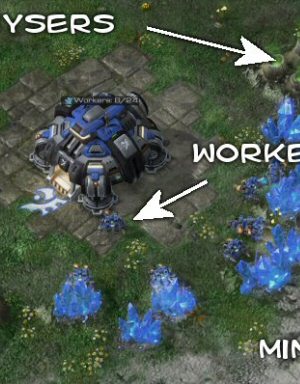
I know it’s old, but I still dig those 1998 Starcraft graphics.  Not just in a nostalgic sense, but even compared to modern titles.  It’s not as sophisticated, but it still looks great.  The technology made it good then, but the art direction keeps it good today. (Still, I do find myself wishing I could zoom out.)
I know it’s old, but I still dig those 1998 Starcraft graphics. Not just in a nostalgic sense, but even compared to modern titles. It’s not as sophisticated, but it still looks great. The technology made it good then, but the art direction keeps it good today. (Still, I do find myself wishing I could zoom out.)
But it’s not like they’ve been sitting around doing nothing all this time. In the past decade Blizzard was bought out, suffered at least one employee exodus, refocused on the (insanely profitable) MMORPG World of Warcraft, began and then aborted the Starcraft spinoff title Starcraft Ghost, and manged to put out a title and an expansion in their other RTS property, Warcraft. They are a company with more opportunities than manpower, and I give them credit for not just hiring an army of losers to crank out sequel after sequel. The ten-year lapse may indicate they were waiting until they were in a position to do it right.

I know I’ll get the game, although the RTS genre has pretty much left me behind since Starcraft ruled the earth. RTS has evolved in much the same way FPS games did over a similar time period: Each new title introduces another layer of depth and complexity intended to please existing fans, while placing the games further and further out of the reach of newcomers. This demo from BlizzCon ’07 is a parade of confounding new elaborations for players to master: Continue reading ⟩⟩ “Starcraft II”


Wavatars: Debugging

By Shamus Posted Monday Mar 24, 2008

Filed under: Projects 11 comments

Okay, about a dozen people have emailed me over the last few months to tell me my code is wrong. Which is true. The line in question is where I make the URL for the gravatar.

I do it thus:

gravatar_id=$md5.jpg&;r=$rating&;s=$size&;d=$url

The important thing being that the fields have an ampersand, followed by a semicolon. The API calls for just an ampersand. So my code is “wrong”, except that it works. If I use “correct” code:

gravatar_id=$md5.jpg&rating=$rating&size=$size&d=$url

It breaks. Wavatars show up, but Gravatars do not. Everyone shows up as a wavatar.

Other people report the opposite: My code breaks, the correct code works as it should. It’s pissing me off, because I don’t have the time or the patience to sort out this nonsense, which (I’m guessing) comes from differing versions of PHP. To really fix the problem, I have to figure out what PHP options or versions are causing the different behavior, check for them, and use the different versions of the URL based on those values. I could sink a lot of hours into a fishing expedition like that, and I just don’t have them right now.

Having said that, if anyone has a guess, please drop a comment.

LATER: Perhaps it’s not related to PHP versions. I found a case where leaving the “ratings” blank would cause my code to work, and filling it in would cause the correct code to work.


Wavatars Broken

By Shamus Posted Monday Mar 24, 2008

Filed under: Projects 7 comments

An update on Wavatars:

Yes, I know recent changes to Gravtar functionality (actually, a complete re-write from Ruby to PHP) has broken my Wavatars plugin. I haven’t found time to fix it yet. This is doubly annoying because WordPress 2.5 is coming out very soon, and it will have built-in support for Gravatars. I have no idea how my plugin will work with a system like that. My worry is that it won’t, or that my plugin will become an ugly hack that runs independent of the integrated system. I might need to make small changes, or I may need to re-write the blasted thing. I dunno.

I don’t really have time to spend on it, and now I’m facing a situation where I might fix the plugin only to have the whole thing become obsolete in a week. Or perhaps require a re-write. I could install the upcoming WordPress 2.5 release candidate and find out, but that would take more time I don’t have.

Anyway, all of this whining is here to you know that:

  1. Yes, I’m aware of the problem.
  2. No, I can’t fix it right now.

Several people have fixed my plugin themselves. Someone actually sent me a .diff this morning, which resolved the problem and also cleaned things up a bit. If I manage to get time I’ll update the plugin, but I can’t make any promises.


My Favorite Podcast

By Shamus Posted Monday Mar 24, 2008

Filed under: Links 44 comments

article_microphone.jpg
Fear the Boot is a Podcast dedicated to tabletop roleplaying games and whatnot. They had me on the show in May of 2007. They hooked me up with Shawn, which led to the creating of Chainmail Bikini. I’m pretty fond of the show and the hosts, and so what follows might, to the untrained eye, appear to be little more than fanboy cheerleading. However, this post is actually a cleverly disguised diatribe on all the things wrong with podcasting in general. There are a lot of podcasts out there, run by earnest, enthusiastic, and sometimes even talented people. Rather than deface their efforts by using them as a negative example, I’m going to list what FtB does right and why it works. What this means for other podcasts and what I think of their work is left as an exercise for the reader.

FtB is generally considered a rousing success by most podcast standards, even though FtB ignores a lot of the conventional wisdom about how you’re supposed to run a podcast. This is not surprising to me at all, because I think the conventional wisdom is flat-out wrong. The rules state that you should keep your podcasts short, because people like to absorb something quickly and move on. Like blog-surfing. Like YouTubing. Like Flickr-browsing. Visitors are supposedly capricious creatures, prone to hit the back button at the slightest provocation and leave your site if there is a lapse in the entertainment. Surfers are nomadic hunter-gatherers, who seek out and subsist on entertaining media. Continue reading ⟩⟩ “My Favorite Podcast”


Campaign Logs

By Shamus Posted Friday Mar 21, 2008

Filed under: Tabletop Games 65 comments

Sometime in the early days of this site I mentioned that I enjoy reading accounts of people’s D&D sessions. Campaign logs. (It seems like we need a better name for these. “web log” got shortened to “blog”, but if you shorten “campaign log” you’ll end up with something like… “clog”, which doesn’t really work for me.) Once in a while someone finds those old posts and sends along an email with a link to their campaign log, hoping I’ll read or link it. I normally don’t mention them because they’re always brand new: It doesn’t make any sense to send readers into a brand spanking new blog with no content. What you want to do is get a few posts under your belt, and then promote it. It’s easier to get links when you’ve got content, and it’s easier to acquire and keep new readers if you have a good story to hook them.

Complete campaign logs like mine are pretty rare. Blogging a campaign is rare. Of those that do, a lot of the games fizzle out, for all the normal reasons games fizzle. Of those that go the distance, often the campaign finishes but the blog doesn’t get updated. (I was guilty of that myself for a while. It took a lot of prodding from my readers to get me to finish the thing, and our campaign wasn’t even that long by most standards.)

I enjoy reading them, but good ones are danged hard to find. Many are semi-private. They’re not hidden or anything, but the author (usually the GM) is setting things down for the benefit of the other players in the group, not strangers like me on the internet. What I look for in a campaign blog is one that will let me enjoy the session vicariously.

Everyone reads and writes these things for their own reason. Here was how I approached my own campaign blog, and what I look for in others:

  1. Let the reader sit in on your session. You need to draw them not just into your gameworld, but into your group. Let them know who is playing. (Use pseudonyms to protect your player’s privacy if you need to.) How old are the players? How long have you been playing together? Letting the reader know the age and gender of the players lets us put their roleplaying into context. Someone playing a character of a different gender and age is a lot more interesting than someone that just seems to be playing themselves, but as an elf.
  2. Be careful with the flavor text. Some campaign blogs try to turn their story into a novel. This can make for interesting reading, but it’s risky. It takes a long time to write that way, which increases the odds you won’t be able to keep up with the thing. You don’t talk that way to the players, which means you’re not so much blogging the campaign as writing a book in parallel. Odds are you’re not a professional writer, but people reading your work are going to compare you to one if you go for that style of writing. This is not always a bad thing, and honing your writing skills is always good for a storyteller, but you need to be aware that if you go for novel-style writing you’ll most likely end up doing a lot more more work for fewer readers. I give Jennifer Snow a nod for doing this and doing it well, but her site is an exception.
  3. Let the reader in on the campaign setting. Post maps if you have them. Give the reader a little background. I hit a lot of campaign blogs that feel like I just started reading a book in the middle. You don’t need to define every little hamlet and NPC in the game, but a general overview of the major locations, leaders, and problems is really important for people trying to make sense of your story.
  4. Break huge posts down into smaller posts. It makes it easier for people to read the thing if you put it up in bite-sized chunks. Some people just want to read their blogroll over morning coffee, and don’t have time for your five thousand word beast on Monday morning. It’s also a little more rewarding for you as the writer. Once you get done typing it all up, you’ll have five posts instead of just one. Finally, this makes it easier for readers to link to and comment on the bits the interest them.
  5. Normal blogging rules also apply: Regular updates. An “about” page or something for newcomers to get up to speed. Some author info. Make sure you have good navigation so visitors can easily read the whole thing in sequence.

I’m looking for some fun campaign logs to read. Don’t worry if they don’t follow my list above, that’s more a personal ideal than a list of rules. If you have or know of a good campaign log, please drop a link in the comments.