Ubuntu: Faster, Stronger, Better

By Shamus Posted Tuesday Apr 15, 2008

Filed under: Personal 58 comments

ubuntu.jpg
Linux has come a long way.

In 2003 my wife switched to Linux for a year. She’d been using Windows 98 and was reinstalling the OS about once every four months to recover from some cataclysmic internal failure on the part of the Windows. This was just how things went for her – about the time she had everything working again, the system would implode and she’d have to start all over.

When it came time to upgrade her computer, she balked at the idea of giving her tormentors in Redmond more money. It felt like leasing a jail cell. We got a no-OS computer and she put Linux (Red Hat) on it.

The beginning was rough. I would usually find her toiling over some long list of terminal commands and altering – waddya call ’em – RPM files or somesuch? I dunno. They were these files you used to install programs, but which always needed a little tweaking first. She installed stuff. Compiled stuff. Read stuff. She spent a lot of time on it. She was getting faster as she learned, but it was clear that there was a certain terminal-window overhead to a lot of mundane activities. If you make a mistake in Windows you can crash a program or get a stupid dialog. If you make a mistake in a Linux terminal window you can create problems that will take you an hour to unravel and solve.

It was frustrating because it was clear that a lot of this stuff could be better automated. It could be easier to use. A lot of the stuff she was doing wasn’t stuff that required a human brain to do. It just involved making many adjustments to config files and the like. The stuff she was doing was annoying, time consuming, and required a high degree of knowledge even to perform basic tasks. It felt like she was trying to earn her pilot’s license in the hopes that she could someday build paper airplanes.

She sought help in various message boards, which were inhabited by the classic Linux fanboys: Guys who scorn the unwashed who attempt to join their ranks, and yet moan about the Microsoft monopoly and can’t understand why more people don’t switch. When she wasn’t ignored she was told to RTFM. On the rare occasions where documentation was actually available, it was either written for people who had never seen a keyboard before, or for Richard Stallman. Imagine you are learning English. You have two books. The first is Dick and Jane and the Big Ball. The second is Supra-segmental features and characteristics of intonation within the Indo-European family of languages. Inasmuch as it existed at all, Linux “help” was a wading pool where a sign saying “sink-or-swim” had been posted in lieu of a lifeguard. A wading pool which quickly and without warning would drop off into the crushing depths, leading you down to where eyeless creatures devour one another in the lightless abyss.

It was a lot of work, and she began to realize that she’d just replaced the time lost reinstalling Windows with screwing around in terminal windows in Linux and looking things up. Her computer wasn’t ultimately any less of a hassle to use than before, it was just uglier and it didn’t run any games. She switched back. We bought a copy of XP and concluded that Linux wasn’t quite ready for regular people just yet.

A couple of months ago she tried again. Continue reading ⟩⟩ “Ubuntu: Faster, Stronger, Better”


JC Denton: Not Just a Tough Guy

By Shamus Posted Monday Apr 14, 2008

Filed under: Game Reviews 35 comments

comic_deus_ex.jpg
I regret including JC Denton in the list of wooden heroes in my post on The Tough Guy. Several people chimed in with defense for the character, and they are right: Whatever his faults, Agent Denton doesn’t really deserve to be lumped in with the likes of Hawaiian Shirt Guy and Masterchief. While his “secret agent” persona always held him at arm’s length for me, he was not a terrible character. Jonas Wà¦ver at Narcissism Incorporated sums up my feelings towards JC perfectly. He was a fine character, he just didn’t fit me when I tried him on.

Part of the problem was his outfit. I’d be playing the game, immersed, “in the zone”, or whatever you call it when you’re playing a videogame so hard you forget you’re doing it. Then a conversation would start, causing the view to switch to third person and show me my character. The effect was a sudden rift between myself and my in-game persona. Oh right. I’m that guy.

I felt ridiculous having these philosophical and political conversations while dressed as a Morpheus cosplayer. It always felt like the NPC’s were just humoring me, and the room was going to erupt into derisive laughter the moment my character stepped out the door. The outfit also put a terrible strain on versimilitude; it’s hard to imagine how I was able to sneak up on people and move unseen while wearing that enormous floppy coat. It would be like trying to creep up behind someone while dragging a tarp.

This is not to say Deus Ex was not a tremendous game. It’s a playground of incredible potential, and I returned to it many times before I at last felt I had exhausted its dialogs and and explored the breadth and depth of its countless locales. It had much in common with my beloved Thief and the revered System Shock. Lots of freedom in how to approach obstacles. Interesting choices. RPG character development. Large, branching plot. Hours of fulfilling of gameplay just to get to one of the endings. (I’d gladly trade in one of today’s eight-hour graphics demos for another 30-hour gem like Dues Ex.)

I would have preferred it if Denton was a bit more approachable to the average Joe, and his costume was unintentionally funny, but he wasn’t a cardboard cutout. He was a serviceable character riding atop a stellar game.

LATER: More here. (Don’t miss the Monty Python reference at the end. Heh.)


Roundtable:
The Tough Guy

By Shamus Posted Friday Apr 11, 2008

Filed under: Game Design 41 comments

This is part of the April ’08 roundtable discussion over at Man Bytes Blog. This month we’re talking about established themes in videogames. The ones we love or hate. As is my custom, I have chosen the latter.

Meet Slate Rockman, Ex-Navy SEAL. He’s haunted by demons in his past based on what happened to him in [insert name of timeperiod war here] but not in in such a way that it interferes with his ability to engage in additional violence right now. He’s amazingly good-looking but single because [he doesn’t have time for a woman in his life / his girlfriend was killed] and he shows only enough interest in females in order to make it clear that he’s a loner, but not like, gay or anything. He’s built like Hercules on ‘roids, even though he spends all of his time sitting around [in his cabin / on his boat] drowning his regrets in beer and brooding in a manly way. Despite his time in the military, he doesn’t seem to have any buddies and he’s inept at working with others. His prowess with a firearm is only surpassed by his flippant attitude towards danger. He’s a tough guy.

This is the standard-issue tough guy, although they come in many assorted flavors. What they have in common is that their characters are about as deep as the anti-glare finish on your monitor. I’ve met this guy, a dozen times. He didn’t impress me the first time around, and he’s done nothing but grate since then. If game developers could arrange it so that I never have to embody this dull, soulless shell of a character ever again, they would earn my profound and enduring gratitude.

Garret, from Thief.  Not a tough guy.  He is outmatched by town guards, and must rely on stealth to survive.  His skills are an emergent aspect of his character, not the whole.
Garret, from Thief. Not a tough guy. He is outmatched by town guards, and must rely on stealth to survive. His skills are an emergent aspect of his character, not the whole.
Videogames are often compared to movies for various reasons, although in the end they are different mediums with different requirements and limitations. I love watching movies where the main character is a tough guy, and I am bored to the point of anguish when they are the main character in a videogame. In a movie, we might experience adventure vicariously through the main character, but in a videogame we embody him, and he’s just not a fun guy to be. If I’m going to be playing an empty shell of a character, I’d just as soon have him keep his yap shut, like Matthew Cain from Quake 4, or Gordon Freeman from Half-Life. I’ll fill in the blanks myself.

And people do exactly this. Continue reading ⟩⟩ “Roundtable:
The Tough Guy”


User-made AI

By Shamus Posted Thursday Apr 10, 2008

Filed under: Game Design 55 comments

In yesterday’s post on Startcraft AI, SolkaTruesilver mentioned here that it would be nice to have a way to make custom AIs for the game and pit them against each other.

This is something I’ve been pondering as well. It’s probably too much to hope that Blizzard will release the Starcraft source someday. That might be a terrible idea anyway, given the fact that the community is still going strong, not to mention the professional-level competition gameplay. Having the source would make certain kinds of cheating possible. You couldn’t get free money or anything like that, but you could make it so that the interface shows you information which should be hidden from you. You’d be able to see (but not attack) fully cloaked units, start with the map explored, see what resources your foe has, and other information along those lines. Basically you couldn’t make a hacked client to let you do anything you couldn’t normally do, but you can make one that would let you know what you shouldn’t.

So, Blizzard releasing the Starcraft source probably isn’t going to happen for us.

Still, the idea of competitive AI programming is really compelling, and moreso if we’re talking about doing it with a game where humans can join in. Sure, you could write your own platform designed to let programs fight it out in some arbitrary manner (and there have been many systems like this in the past) but the whole thing doesn’t really get interesting until it has to face a human being. I think an interesting idea would be for a game designer to devise their own scripting language (probably some C++ flavored thing, but whatever) that allowed anyone to write AI modules and share them with others. Non-programmers could download new AI packs if they want a new challenge. Introduce some sort of global rankings system and we can see which AI packs fare best against the userbase and which ones people enjoy playing against. It would keep the game fresh and new, even for people who stick to the single-player experience. Actually, it would turn vanilla Human vs. AI play into a sort of proxy Human vs. Human. It would be some sort of new form of multiplayer, going against someone else’s AI.

And now, let me construct my fantasy system and how I think it should work: Continue reading ⟩⟩ “User-made AI”


Starcraft: Bot Fight

By Shamus Posted Wednesday Apr 9, 2008

Filed under: Game Reviews 141 comments

I’m not sure who will find this interesting. This is an AI analysis of a ten year old videogame. This entire endeavor will sound absurd to people familiar with the game in question, and hopelessly esoteric to those that aren’t. Still, I’m putting this up in case there is someone else out there who is just as peculiar as I am, in that I find this sort of thing intensely compelling.

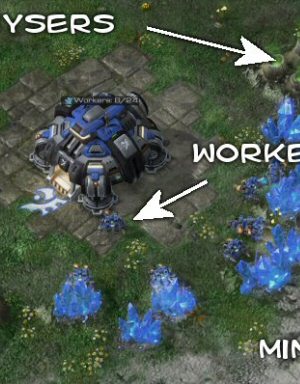
About a month ago I wrote a Starcraft scenario which allowed you to observe a game between AI players. I’ve been curious about the quirks in the Starcraft AI and I’ve wanted a chance to see them do their thing in a deterministic environment. I learned some surprising things about this ten-year-old gem. While the races themselves are very nearly balanced in the hands of humans, it turns out the AI is a lot better at using some races compared to others.

This is a very pixelated map of The Hunters.  The map has eight starting locations, marked by the colored squares.  Players are randomly placed on the map, with one random spot left empty.
This is a very pixelated map of The Hunters. The map has eight starting locations, marked by the colored squares. Players are randomly placed on the map, with one random spot left empty.
The setup is this: Seven AI players. Randomized start locations. Using the Broodwar expansion. The last “player” is the human observer, who controls no units but who can see the entire map. The script in question runs on the map “The Hunters”, although it could easily be exported to other maps. There are two Protoss players, two Zerg players, and three Terran Players. The computer players are all set to “insane” level difficulty, informed that all other players are their enemy, and told to go at it. Mayhem ensues.

I’d usually let the game run overnight and check on the results in the morning. (Yes! This was my solution for being too busy to play computer games, I programmed a game to play itself for me!) A game normally takes a couple of hours, although rarely one will end in an hour, and several became endless stalemates.

At first I just set the difficulty to “normal”, but I found that the computer players were far too likely to consume all the resources on the map, go broke, and then just sit there. I’d start a game before going to bed, and when I came back in the morning I’d find the battle was down to three sides who couldn’t make any fighting units. I changed the difficulty to “Insane”, which auto-cheats by giving itself 2,000 minerals and gas anytime it goes broke, meaning the thing is always rolling in resources. This made sure that most battles came to a proper conclusion. Although this made battles larger, more spectacular, and a little more chaotic, it didn’t seem to affect who won. I ran many overnight battles with both AI setups, and while higher difficulty made for inflated scores, over many games the results painted a clear picture. Continue reading ⟩⟩ “Starcraft: Bot Fight”


Testing New Theme: Lawful Good

By Shamus Posted Tuesday Apr 8, 2008

Filed under: Projects 88 comments

A few weeks ago I was working at tweaking the existing theme for the site and making a few improvements. It turned into an unintentional overhaul, and then I got sidetracked and didn’t get time to complete it. I thought I’d make it available now and get some feedback and see if anyone spots any problems. It works in IE7, Firefox, and Safari. I haven’t tested it in IE6, but I’m sure it will look like a train wreck. The theme relies heavily on masked PNGs, and IE6 doesn’t go in for that sort of business.

To see the theme, just go to the front page and use the dropdown box on the right, select “Lawful Good”.

The goals I had for this theme:

  1. I liked the “glossy surface” thing going in the current theme, and I wanted to expand on that.
  2. The old sidebar is hopelessly over-cluttered, and I wanted to trim it down. The archives have grown and now take up a lot of screen real estate, so I’ve moved them and other lesser used items to the bottom of the page. The new sidebar is a lot lighter and hopefully more useful. (Search is now at the top.)
  3. I wanted to back off from the pure white background. The major problem with the old theme was that it was just too dang bright for some people. At the time I couldn’t just dim the background by a couple of shades, because all of the logos and dice images would have ugly white boxes around them. I’ve fixed this so the the images are now very tolerant of background color changes – pretty much any light color will work.
  4. I wanted to clean up the sprawling, hackish code of the old theme. Not that it matters to visitors, but this theme uses a lot less code to get the job done.
  5. I wanted to replace the current black / white themes with Chaotic Evil / Lawful Good, which would make for a nice meta-theme.
  6. I wanted more dice. I’m still working on this. I really like the handful of dice at the bottom of the page, though.

Yes, I know glossy silver doesn’t exactly match the purported content of this site. A proper RPG site theme would probably be cartography / papyrus / middle ages, and a proper videogame theme would probably just have iconic characters splashed around. But there are already a lot of sites along those lines. And besides – this really does it for me, visually. I guess I’d rather the site theme look sexy than make sense.

It’s not perfect, but it’s an interesting work in progress. If anyone wants to put up a shot of how it looks in IE6 I’d like to see it. Please let me know about any problems / errors you find. Or just let me know what you think of it.

EDIT: One further note is that the new theme assumes a desktop width of at least 1024. Up until now I’ve stuck with 800, but I noticed that people running in 800×600 has vanished to almost nothing over the last couple of years. Less than 1% right now according to my web stats.

ALSO: To get back to the old theme, return to the front page, look in the left sidebar. It’s right under “search”. It’s a list instead of a dropdown list.

The Next Day: I’ve made some minor changes to get rid of the h-scrolling everyone is getting. I haven’t really addressed the major gripes with the theme, but this quick fix should make it a little more useful. A fuller overhaul will have to wait until I have more time.