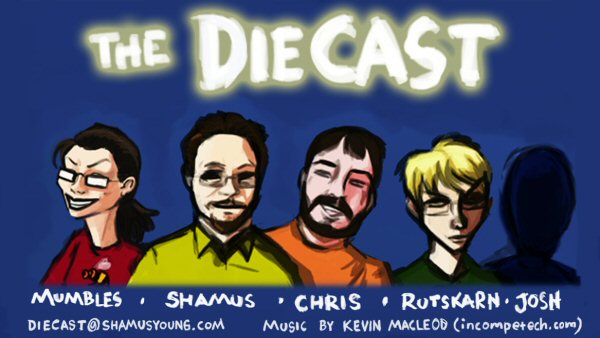
Diecast #18: Xbox One, The Witcher, Unrest

By Shamus Posted Tuesday Jun 25, 2013

Filed under: Diecast 145 comments

Mystery guest this week. Even if you’re not usually a Diecast listener, you might want to give the first couple of minutes a try. Just saying.

Download MP3 File
Download Ogg Vorbis File

3:15 Chris is still working off his indentured servitude to Thomas Nook, certified jackass of Animal Crossing.

8:50 Rutskarn explains the depth and verisimilitude of the Tropico political simulation.

12:00 Josh tells us some Crusader Kings II stories. And also X-Files.

19:45 Shamus has been playing Papo & Yo and watching the Red Bull Training Grounds Starcraft II tournament.

23:30 Xbox One policy reversal.

46:05 Rutskarn regales us with his horror stories of the Witcher’s tutorial and the tragedy of his faithful companion, Jackass McSpuds

54:20 Kickstarter, Unrest, Horrible Pick-up Lines, and Snake People!

1:11:55 Mailbag


The Twelve-Year Mistake Part 7: The Unicorn

By Shamus Posted Monday Jun 24, 2013

Filed under: Personal 169 comments

It’s 2012. Early in the year we go to PAX and I get to meet my friend Josh face-to-face for the first time. We do the PAX thing and generally have a lot of fun. It’s nice to get away from the house for a few days and stop worrying about the mortgage and instead worry about the expenses and logistics of travel.

I’m always conflicted about travel. I love visiting new places but I really hate the act of travel. This is like enjoying food but hating eating. You really can’t have one without the other. I develop some really strange OCD behaviors when I travel. Where are my keys? Do I have my wallet? What happens if the car breaks down? Where are my keys? What if the GPS stops working? Do I have my wallet? Do I have my medicine? What if I get sick? What if my asthma gets bad? What if I get one of my headaches? What if I make a fool of myself at one of my public appearances? Do I have my wallet? What if I’m allergic to the hotel room because everyone on this wretched planet owns a friggin’ pet? Do I have my medicine?

Part of the problem is that I’m incredibly absent-minded, and the only way I can mitigate this is by keeping rituals. I think nothing of going for three weeks eating the same meal three times a day, drinking the same tea, playing the same games, making the same jokes. The rhythm keeps me on track and lets me manage complexity. But travel shatters all rituals and I start to freak out.

Day two of PAX East 2012. I’m sore, tired, and waiting for the tea to kick in before we set off for the convention center.

My book is out now, and it’s a fine success by the standards of first-time authors. It brings in a nice chunk of money. When sales finally drop off, I’ll gross about a third of my old salary at Activeworlds. It took me a year to write it, but I didn’t work on it full time. In fact, I spent a lot less than one third of my work hours on it.

Continue reading ⟩⟩ “The Twelve-Year Mistake Part 7: The Unicorn”


Bioshock EP7: Hold W to Win!

By Shamus Posted Sunday Jun 23, 2013

Filed under: Spoiler Warning 40 comments

Wherein Atlas continues to guide us through the zany madcap world of “BoyoShock”.


Link (YouTube)

I think it’s really interesting how Bioshock and Bioshock Infinite both have the same trouble with the hint system, which is that you’ll be 80% of the way through the game and you’re stilling getting messages explaining how to switch weapons or reload. Sometimes the game would even explain how to do something just after you finished doing it.

On one hand, I’m in favor of games that are accessible. It’s bad when games assume that you’re a master of all mechanics once you leave the tutorial area. It’s also bad when games simply take concepts for granted. For game designers, its important to remember that for some small percentage of players out there your AAA shooter will be their first AAA shooter. Crouching, jumping, and using cover are obvious to most players but can be completely mysterious to a newbie. If game designers take too much for granted then they run the risk of making their games too insular. Even if the player knows about all of the mechanics, they might forget which buttons do which things if they step away from the game for a while.

On the other hand, randomly throwing up tutorial messages at all players at random intervals and telling players how to do things they’ve long mastered is an ugly, brute-force solution to the problem. It breaks immersion, clutters the screen, and distracts the player.

It’s really strange that this design decision persisted throughout the entire Bioshock series. (I’m assuming it was in Bioshock 2 as well.)


Bioshock EP6: The Hazardous Vector

By Shamus Posted Friday Jun 21, 2013

Filed under: Spoiler Warning 65 comments


Link (YouTube)

We make fun of the game here for having a situation where somebody dies just as you’re about to meet them face-to-face. I don’t know if there’s a trope for this; it would need to be specific to videogames. Of course, this is done because having two characters meet creates immense and ever-expanding design problems.

  1. If we don’t have anyone else alive in the world, then the game feels “empty”.
  2. If we have other people alive but kill them off (or trap them away from the player’s reach) then it feels contrived.
  3. If we let the player meet them then the player will expect them to have something to say.
  4. If we let them speak, then players will inevitably demand that their character be able to reply. (See the comments of my defense of silent protagonists.)
  5. If the protagonist speaks, players will inevitably find some kind of disconnect between how they view the game world and how their character views it. They will want the option to say different things.
  6. If we give them different things to say, then players will get irritated when they discover the choices don’t “do anything”. If they’re making choices, they want those choices to have consequences.
  7. If we give them short-term or isolated consequences (save the life of this nameless NPC you’ll never see again) then players will complain that the choices offered in the game are empty.
  8. If we give them meaningful, long-term choices then we run into multiplicative outcomes. If choices impact each other and branch off in meaningful ways, then we end up with rapidly escalating design costs. If all choices are binary, then the number of outcomes we have to write, script, animate, code, and test is 2n where n is the number of choices in the game. And players will complain because all outcomes are binary and don’t allow for shades of grey. (How come I can only murder this villain or let him go without harm? Why can’t I break his legs or something to make sure he doesn’t cause any more trouble?)
  9. And if you want offer the player multiple long-term choices with divergent outcomes and shades-of-grey decisions, then you are probably crazy. And players will still complain because it’s impossible to get all those systems working just right. Mass Effect and Alpha Protocol come to mind.

This isn’t because players are unreasonable and entitled. Well, it is, but when a player asks for the first item on this list it’s not because they plan to drag you all the way to the end. They’re not really demanding an RPG. It’s just that we get frustrated when the systems of a videogame break down, and interpersonal stuff is something videogames are really bad at.

It’s not like there are players who complain at every point in the list, either. (Well, aside from me. If anyone else wants to own up to it that’s your business.) Every player has their own little sticking point on the list. One person says “If my character is going to talk, I should be able to control what they say.” Another player will say, “I don’t mind not having dialog choices, but if the game does make me pick what to say then those choices need to matter.”

You can end up spending a ton of money without improving a game at all – you’ll just move the point of failure a couple of bullet points down the list.


Starcraft 2: Story Time

By Shamus Posted Thursday Jun 20, 2013

Filed under: Game Reviews 181 comments

It has been suggested by some that the campaign story in Starcraft 2 is hammy, obvious, and slathered in thick, cheesy melodrama. I can’t really argue with this, but I don’t think Blizzard’s storytelling has gotten any worse. I think the problem is that their production values got way better.

It’s sort of intuitively understood that the events we see during gameplay are abstracted and stylized a great deal and that we shouldn’t take them literally. I mean, if we did we’d have to conclude that a barracks was about the size of your average living room, tanks are minivan-sized, and the dreaded Protoss Carrier is barely larger than a schoolbus. We don’t want our small units to be teeny tiny things that are impossible to click on and we don’t want our large units to cover the entire screen so we can’t see under them. Averaging out the sizes solves both problems. We also have the sides wearing vibrant colors and nobody can see more than twenty meters in front of their face.

Try to picture that marine climbing into the cockpit of that plane.

There are really good gameplay reasons for this, and nobody minds these abstractions because the game would look ridiculous if we tried to depict it in a photorealistic way.

Keep in mind that while the original game had animated cutscenes, they were not used to tell the story. Often the events depicted were completely unrelated to the stuff you were doing. Once in a long while a main character might make an appearance, but generally these little vignettes were just there to set a mood and show what the world “really” looked like outside of the abstracted depictions that we were given during gameplay. They were a fun reward for completing the recent block of long, grindy missions.

starcraft_briefing.jpg

The bulk of the story was told in mission briefings. Every mission briefing was basically a Google Hangout with the principal characters, but with lower video quality. (The future of the past always looks kind of strange.) They would talk, argue, emote, and threaten, all while the same few seconds non-lip-synced head animation looped.

Sometimes it was even told in blocks of text.

starcraft_intro.jpg

Like the abstracted visuals of the gameplay, the story itself is told in broad, exaggerated strokes. Since the story happens with talking heads, it would be very, very easy for this to become tedious. The writers keep it lively by filling the story with vibrant, over-the-top characters. You’ve got flawed heroes, noble idealists, scheming opportunists and devious backstabbers. The performers lay it on thick and try to sell the drama with just their voice.

And then we get to Starcraft 2…

Continue reading ⟩⟩ “Starcraft 2: Story Time”


Diecast #17: The Citizen Kane of Podcasts

By Shamus Posted Wednesday Jun 19, 2013

Filed under: Diecast 134 comments

I won’t tell you not to listen to the podcast because I know you’re going to do it anyway, so I guess I’m stuck preemptively apologizing for this chaos. I really thought they were ready for this. I don’t know what happened.

Download MP3 File
Download Ogg Vorbis File

01:00 Shamus isn’t here this week.

True story: I was asleep. Since I don’t have obligations at specific times, I generally live on a 25 hour day. I’m currently on my favorite schedule, which is to go to sleep in the evening and get up in the wee hours of the morning. HOWEVER, this schedule is 100% incompatible with The Diecast and Spoiler Warning, which is recorded at night. By next week I expect my schedule to have rolled forward to the point where I can participate again.

08:45 What’s everyone playing, and what’s your favorite E3 news?

Chris made this video and played Animal Crossing.

Rutskarn graduated.

Rutskarn’s dad is playing Infamous 2.

Josh is wanting to play Borderlands 2 but I’m never around due to overlapping Minecraft and Starcraft addictions.

25:00 (ish) The “Citizen Kane of Videogames”. Found here.

54:30 (ish) Mailbag!


Bioshock EP5: The Flame War Plasmid!

By Shamus Posted Tuesday Jun 18, 2013

Filed under: Spoiler Warning 115 comments

As part of my ongoing effort to repeat mistakes of the past, here is the Spoiler Warning where we we talked about both Objectivism and religion.


Link (YouTube)

About four years ago we had a thread where an Objectivist weighed in on Objectivism in BioShock. It made for an interesting thread and was surprisingly civil, given the subject matter. At some point (and I can’t find it now) I said that it’s not at all clear what property anyone owns in Rapture. If Ryan owns everything, then he didn’t build an Objectivist society, he built an Objectivist house and invited a bunch of assholes to live with him.

I mean: Ryan is a totalitarian thug. If they really wanted to explore with the ideas of Objectivism then they ought to have messed around with the classic conflict between individual liberty and the common good. It’s like if I wanted to make a game about (say) environmentalists, so I fill the gameworld with standard mooks who talk about trees a lot. And then their leader loves pollution because ENVIRONMENTULISM!

The further I get from this game, the more childish and sophomoric its handling of Objectivism seems. There doesn’t seem to be anything of the philosophy in the characters, in their discussions, or in how they relate to one another. The game comes off like a college senior who just got done reading Atlas Shrugged and is looking for a way to work bits of it into conversation.

Related: thecitizenkaneofvideogames.tumblr.com

ON THE OTHER HAND…

I have to give the game credit for at least having the ideas on the canvas. I suppose I’d rather a game fumble philosophical themes than have another macho melodrama. And getting the gameplay and the themes lined up is something few games attempt and fewer still pull off. BioShock fell down, but at least it fell down trying.