In my post on Starcraft yesterday several people reacted as though I suggested that RTS games had all gotten too complex in absolute terms, or that they should not evolve. In my last paragraph I was pretty clear: Evolution is not bad. Complexity is not bad. It’s just that, after a certain point, it’s not for me. Everyone has a limit for how many variables they want to juggle. Certainly a game with twelve resources, two hundred units, and twenty races would have a learning curve like a sheer vertical wall, the top of which is obscured in clouds. Certainly a game with one resource, one race, and one unit would be mind numbing for just about everyone. In this continuum between the inscrutable and the inane is a sweet spot, the location of which is different for individual players.
 |
| The Zerg, intergalactic cockroaches, shortly before I begin yet another effort to drive the little buggers into total extinction. |
McNutcase insightfully
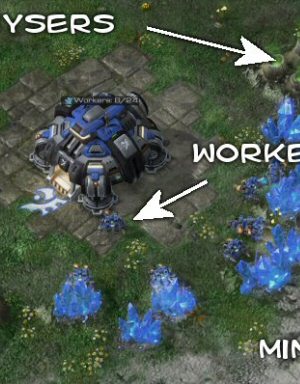
observed that Starcraft isn’t so much a “strategy” game as a “logistics” game. It’s true. A great number of mouse clicks are expended managing supply, moving units around, acquiring new resources, and planning your base to facilitate movement of troops
out while (hopefully) impeding the movement of enemy troops in the opposite direction. This is the aspect of the game from which I derive nearly all of my enjoyment. For me, the actual combat is secondary. The game appeals to me inasmuch as it allows me to design a well-oiled
machine that will begin by devouring vast quantities of resources and end by delivering large groups murderous vandals to the doorstep of my enemy. My goal is to design and optimize this machine as challenges present themselves. I’ve often thought that the process would be so much more fun if someone else could take the units and oversee their actions once they enter the field. I could be perfectly content managing supply lines, delivering troops, and erecting systems to bestow a gruesome demise on anyone that tries to enter the base while wearing the wrong color uniform. My ideal base is one where, once built, there is nothing left for me to do but watch the troops march out on their way to bloodshed and glory.
But there are other, more visceral reasons to play these games, and I wouldn’t dream of demanding someone else make due with a less robust experience just so that I can attempt to reduce the game to a shockingly destructive variant of Sim City. I don’t blame players who want more units, more weapons, and more powers. The first time your marines gun down a rushing line of filthy Zerglings, spilling their glistening, acrid innards onto the soil of a distant world, the satisfaction is real and palpable. But somewhere around your five thousandth dead Zergling you’re going to start to wish you had a more interesting way to bring about their deaths. If merciless conquest and destruction is your goal, then unit variety is the spice of death.
The part of the game I find most tedious is managing combat. I admit that this is an inversion of the intended experience – you’re supposed to endure the management aspects of the game so that you can more fully enjoy the violence that follows, the former being the price of admission of the latter. The idea that someone would thrive on supply duty and grow weary with combat is strange enough that I doubt it gets a lot of consideration when designing the game.
Still, I do hate directing my units, mostly because they are so astoundingly stupid. I don’t know what they have planned for SCII, but if I were to ask for special unit abilities to add to Starcraft, they would be something like this: Continue reading ⟩⟩ “Starcraft Evolution”
 Shamus Young is a programmer, an author, and nearly a composer. He works on this site full time. If you'd like to support him, you can do so via Patreon or PayPal.
 T w e n t y S i d e d