 T w e n t y S i d e d


Like I said last time, Prey ends with us either “saving” Talos-1 or nuking the station, and then we get a post-credits scene where we learn the entire game was a simulation. We’re actually a ball of Typhon cells that have been implanted with the memories of Morgan Yu, and allowed to experience a simulation of her struggles aboard the station.
This reveal creates an extra layer of possible confusion, because we now have an overabundance of characters named “Morgan”.
- The original person that worked on Talos-1 and studied the Typhon.
- The person who originally fought the Typhon in the real world. We don’t know what happened to her, although I guess we have to assume she died somehow.
- The virtual person recreated from the memories of #2. This is the version of the character that was controlled by the player.
- The ball of Typhon cells that’s been tricked into thinking it’s Morgan Yu. Arguably this is the same as #3, but this reveal means that we might want to make a distinction between the two.
In this series, I’ve been referring to #1 as “Old Morgan”. To help us keep track of these different versions, I’m going to give the name “Morphon” to #4, the Morgan-Typhon hybrid.
If you’re still confused, I’m sorry. This is as clear as I can make it. The writer is really throwing us a curveball here. Again, I think that a reveal this big needs to appear BEFORE the credits, and we need to be given a little space to process it. This post-credits replacement of the plot is trying to fit too big an idea into too small a space.
The Judges

Alex is the only apparent human around. With him are four operator robots representing your fanboy Igwe, anti-fan Danielle Sho, ex-girlfriend Mikhaila, and security Chief Elazar. After Alex explains the premise of this sudden post-credits reveal, the robots each take a turn commenting on how you behaved in the game.
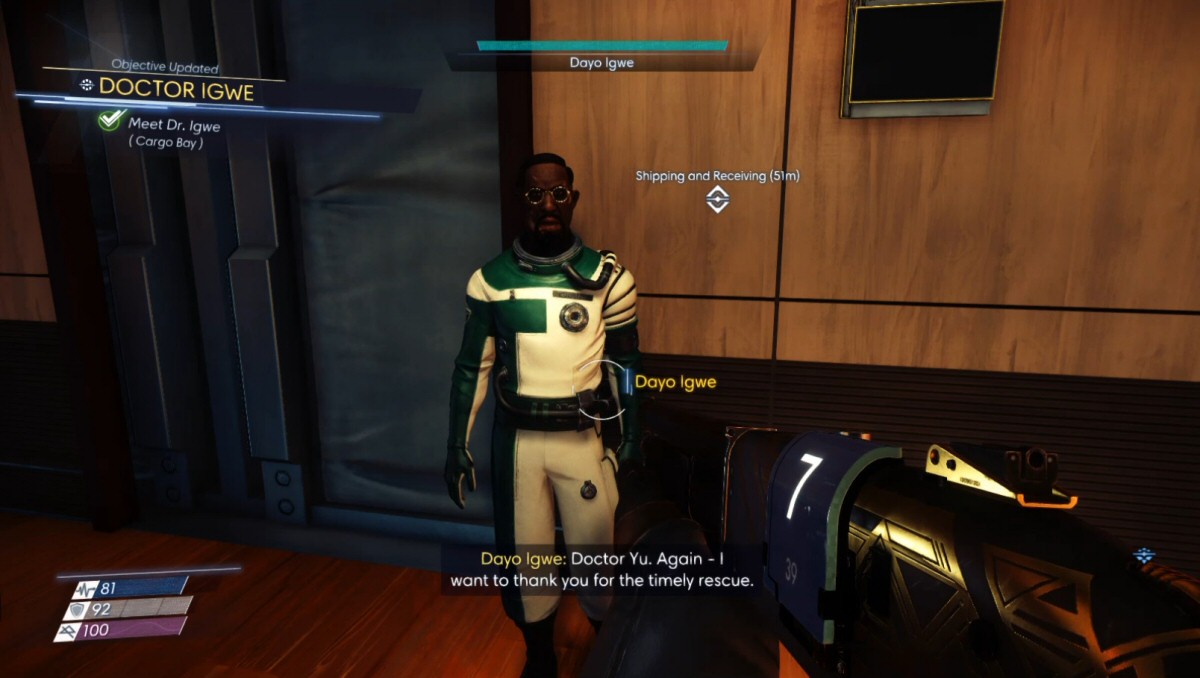
Dayo Igwe looks at how empathetic you were. Did the mirror neurons take? Did you show any sort of empathy for the people you met?
More than you, Igwe. In the simulation, your interactions with Mikhaila and your casual dismissal of what happened to her father make me think that your dumb ass should be strapped in this chair, getting a booster shot of mirror neurons. You dick.

Mikhaila Ilyushin just looks at how you treated her within the simulation. She seems to assume that if you saved her life, you’re a really good person, or you were really into her.
Not really, lady. It’s just that qualified reactor technicians were in kinda short supply at that point and I thought those skills might be important. Get over yourself. I can’t even remember if we banged.

Sarah Elazar wants to see you kill a ton of Typhon in the simulation. She assumes that if you killed a lot of them, then you must be a good egg. I don’t know how she reacts if you don’t. For me, Typhon were full of exotic material, which was the key to more neuromods. I’ve watched a lot of ending compilations on YouTube, and I’ve never seen one where she expresses disappointment that you didn’t kill enough Typhon.
I appreciate the vote of confidence chief, but I killed the Typhon because they made me stronger, not because I’m driven by some fanatical anti-Typhon hatred.

And finally, Alex asks Danielle Sho what she thinks. For some reason. Danielle Sho’s bot is most concerned with how you treated Volunteer 37, the fake cook we met back in part 9. Did you avenge the deaths of the people he murdered by killing him? If so, she assumes you did so out of a sense of justice.
Not really, Danielle. I killed him more for revenge than justice. But I suppose revenge would still qualify me as human. I’m willing to bet the Typhon can’t develop hatred and grudges for the same reason they can’t develop empathy and compassion. So I guess you came to the right conclusion, even if you got there with faulty reasoning.
Whatever. At least I didn’t sit outside and hold my breath pouting. You goof. There’s no reason you couldn’t have gone in and dispensed a little space-justice yourself.
When the robots have passed judgement, Alex shrugs and – even if the robots all think you acted like a lousy human being – shakes your hand. At this point you have one final choice to embrace him as a fellow human, or to kill them all.
Choice and Consequences

On one hand, I love the idea of the game spending the last couple of minutes commenting on / reacting to your behavior. This gives us the sensation that “choices matter” that players always seem to crave, but without creating the endless fractal branching that makes development impossible.
This is similar to how the original Fallout worked, where the game explained how your actions impacted the communities you visited, but without the developers needing to manually depict all of those possible outcomes. It’s a lot easier to write an alternate paragraph than to build an alternate version of the world. In theory, this is a great way to respond to player behavior without breaking the budget.
My problem is that these judges don’t actually have the information required to make their judgements. In Fallout, the game wasn’t attempting to pass judgement on you in a moral sense. It didn’t need to care why you did anything, because it was simply reacting to the concrete things you did. You killed the sheriff of this town. It doesn’t matter if you killed him for sport, or because you thought he was a bad leader, or if you did it for resources because your only real loyalty was to the people in your home vault, or if you killed him in a friendly-fire accident by trusting that maniac Ian with an SMG. Your reasoning doesn’t matter, because the game is just telling you what happened to the world once the guy was dead.
But this is not the case in Prey. This entire ordeal was an experiment on the part of Alex and these robots. Up until the closing credits, the stakes of the story have been about saving lives. The stakes began with the personal, and our concerns gradually expanded as the story progressed…
- Can Morgan survive?
- Can Morgan save others?
- Can Morgan save the station?
- Can Morgan save Earth?
Now here at the end, all of those questions have been casually swept aside and replaced with:
- Can Alex tame a Typhon by teaching it empathy?

But to answer that question, the robots need to know why the player did the things they did. The problem is that this entire experiment is muddled to the point of being completely useless. It doesn’t just fail to reveal Morgan’s priorities, the scenario actively obfuscates what would otherwise be a straightforward choice between selfishness and empathy. The asymmetrical dual jeopardy of Talos-1 and the Earth means that every decision in the game turns into a trolley problem with poorly-defined stakes.Do nothing, and the trolley will run over 30 or so people. Or switch the trolley to the other track, and there’s a chance with UNKNOWABLE ODDS that it will run over the entire human race. I don’t think you can use this decision to gauge someone’s capacity for empathy, Alex.
In the end, did I blow everyone up because I hated them, or did I regretfully kill people I cared about because the entire Earth was at risk and I was afraid that I’d be dooming the planet by saving my friends? When I chose to escape alone, did I do it because I’m a selfish little shit, or because someone needs to survive to tell people on Earth what happened up here, and as the inventor of the Null Wave device I’m the best person to help mop up any remaining Typhon?
Did I acquire a bunch of Typhon-based neuromods and powers because deep down I’m a Typhon at heart? Or did I, with great reluctance, inject these horrible monsters into my brain because I thought that’s what I needed to do to save humanity? Depending on your viewpoint, you could view the acquisition of Typhon powers as selfishness OR self-sacrifice, and the only way to tell the difference is to peer into Morgan’s heart. Nobody in the story can do that.

The game makes a pretty hard distinction between mods that give you Typhon powers like telekinesis, and mods that just give you more human knowledge, like hacking or firearm expertise. I’m not sure how relevant this is to the proceedings. BOTH kinds of mods require you to stick Typhon cells into your brain matter, so I’m not sure why the robo-judges feel the need to split this particular hair. Then again, I avoided taking Typhon mods because January warned me that the turrets might come to see me as a Typhon if I took too many of their powers. I don’t know if this means I’m human per se. I think if anything, this indicates that maybe I had an unhealthy codependent relationship with my turrets. But whatever.
Mikhaila-bot can’t tell if you valued her expertise or her life, which muddles the decision to save her. Worse, the simulation dangled free neuromods in your face if you were willing to spacewalk to Mikhaila’s office. If this is a simulation to test if this Typhon had developed empathy, then telegraphing an obvious reward for helping a skilled crew member invalidates the entire experiment.
There’s also the side-quest involving her father, which is possibly the most gut-wrenching decision in the game and also the most useless data point in the entire experiment. Maybe I told her the truth about her father because I feel guilty and I want to give her closure. Or maybe I’m a sadist and I told her because I wanted to see her horrified reaction up close as she listens to the recording of her father being eaten by mimics. Maybe I hid the truth because I was ashamed and terrified of inflicting more pain on the poor woman. Or maybe I don’t give a rat’s ass about either of these people and I’m just trying to avoid the consequences of my actions.
Sho-bot seems to think you have a sense of “justice” if you decide to kill a dangerous criminal that tried to lure you to your death. Once again, the circumstances of the scenario invalidate the test. This guy has stuff I want and he’s a threat to me. It’s entirely possible that I killed him out of self-interest, not because I care about the other members of the crew.
Elazar-bot gives the player credit for killing lots of Typhon, but they tried to kill me first. It’s not like the simulated Typhon invited me to join their side and I refused. I just defended my life. This simulation proved I’m not suicidal, but it didn’t really demonstrate anything about my allegiance towards the Typhon in the abstract.
Igwe-bot is impressed if you don’t install Typhon powers. This is more a problem with the mechanics than the story, but there are already built-in disincentives for using Typhon powers. If you take too many, then the turrets will turn on you, turning your best ally into a huge liability. Maybe the player character has an aversion to Typhon implants like Igwe suspects, or maybe they were just really fond of cheesing fights with turret spam.
These Robots Are Unfit Judges

The other quibble I have with the robots is that they are also a little slow to take the Typhon threat seriously. Which is really crazy, considering they know how it turned out.
In my first playthrough, I didn’t know about the post-apocalyptic ending. But I did worry about the possibility of a single Typhon reaching the surface. I didn’t realize that Dahl was the only way to get everyone home, so I killed him. As a genre-aware gamer, I sensed that there was probably some way to get some of these people home, but I wasn’t willing to explore that possibility because I didn’t want to screw up and infect Earth.
I set the reactor to self-destruct and went down with the ship. Ultimately, I wasn’t willing to risk any Typhon making it back to Earth. I figured the people up here were basically children playing with dynamite. Recent events had demonstrated that these people did not know what they were doing. Fleeing back to Earth would just make it incredibly likely that one of these chuckleheads would bring a mimic down with them, and we’d repeat this entire ordeal on a global scale. It wasn’t worth the risk. The whole place had to go.
That’s how I behaved on my first playthrough, before I knew it was a simulation and before I knew that the apocalypse had already happened.
So I was really put out when Igwe-bot seemed to think I was lacking in empathy because I didn’t go out of my way to put the entire human race at risk by helping the crew return to Earth.
I’m not lacking in empathy, you flying toaster! I’m not willing to risk the lives of every human alive and every human to come, just to save the lives of a dozen people. The people on Talos-1 had been gambling with the Earth for years, and I wasn’t willing to do that anymore. Not even for a “good cause”. Because that’s what Alex had been doing. He’d been risking the life of everyone, without their consent and without even letting them know, for a “good cause”.
Aren’t these people supposed to be scientists? Why is their methodology so shit?
That’s the real post-apocalypse. Not just that the Typhon ate Earth, but after doing so, these dipshits still hadn’t learned anything.
So What?
But let’s ignore all of that. Let’s pretend for a moment that somehow these robots are able to untangle the purpose behind all of your actions. Let’s also say that the experiment is a success. They implanted the neurons, they ran the simulation, you behaved the way they wanted, and they have now created a Typhon capable of empathy.
Great. Now let me ask you this:
Who cares? Why does this matter?
Up until now, this story has been a struggle for survival. For Morgan, for Morgan’s friends, and for all of humanity. Now we learn that — regardless of the player’s actions — Morgan’s quest has failed unequivocally. And so now the writer dumps this new premise on us, and we don’t even know what the stakes are. Is there anyone alive besides Alex? Assuming there is, how does this experiment help them? Is this part of some overarching plan to repel the Typhon and reclaim Earth? Or are we just doing this to pass the time while we wait for the end?
The entire world is wiped out in a nuclear war. Only two guys are left. Tonight, their supplies will run out and they will die. To pass the time, they decide to play a round of Scrabble.
Do you care who wins? Do you want to play a 20-hour videogame to find out who wins this no-stakes game of Scrabble?
Short Story

On one hand, I’m glad the writer didn’t play the ending straight. I don’t mind if an action story is a simple journey to a clear end goal, but I generally expect more from my science fiction. I prefer that these kinds of stories lean more towards “Twilight Zone” and less “Marvel-style Escapist Empowerment Fantasy”.
This is a really good ending… for a short story. This is a great twist to put at the end of something that takes 20 minutes to read. With a bit more exposition, you could probably make this ending work as the conclusion of a sci-fi novel.
But this ending doesn’t really work as the conclusion of a 20 hour videogame. I spent twenty hours trying to save myself, my friends, and the Earth, and at the end I discovered all of that effort was pointless because I’d failed at all three goals before the game even started. Instead I’ve been participating in a cluttered and poorly explained test for a panel of judges that have no way of measuring the thing they’re interested in. And even if I could overlook all of that, it doesn’t matter because the test itself doesn’t have clear stakes and I’m not invested in the outcome.
If this was a book, then our judges would be dealing with a single collection of events. The author could claim that the judges were able to see what Morphon was doing and why she did it. But this is a videogame where the judges are driven by if()else{} statements and I control the protagonist. The game can’t know why I chose the things I did, and it also can’t explain its reasoning to me.
I’m glad the writer tried to do something more interesting than having Morgan be a Big Damn Hero, but this after-credits premise-change isn’t given enough time to develop and the stakes aren’t properly established.
I don’t hate this ending. This idea isn’t rotten to the core. It’s just underdeveloped and lacking conviction.
We’re going to spend one more entry on this, and then we’ll wrap this series up.

Footnotes:
[1] Do nothing, and the trolley will run over 30 or so people. Or switch the trolley to the other track, and there’s a chance with UNKNOWABLE ODDS that it will run over the entire human race. I don’t think you can use this decision to gauge someone’s capacity for empathy, Alex.

What is Piracy?

It seems like a simple question, but it turns out everyone has a different idea of right and wrong in the digital world.
TitleWhat’s Inside Skinner’s Box?
What is a skinner box, how does it interact with neurotransmitters, and what does it have to do with shooting people in the face for rare loot?
Artless in Alderaan
People were so worried about the boring gameplay of The Old Republic they overlooked just how boring and amateur the art is.
Please Help I Can’t Stop Playing Cities: Skylines

What makes this borderline indie title so much better than the AAA juggernauts that came before?
The Best of 2016
My picks for what was important, awesome, or worth talking about in 2016.
To be fair, Alex Yu explicitly said that they can’t know why exactly you choose to do the actions that you did, they are simply making their best guesses. Also the feeling I get is that this entire project is abit of a hail mary to find an alternative to killing all the typhon or getting killed by them, so I wouldn’t necessarily fault them for their lack of scientific rigour.
This. I feel that this ending is totally consistent with how Alex has behaved all throughout the game. He sees an opportunity and takes it, without bothering to consider further implications, potential risks or even if the outcome will necessarily be what he wants. If there’s a chance the opportunity will profit him he will not hesitate to try. So here he is, trying to make a Typhon feel empathy for humans and no matter what Morphon does he’ll take the chance that Morphon is actually feeling empathy and is on his side.
The sudden bait and switch of the post-credits is still jarring, but it doesn’t diverge from the established characterization of Alex and when that is taken into account I feel that the stinger is actually pretty consistent. Alex never was a rigorous scientist, so of course he devices a dangerously bad test for Morphon.
I thought the ending worked surprisingly well, although that might be because I’ve only ever played through the game once. I liked how the entire plot is foreshadowed in the first ten minutes, and I think it does as good a job as any game ever has of having the twist explain and contextualise a lot of the “that’s odd” moments in the game.
I also liked how the ending plays with how moral choice systems in games really don’t matter. None of the moral choices in the game are actually about moral choices, they’re all about trying to assess whether Morphon can understand that humans are sentient.
>> “Alex Yu explicitly said that they can’t know why exactly you choose to do the actions that you did”
Even if Morphon can’t speak, they could give her a computer. Let the judges ask why she made her various choices and let her pick from a list of options, like the multiple-choice questions she answers in the tutorial. You won’t be able to cover all the possible justifications but you can get the obvious ones (and maybe add more options based on player feedback in an update).
This is exactly what I thought of. To solve the problem of knowing what the player did, but not why, maybe just…ask the player? Have each of the robo-judges ask a few multiple-choice questions. Sure, they writers won’t be able to think up every possible reason for why the player did something, but even just four or five options should cover a pretty large swathe of ground (and is par for the course for most games anyway). Then they can happily render their judgement knowing both what Morphon did and why they did it.
Also, can Morphon talk? Either in the simulation or out of it? Because giving a Typhon the power of speech seems like a pretty major deal if so.
This, this, this. This is the actual most important line in the ending. “We don’t actually know why it did any of the things it did.” Because that’s Prey commenting on the fundamental problem of all video game “moral choices” — the game never knows why you chose whatever option you chose. That’s an issue whether it’s a game like Bioshock with Good Points and Evil Points, or a game like Prey which just presents a sequence of choices without assigning them to a good/evil meter.
I was not at all surprised to see Chris Avellone credited as a writer on this game, because this is absolutely the way that Avellone writes choice-based videogames. He likes interrogating the concept of “moral choice” in video games from any angle he can think of, whether that’s his pure contempt for the Light Side/Dark Side in KOTOR2 or his constant “bad things for good reasons/good things for bad reasons” pressure in Pillars of Eternity. Prey’s ending is fundamentally just yet another revisit of one of Avellone’s favourite themes. I suppose we should be grateful that he didn’t get to add his other favourite thing, an elderly trickster mentor with a weirdly Freudian relationship to the main character who repeatedly yells about how morality is a sham even though they’re the one tricking you into acting immorally in the first place.
Not really.
Avellone’s only involvement on PoE was two companions, Durance and Grieving Mother. In Prey he wrote several characters and their quests (notably Mikhaila Ilyushin) but had zero impact on the overall story or the ending (that’s all lead writer Ricardo Bare). In both cases his role was pretty minor.
I am genuinely shocked to learn this, considering that Prey was in my Top 3 Avelloneiest Games ever.
Like I said in the last post, I killed the judges and Alex because I thought it made for a funny ending.
I did it because I thought the ending sucked and it was the closest I could come to symbolically killing the writer responsible.
Ain’t it possible for Alex to act as if you entirely failed them right at the end? I didn’t get this ending myself and only really saw it when you escape by yourself before dealing with the Typhon at all, but I read that if you act like a homicidal maniac, killing every human you meet, Alex just says “yup this ain’t the one” and restarts the simulation
Granted there’s no real incentive to ever do that in the game besides an achievement, but hey, at least there’s a failure condition to the experiment. Two, technically
Anyone else finds the wording in this line bizarre. Like yeah, technically this Typhon-Morgan that you are could be called an “it”, but given that it has the memories of an actual human person, possibly even a human or human-like consciousness, calling the player an “it” feels very degrading. It even sounds a bit like a threat. “It better chooses right or it gets the punishment.”
This would have been a prime example for when to use the singular they, yet the writer didn’t do that.
The issue is that it’s not clear to what extent you do have the memories of an actual human person. We know that it’s more than literally zero because you’re able to type in the password to your email at the start of the game, but past that who knows? Maybe Morphon knows as little about the world as the player does and is playing along out of some mix of confusion and dream logic. Or maybe Morphon is an exact copy of Morgan’s brain downloaded into an alien body and we could argue that it is in a sense literally Morgan.
This is the problem with the scene happening post-credits: there are a bunch of really big questions it raises, and no time to address them.
The way Alex responds on the good end, “We’re gonna shake things up. Like old times.”, suggests that at least he believes there’s enough Morgan in there to speak to Morphon in the same way.
However, the way they try to analyze Morphon’s motives suggests that this isn’t expected to be a perfect copy of Morgan. Either it’s a partial transfer (‘teach empathy to the Typhon”), or the test here is that they’re copying all of Morgan’s mindstate into alien neurological hardware and hoping the Morgan personality software doesn’t completely crash.
The ending establishes a few things (I just played through the game for the first time after a Steam sale a few weeks back):
Alex is more corporate stooge than scientist and does not actually know how to run an experiment to show outcomes supported by evidence. As Shamus alluded to, there are way to many confounding variables in this set up to make any real conclusions about what happened.
The dude is desperate and is trying to make a Typhon with empathy…for a purpose. What a Typhon with empathy can do to really change things considering the state of Earth, unknown.
This is completely absent from the text, but my guess was that the plan was to plug the empathetic Typhon into the coral and hope that magically downloads empathy into the whole species so that they stop destroying Earth, and the fifty people still alive in underground bunkers can live out their days in a postapocalyptic wasteland I guess.
I feel like this is one of those things like the ending of Mass Effect 3 where blowing up the mass relays should have vaporized the Earth but the writer forgot about that detail and so ended up presenting a story that was much more apocalyptic than intended. Because the obvious read on what we’re presented in Prey is that there is nothing left to save, but the ending makes way more narrative sense if it’s something like “New York has been destroyed and we need to stop them expanding to the rest of the country”.
I always assumed that the ending is less about “Typhon stop destroying the earth, existing humans get to live” and more of “Typhon become new humans instead of the monstrosity, which is next best thing”. Alex can’t save humans, but he can potentially make new humans out of Typhon. Which is kinda a cool twist, I love it.
That doesn’t really fit with what we’re presented about the Typhon, there’s a lot more than just empathy separating them from human-level cognition. If this were a Typhon uplift project they’d presumably be paying attention to some measure of whether you’re smarter than a raven.
It would be a pretty cool ending though.
Well, the entire game is Morphon acting like a good normal believable human when convinced that it is human. So at least typhon can pretend to be human pretty well in the right circumstances. It is reasonable to assume that Morphon project is not just about the empathy, but about the entire “simulating human” thing
Is it? It never speaks despite a number of people engaging it in conversation. Moreover my point was that if the project was about full humanity, you think the robots at the end would be evaluating full humanity, not just empathy.
Well regardless of speaking itself, it is clearly capable of understanding speech. It is capable of using tools intelligently, it is capable of using human neuromod knowledge, hacking, repairing, fighting (which is clearly seen throughout the game). It is capable of understanding objectives, capable of strategizing on how to reach them, capable of choosing between several nonobvious paths. So intellectually, it’s indistinguishable from a human. The only thing that is left to determine is what’s happening inside that head, whether or not it understands and shares the concept of justice, whether or not it’s capable of sorrow or pity, whether or not it shares human morals. Whether or not it’s an intelligent alien, or it’s capable of becoming a human. Which is exactly what Alex is testing
He wants to communicate with Typhon, that’s why he needs to know if they can have emphaty. If they do, he can use you to talk to them and convince them to stop attacking earth – the assumption is that people are still alive there.
I missed something here… Why is it that you and Shamus believe that humanity is virtually extinct given the ending? I saw the screen with the coral all over a city and thought “this is bad, the typhon are on earth”, not “humanity is definitely doomed”. Is there a dialogue line I’ve forgotten?
Because of how the Typhon work, having a city wrapped in coral suggests that the conquest is over. (They don’t seem to build coral AFTER they’ve devoured the locals. In the game, coral is used as a shorthand for “The Typhon control this area now”.) Yes, this COULD just mean that the Typhon have taken a single city, but Alex doesn’t mention a struggle or a war. He doesn’t say X people are left. We don’t see any hint of activity on his monitors. If the writer wanted to hint that there were still humans alive, they could have done so. But they didn’t. So the most obvious conclusion is that this city is supposed to be representative of the whole.
Again, this speaks to the problems with trying to introduce a new story in the last 3 minutes. We don’t get enough time to get a grip on this new setting. We have to make due with conjecture and argue about what the author was trying to say, because the author didn’t take the time to make the situation clear.
I would also add in that having Alex surrounded by robots rather than humans very much shorthands “Look there are so few people that Alex is forced to rely on robotic entities!” There are no scientists in other bunkers on screens doing video calls. Alex literally has to build robots in order to brainstorm and bounce ideas around.
It’s also worth noting Alex’s line when turning on those monitors: “This…is the world today.” Not “This is New York” or “This is happening on Earth.” That brings with it a strong implication that this type of scenery is typical, or even universal on the surface.
Thanks, all good points! I forgot a lot in just a few months….
It’s funny that you should mention Fallout, because
this is kind of what happens there too. The desperate struggle for the survival of your vault in the first game is thrown into very different relief in the sequel, when it is revealed that the megalomaniacs in charge of the vault program weren’t interesting in saving lives, but instead chose to run them as social experiments with incredibly poor methodology in pursuit of vague goals and undefined stakes. I don’t know about anyone else, but for me that kind of stretched the credibility of the series to breaking point. I was just left wondering, ‘…ok, but why would this of all things be what the villains chose to conspire to do?’Corporations can be very very very stupid. Evil can be banal, not really well planned out.
Fallout 2… is a very strange game and an even stranger sequel. The first game had a fairly consistent tone and atmosphere that was serious but the second was what turned the series into a comic book setting where you have all kinds of tones and sci-fi/fantasy elements co-existing with each other like a hodge pode stew. The later games still ran with it but balanced it out more with the serious stuff.
Also I don’t think what you filtered counts as a spoiler anymore since the sequels (which are the games most people are familiar with) acknowledge that twist and what the Vaults’ true purposes were.
Pretty sure that twist wasn’t in 2. That was all 3.
If that twist is that the Vaults were not meant to ensure humanity’s survival but were various kinds of experiments, then that first appeared in 2. You can find clues to it in various places, like talking to the Overseer in Vault City, and can outright find out either through accessing the database in Vault City with a Computers check or through various sources related to the Enclave, like President Anderson.
In Fallout 2 and the Fallout Bible written by Cris Avellone most experiments are pretty subdued (like Vault 13 being intended for prolonged isolation or Vault 15 testing racial tensions) but the got increasingly zany in the Bethesda games.
The thing that’s always got me about the Vaults in Fallout being experiments:
How were Vault-Tech going to gather the results of them?
The Vaults are designed to be shelters for the apocalypse. Were they transmitting data back to a central hub? Was there someone watching camera feeds of each vault? What was anyone going to do with the data they gathered?
‘Cos evil science is one thing, but even the craziest lab-coat wearing loony wants to survive to see the damned results of their experiments. What’s the point of doing this kind of thing in fallout shelters, that are designed to last for generations?
(Leaving aside some of the ridiculous ideas for ‘experiments’ that happen in vaults. Even in New Vegas, I found myself going through a vault, finding out its backstory and just shaking my head. What were you idiots even trying to acheive here?!)
I thought the implication was that there was never supposed to be a nuclear war. Vault-Tec really wanted to run some cartoon villain science experiments and came up with “We’ll give you shelter from nuclear bombs” as a marketing pitch/excuse to lock a bunch of people in underground vaults. That the bombs actually fell ruined all their plans, and probably killed most of the scientists who were supposed to study the vaults.
I think Fallout 76 implied that Vault-Tec were actually responsible for setting off the war in the first place. It gets pretty ridiculous.
As I understand it, the Vault experiments were carried out by the Enclave as test cases for Generation Ships which they would use to escape a totally devastated earth. As it happened, they settled on a different plan. I seem to recall reading something to that effect somewhere in the Fallout Bible.
Whatever their purpose, they were definitely an Enclave project. You learn about the experiments from President Richardson, and both the opening cutscene and a later conversation with First Citizen Lynette indicates that they controlled the “All Clear” signal – and were likely collecting data from every Vault. Even Fallout 3 supports this, kind of, since the Enclave was able to get into Vault 87 without going through (sigh) Little Lamplight. It’s possible they were just test kitchens to see if there were improvements that could be made to their own long-term living arrangements, though that doesn’t really explain Vault 106 (
drugs in the air make people crazy, four hundred billion dollars well spent), 11 (I love Vault 11, but the use of the sacrificial chamber as a test of moral character is of dubious utility to the Enclave. Maybe it was built to settle a bet. Four hundred billion dollars, please), 15 (15’s experiment relies on ethnic and cultural diversity the Enclave couldn’t [and wouldn’t] emulate post-war), 114 (which relies on being populated by rich high-society elite, which the militarized Enclave would be hard pressed to simulate), 118 (Basically the same bit as 114), 21, or 95 (filled with addicts. I guess they planned to induce addiction if either of them turned out to be real barn burners? Eight hundred billion, please).Most of the others are semi-plausible.
Cloning aside, Vault 108 was apparently built to simulate an intense leadership crisis, Vault 8 simulated shielding failure, Vault 22 was a test farm for terrarium agriculture, Vault 75 was a program for intensive eugenics, Vault 92 was testing an environmental feature to render citizens docile, Vault 81 was testing the spread and treatment of diseases in Vault populations…Stuff like 106, 95, 19, and 34 are kind of boring because the ways in which they fail are so predictable. Vault 11 is the best vault because even though its test conditions don’t make a great deal of sense, it’s a simple variable that has circuitous, cumulative, and interesting effects on the society.
The first overseer was a natural choice for the sacrifice, which paired the role of overseer with the role of sacrificee. The rapid turnover of Overseers and the fate paired with the office led to the institution of a democracy, which in turn empowered political parties that wielded the election as a threat. Rebellion against those parties eventually led to open war, which killed the vault. The parties, the elections, and the doomed overseer were all organic results of the single condition,which FEELS like an honest to god social experiment with interesting consequences.The whole generation ship thing is not canon as it isn’t mentioned in the games but only in the bible, which is semi-canon until a game confirms it and until then it is all Avellone’s mind-canon. The games only posits that the Vaults were experiments conducted by Vault-Tec, the US government and in extension the Enclave as the continuation of the US government. And from the perspective of a cynical government doing tests on their population because they could, pretty much all the vaults make some kind of sense. Vaults like 106, 114, 118 and 95 makes sense if we assume that the idea was to monitor the breakdown of society due to various factors. Something that makes sense if the Enclave wanted to restore the US post-war as said in game, but makes no sense if the idea was to build a spaceship and fly away.
They were, yeah. The exact details vary from game to game and source to source (Fallout Tactics had a Vault-Tec Vault designed to be the actual perfect fallout shelter… except executives skimmed safety funding for personal use.) but in general, there was a “real” survival plan for the most important people, which was supposed to get constant updates from the vaults so they know more about how to handle the pressures of the wasteland, and thus they’d get to dodge the pitfalls that the regular vaults failed to while getting to take advantage of their successes.
Of course, the plot in Fallout 2 was terrible for a million other reasons, but the basic concept made sense… to an extent, anyway.
It started out as “let’s test various stressful situations and see how people react in a crisis”. But yeah, then it got a bit silly.
“But yeah, then it got a bit silly.”
That kinda reminds me of a scene in the movie Cube, where a character speculates that the whole Cube thing and their imprisonment is just because some dumb government department or corporation made the Cube as some boondoogle project to soak up the budget, embezzle funds, justify pay raises, artificially inflate the stock values, pad resumes, give the deadweight employees something harmless to do, score kickbacks and so on…Then they got to the end of the road, the dog caught the car, and now they need to actually show results, so they just threw a bunch of expendable shlubs into the Cube and pretended that this was their plan all along.
Did you end up cutting parts of the retrospective? Because I can swear that one time I heard you say that this was going to be a 25-part series…
If this is really the case then I hope the Shamus Cut gets released someday.
From memory it said about 23 parts. Since this is 20, with 1 more specifically forecast, and then a wrap-up, we’re going to end at 22 or perhaps 23 parts. So pretty much correct for that prediction.
If anyone is curious:
I originally projected 22 or 23 parts. At that time, I had 22-ish parts basically written and I knew from experience that I tend to add more than I remove when editing an in-progress series.
But then late this summer I started looking at the length of some of these posts and I decided I wasn’t happy with them. A 1,500 word post is the bare minimum, and I had a lot of posts (mostly covering the midgame) that just barely made it over that threshold. I thought these shorter posts were a little thin on substance. So I started merging entries. I’d take two 1,500 word posts and merge them into a single 3k word post. This shortened the series down to 19.
But then I started adding material again in response to objections and questions that people posed in the comments. The ending analysis kept growing and growing. The series grew until it was once again 22 entries long.
So my original projection was correct, but the overall outline has changed and the series is quite a bit longer than the first draft.
And that’s how we make the sausage.
Ahh, it did feel to me like some of the articles were kinda covering 2 separate subjects.
I see. I guess the 25 parts were just me subconsciously wanting there to be more of this series after this :D
My favourite articles of yours have always been the ones where you talk about the broader themes and problems with a game’s narrative…
In general, I love the idea of a twist ending. I think those types of endings work best in horror-flavoured stories such as Prey. But I definitely don’t like the twist ending here. When I first learned about it, I was glad that I never finished the game – I would have been extremely disappointed.
That being said, though, I think it could have worked if only they had decided to go with a simpler concept. E.g. leave the player-choice ending as is (nullwave, self-destruct, whatever), but at the end, as the camera is showing what’s happened with the station, the shot pans and shows what’s going on on Earth, where the Typhon have already arrived, and have eaten everything. Now, you’ll need to have earlier points in the game where you foreshadow the fact that the Typhon are already on Earth, but it can be done.*
Of course, that leaves the obvious problem that this makes the nullwave ending objectively the best course of action – after all, since Earth is already screwed, the best course of action is to save Talos-1 as the last bastion of humanity…
So maybe, we could – again – leave the endings as-is, but have a custom twist for each of them. I’m just spitballing here, but I think it would be cool if:
– After you see the station explode in the destroy ending, the camera pans to an Earth already eaten by Typhon.
– If you go for the nullwave ending, after the shot of the station (the one Shamus shows in the article), the station itself flashes in a telltale way. LOL! Turns out, that nullwave thingy super-charged the Apex, who is now a giant Mimic taking the form of the space station, which is now calmly cruising towards Earth, the real station having presumably been eaten.
I don’t remember what the other endings were, but I’m sure there are lots of creative mindfucks you can think up for a twist ending. Of course, the ideas I gave above still run into the same problem of the current twist ending – it feels like we’re invalidating all the hard choices the player was making these past 20 hours. But – given the setting and the genre – I don’t know how you could make a twist ending without running into that problem.
*Maybe one of the escape pods is mysteriously missing – e.g. have a throwaway line early on that Alex has a special escape pod hidden in his office bunker. But when you enter the bunker you see no signs of such a pod, and the conversation takes on such a direction that no one mentions it. What’s actually happened is that a Weaver has managed to hijack it, and ride it to Earth
So here’s an idea:
At the very end, when you pop off the big nullwave bomb, the blast wave causes your own hands to glitch out into typhon tentacles. As in the actual ending, you were a typhon all along, but instead of the whole situation being a simulation, it was real.
The real Morgan was killed in a typhon lab mishap before the game started, and Alex used her to make his human-typhon back then (for the same purpose as in the actual ending, just as more of an unfortunately too-late attempt at prevention, rather than a post-disaster Hail Mary). That’s really why Yu were in the terrarium at the beginning: Yu were undergoing daily tests (and mindwipes) to try and refine the typhon empathy neuromod, rather than testing neuromods for human use. The whole testing sequence in the opening was actually to assess how human they’d succeeded in making Yu, rather than whether Yu’d successfully gotten typhon powers (but with the pretense of the latter, to keep Morphgan immersed in the fiction of being Morgan).
The game wasn’t Alex testing you, it was an unintended trial-by-fire of Morphgan’s “humanity”.
You’d still need an denouement of some kind to make the twist clear, and some earlier details would probable have to be tweaked (mostly in regard to January and December’s motivations, I think), but it would retain all your choices and their meaning to Morphgan’s final “humanity”, but without invalidating your literal actions/accomplishments.
The idea would still be there that your choices are meant to represent how human/typhon Yu ended up being, but it wouldn’t make the textual leap of actually grading your humanity via an NPC (or morality system mechanic). So the game wouldn’t present assumptions about why Yu made your choices (like Shamus criticizes), but instead would simply call attention to the issue when the twist drops, so that the player would be provoked to mentally grade themselves as part of their internal “oh shit” flashback (where a twist causes a player/viewer to go back over events in their mind to process the new info).
You’d probably have to duct tape a few devs and producers to the floor to prevent them from putting in a literal in-game “clip show” flashback sequence of your decisions (or something similar, like the bot’s commentaries in the actual ending), rather than leaving it up to the players own mind, but if you could do that, it could be an ending that would preserve the WHAM effect of the twist without ruining the game for so many people in the ways the actual ending does.
And it wouldn’t conflict with an apocalyptic ending, if one wanted to preserve that as well either. TBH, that was always in the cards in the game as-is. It’s very clear in game that no-one can be allowed to actually leave the station without risking Earth, and given the nature of the outbreak on station, it’s heavily implied that it was already too late. BUT if Yu turn out to be a sympathetic typhon, then there’s arguably more hope in the above than in the actual ending, since Yu’d be established at the beginning of the “invasion”, rather than after it’s already run it’s course.
Also, this doesn’t prevent you from having the twist that the Earth was Typhon-ized all along! After all, if we ignore the Dahl sequence – during the game you never make contact with Earth, and neither do the other inhabitants. Maybe, Alex and Old Morgan knew all along that everyone on Earth was dead (maybe because they accidentally shipped a Typhon along with some of the new, experimental neuromods), and they were just covering it up all along so that people don’t freak out and mutiny. That way, they could keep everything “business as usual”, and use the crew to help them discover some sort of solution…
Already in the game. There’s a Neuromod smuggling ring operation on Talos, a shuttle that is heading back to Earth that’s mysteriously silent, and probably a load of other things that I missed because I only ever beat the game once.
So yeah, the reveal that the Typhon are already there isn’t too much of a surprise.
An alternative that sounded good to me is to preserve the twist ending, except the Typhon haven’t made it to Earth yet. Alex is being proactive and trying to get the Typhon empathetic before everything goes down the tubes. It might still run the risk of feeling like “your choices over the past 20 hours didn’t matter because they weren’t real,” but at least it doesn’t then add on “and by the way, everyone on Earth is dead”—it’s no longer totally pointless because Morphon the Empathetic Typhon might be the first step to stopping that possible future, leaving the story ending on a hopeful note. But perhaps this would conflict too much with Alex’s personality as revealed.
I also hated this ending and it made me never want to do another playthrough. It’s a great game up until that point and it’s the only thing I didn’t like.
I disagree with you that a straightforward ending would be uninteresting or a power fantasy though. You could just do it like Fallout and show how everything ended up without showing all your efforts to be completely pointless, and throw some twists in there.
I’m not very fond of too-twisty endings either. How about these alternate post-credits: “All you learned in this game is worthless. You are now [19:34] hours closer to your death. Play again? (Y/n)”
Wait, the proper ending would be to return Prey to the store for cash back. All the efforts of the developers were for nothing. How’s that for a twist?
To be fair, I think the developers are aware of the tropes regarding morality in videogames and expect you to simply take the obvious message out of the twist ending rather than go into deep analysis about it. After all, the problem with the consequences for moral choices in games isn’t exclusive to this one and it’s proliferate among all the games running with this idea. But what are developers going to do? Stop putting moral choices in games, despite how popular they are? While I do agree that the game could have done a better job of showcasing the morality of Morgan’s choices, there’s simply no perfect solution. For all we know, the player is just picking choices at random just to see what will happen.
The other solution would have been taking control from the player and make moral choices for you, which would work better for story integrity but would absolutely suck for the player (kinda like how Mass Effect 3 keeps mocking you for failing to stop Kai Leng when you know damn well that if the game didn’t force you to be an idiot in cutscenes you would have gotten rid of that useless idiot in your very first encounter).
And about the reasoning for Alex doing this experiment, well, I figured he was going for a “reverse zombie” scenario, where he would have the Morphon infiltrate the Typhon and inject some mirror neurons into them. Regardless of how much of humanity there’s left, it’s simply preferable to have the invader creatures be capable of empathy, even if they remain the dominating species. Alex might not be trying to rescue humanity, but simply creating a better future, which will undoubtedly be a more desirable outcome. Granted, we have no details about the current state of the human race (or just when is that the invasion started), but I’d say that in any case Alex’s work to improve things, small chance of success or not, is better than doing nothing. This isn’t a game of scrabble, it’s a desperate last run for survival.
Yes, I’ve complained a lot through this series about the problems with the game’s moral choices, but the ending doesn’t really make it any worse. If anything, it all being a part of a simulation gives your choices a more abstract tone that helps the player accept them better.
In any case, yeah, sticking this scene after the credits was a terrible idea.
These kinds of counterarguments remind me of Good/evil lawful/chaotic. Unless your a consequentialist then the results are hard to read. Also cramming the reveal in a post credits scene makes me feel like they werent 100% sure on pulling this trick. So they hid it away so people maybe felt like they could ignore it if they didnt like the twist.
Maybe they should’ve worked it out bigger, if your character could speak then it could really be something. Have the bots ask you why you did things, and then explore themes that way. Kinda like the ravel chat in planescape: torment
Ooh, have the bots ask you why you did things, and you can only answer in mimicked speech from phrases you’ve heard before.
FWIW, I genuinely liked the ending– to my mind it was well foreshadowed (both thematically– questioning one’s reality via the simulation in the opening, the various psychological/ existential texts laying around, via the constant mention of Morgan’s amnesia/ neuromod personality shift– and by various points throughout where Morphon starts to wake up/ become aware of the outside reality). So when we got the the post-credits, it seemed well earned to me, and was a nice, “ah, that makes sense” moment.
As far as the ending seeming half baked and raising more questions than it answers, to my eyes that seemed deliberate– a way of opening doors for a future sequel. My (totally ignorant) guess is that a sequel was tentatively sketched out to take place on Earth, with Morphon as the protagonist. And all the questions about the state of things in this universe (what really happened on Talos, the state of real Morgan, Alex’s plans for Morphon etc) would be addressed in the sequel(s)). To me, they laid a great foundation in this post-credits scene for an interesting larger world to explore, and left things open enough to give themselves options about how specifically to move forward. A great hook, although it seems that we may never get that (possibly) planned sequel
My guess for the planned sequel:
At the end it turns out all the humans were Typhons. Alex’s experiment convinced Morphon that they _were_ a human and they infect the coral, so a bunch of Typhon force themselves to look like humans and reinact life on a space station, going about human daily business but subtly getting it wrong. But the uninfected Typhon starts fighting the infected Typhon (or the ‘human Typhon’ are the actual aggressors)
Humanity has been wiped out (?) but we live on through our memories in a weird puppet show as the accidental consequence of Alex’s work.
And then Emil and 2B show up and the Nier/Prey crossover is complete.
“When the robots have passed judgement, Alex shrugs and – even if the robots all think you acted like a lousy human being – shakes your hand.”
This isn’t always the case. If you don’t meet certain criteria, Alex may decide to declare the experiment a failure without shaking your hand or giving you that option.
Wait, shakes your hand? Outside the simulation? Morphon has hands? Are they mimicking a human form now?
Yes, that’s the ending choice- the options are “kill them all” and “take Alex’s hand,” and if you take his hand a half human half typhon limb raises and finishes taking human shape to shake his hand.
Oh that is cool.
video if you’d like to see it in motion
That one detail – to me – is the crux of the whole ending, and one that I haven’t seen discussed here in this thread yet, so I’ll use this point in the thread for a short(-ish) rant:
Yes, the whole “It was just a dream/simulation” reveal is kinda meh. The “We want to determine intent via actions with waaay to sparse information” shtick of Alex and the bot is kinda meh, too. But from where I’m standing, that’s not what the game is saying. What it’s rather saying is: “Being human is a choice.”
Because that’s the only choice that matters in the end: “Kill ’em All” or “Reach out”, and during the reach the hand transforms.
So what do I mean by this? You have nature (Morphos was “born” as a typhon”) and nurture (Alex “injected” you with human emotion/mirror neurons/Morgans imprint – so basically “who influenced you socially”). But in the end, it’s neither that makes Morphon human, it’s a “simple” choice, and that is reflected by the hand becoming human. And I think that is QUITE deliberate on the end of the devs. The game itself states that the methodology for determining if Morphon is human is deeply flawed via dialogue.
So what they’re doing is basically giving the player back the power of deciding what their playthrough meant.
I’d even go so far as to extend this to the games title: “Prey” – It’s the players prerogative to play the game as prey, always sneaking, avoiding combat etc. or to hunt the typhon actively. The game gives you the tools for empowerment as well as a way to play it unempowered, if you so choose.
So, tl;dr: The hand animation after the final choice, to me, is evidence that that choice is the crux of the devs philosophy in this game: Does the player [i]choose[/i] the human side, after all they have seen and chosen throughout the game? That’s the only choice that matters, and that one doesn’t get invalidated in the end.
This is what I meant in earlier entries when I said that the “morality system” stacks the deck so hard in the players’ favor that people will generally be labeled “good” by accident. You really have to be trying to get that ending.
Shamus kinda glossed over this in the retrospective, but one of the decision points includes those people in the cargo bay; they ask you to set up a turret ambush for the typhon in a nearby room (which you need to pass through to finish the game). You could kill all the humans and steal the code or keycard instead but…that’s actually harder than just doing what they ask. Transparently so. Especially since even if you decide you don’t want to spend one bullet on the upcoming confrontation, you can just let the turrets and security guards go up against the enemies and they’ll win the fight for you.
It almost feels like a hypercorrection from Dishonored, where we went from “game’s morality system effectively chides the player for wanting to actually play the game” to “game has a morality system so lenient that you could be forgiven for not noticing it”
I think the biggest problem was they just didn’t stick the landing.
I wish they’d made it more clear what happened to the “real” Morgan. Did she die? Did she make the same choices you did? The Typhon made it to Earth… was it something Morgan did? Did we miss something? They mention a military shuttle encounter at one point, could that be their “out” (even if the player does everything to stop the Typhon getting off, they still get the “Earth is doomed” ending, because the military shuttle brought some back anyway).
I think the game should have deliberately had the “real” Morgan make different choice for somethings, to show that they really were testing Morphon, and the Typhon was making choices, not just re-living Morgan’s experiences.
Then it becomes almost like a second playthrough. “Choices matter, will you choose differently next time?” They already dangled the idea that post-attack Morgan might be different than pre-experiment Morgan. We don’t know if that was just what happened to Morphon, or whether actual Morgan went through the same personality shift.
Maybe you’ve been told this before, Shamus, but you’re missing Miranda and Javik from your Citadel picture!
Shamus has never liked Miranda, so he probably got her killed in ME2. He also didn’t get the Javik DLC, if I don’t recall, the first time he played the game.
There’s also the possibility that even the final ending could be a lie- if you ignore the “our life depends on it” line as Alex being dramatic or manipulative, there’s no active evidence given that there’s been an apocalypse- just an easily photoshopped scene of a major city covered in coral. Even a pan to a window showing the earth itself covered in the stuff could just be a wall sized looking glass panel, just like the command center.
The conceit that Morphon was living through something based on Morgan’s memories (and implication that without that they wouldn’t be able to make a simulation with such fidelity) plus information from Mooncrash
one of the escapes being to upload your brain into a computer which IIRC kills yousuggests that Morgan must be dead, but that doesn’t mean Morgan couldn’t have succeeded. The canon ending could even be that Morgan succeeded with the uber nullwave, died of injuries, and Alex is just trying to prepare for the next wave.But yeah, I like the ending. As mentioned in the first comment/chain above, the ending explicitly acknowledges that they can’t really know why you did what you did, and just have to accept whatever choice you’re about to make. Even if Morphon sees themselves as a Typhon and resents what was done to them, they can still take that hand for no other reason than doing so lets them get out of the chair, get more information, and decide what to do later. Watching the kill everyone ending where Alex says “it’s not the one,” I find it really weird that line is followed by a slow fade out rather than what it obviously should be: an electric jolt followed by a player death animation and cut to black, maybe a bit less videogamey than it usually is to mark out that this is not just a simulation reload.
But I suppose if that happened on the super bad end it would make choosing the normal bad make less sense, since you shouldn’t be able to just kill them all. But apparently Morphon isn’t actually in any restraints- the kill everyone ending needs evidence of them so it can have Alex dispose of you, and the usual endings need to show him releasing some restraints to make it abundantly clear you’re being given the choice and there’s not a contingency that will just end you if you turn on them- so a person properly roleplaying doesn’t take the good end just because it’s what any intelligent being would do for survival’s sake.
Also, I could have sworn someone above mentioned the increment of the looking glass version number, though I can’t find it now- this could be the inclusion of more sense inputs, since the looking glass isn’t a “full dive” technology, it’s just a fancy 3d monitor, while Morphon has clearly been strapped in a chair experiencing it all in their head. The continued conflation of mere 3d imaging with “full dive” brain/computer interfaces, even in a somewhat harder sci-fi game that should know better and had no need to conflate the two, is rather annoying.
And since no one has commented on the choice for the robots, as in why the random Danielle Sho: these could be the only people Alex had available. The typhon consume people (and only people) in some way, and create more typhon which go around muttering some of their last words, and eventually neuron-looking coral, all suggesting they consume sapient brains to make their own brains. Morphon has been implanted with cells from Morgan to transfer memories, and the simulation has been built from Morgan’s memories, so clearly her body was recovered, but most of the people on the station were killed (or escaped), and/or consumed by mimics.
Elazar is presumably a badass. Mikhaila and Igwe will go to Morgan’s office with the idea that’s it’s moderately safer. Danielle suffocated outside the station in a particular spot. These could easily be the only people that avoided having their brains exploded by Telepaths or siphoned by mimics. They also had contact with the living Morgan during the event, so comparing their memories of what the real human Morgan and how they acted did to what Morphon does in the simulation is an obvious starting point. No matter how much of a dick Igwe is or how bad Danielle’s plan was, they were still people that knew how people should act, and who Morgan interacted with, and that makes them useful.
My brother once shared an anecdote with me, and I’d like to share it with you.
He was sitting around one evening with some friends, passing the time, passing around a… the time, and one of the gentlemen put forth this proposition: “If you’s a human, you’s a animal.”
Everyone stopped to consider this simple, but profound observation. Are we any more than the sum of the evolutionary processes that shaped us? Do we deceive ourselves to think our trappings of civilization and culture elevate us beyond the birds of the air, or the fish of the sea? Perhaps an unpalatable revelation to many, but there is wisdom that is woe. Is it possible that—
And then the gentleman finished the other half of his thought: “‘Cuz if you’s a human, you’s a cat.”
And everyone thought, “Oh.”
I think about this a lot.
…says the woman holding a conversation while waving a wrench in a threatening fashion…
As far as I know, it’s actually impossible to for Elazar to say anything other than the line about killing a lot of Typhon. People have done challenge runs to kill minimal typhon, and report that the ending line is the same: https://www.reddit.com/r/prey/comments/6hms0j/has_anyone_tried_to_complete_the_game_without/
Presumably, the developers just assumed that (almost) everyone would kill a lot of typhon to complete the game, and so didn’t bother with an alternative line.
I’m sure there’s some commentary here on the quasi-human way people play videogames, not quite acting like a real person would, and on the fallibility of Turing tests and understanding minds. All you can do is judge something’s actions, and actions by themselves aren’t really a good enough indicator of motive. Even if the Typhon can talk, is it communicating or mimicking? Is it expressing its own motivations or expressing the motivations induced by Morgan’s memories or speaking purely to manipulate you?
There’s a cooperation principle that underlies all human communication. We assume we’re mostly truthful, mostly helpful and always motivated in our speech. If you ask me where the museum is, and I reply ‘Down the street and left you’ll see a sign’, you assume
1) That statement is related to your question. I’m not stating the existence of an unrelated sign.
2) I’m trying to help you get to the bank and not misdirect you (what would be my motive)
If you can teach a Typhon to communicate, you also have to assume they’re not going to lie 100% of the time, and that they’re motivated to come to some kind of accord. You could agree a peace treaty and the next day they swallow up the earth.
All you can do is observe those actions and try and infer motive. But one day you’ll have to take the risk and offer your hand, and see if it eats you.
This is a story that’s more interesting from Alex’s perspective, not the Typhon’s.
Why would I assume you were trying to help me get to the bank when I asked where the museum was? ;p
BECAUSE HE’S A MIMIC, AND HE WANTS TO EAT US!!! RUN!!!!!!!
I nearly choked on my breakfast, thanks for that! :D
My theory by the endgame was that the Typhon reaching Earth was inevitable. Between mind control, technopaths, other greedy sci-fi corporations trying to cash in, and new Typhon “evolution”, somehow they’re going to make it. The only effective counter to the Typhon is humans crammed to the gills with neuromods like Morgan–or, possibly, Alex’s inverse attempt. I guess I got lucky because the ending and DLC support this mindset, so I’m more favorably inclined to it than I might’ve otherwise been.
That makes me wonder if neuromods are an intentional part of the Typhon biology, like viruses that can incorporate into the host’s genome. They’re incredibly powerful and surprisingly safe, for experimental technology that literally rewrites brains. Either the ravenous hordes wipe out a species (like the virus just replicating and bursting a cell), or the target species figures out neuromods and incorporates Typhon into themselves to fend them off. Either they devour an inferior species, or they become symbiotically integrated into the biology of a superior one. Good sci-fi, giving you thoughts to chew on like this.
It looks like that others already commented my thoughts above, only from a more informed stance. Still, reading about it, I feel like this choice for an ending doesn’t work all that well, save for the sake of a clever twist and opportunity to “make interesting commentary”.
I love the opening of this game. I only played a few hours so clearly I didn’t get far, but the opening is excellent. If anything, it basically spells out to you that the whole game is a simulation, not just the introduction. However, what I already commented on and think is relevant here is the tutorial, where every other video game created will applaud you completing the most basic tasks like a parent cheering at a baby’s first steps. Here, you feel like you’re completing those tasks correctly, but their reaction is clearly that of “Are… are you serious? Are you serious right now?” It’s the first time they play with expectations based on common gaming trends.
Here, it would not surprise me if each robot is intentionally the wrong choice for the job they’ve been given to judge, and is basing it on ridiculous circumstances or metrics. As has been noted, a lot of games do this, and often it leaves out the reasoning. For example, if I play either Fable or Dishonored and wish to only kill select people, does the game contextualize them based on reasoning or is killing always bad, regardless? Granted, based on my own personal religious beliefs I feel killing is always bad with no exceptions, but I have philosophical context and reasoning to back it up, and it’s also strictly in the realm of those that also follow the same religious beliefs. Why, in a video game that doesn’t even have my religion in it, is it deciding all killing is evil regardless of reasoning? Does it make sense to the setting that all killing is always bad? Then again, doesn’t a game deem certain targets as acceptable to kill, such as Hobbs and Bandits, regardless of being sentient creatures with cultures and personality?
So I certainly can see a place for meta-commentary on such a thing, but as you say, it’s after a 20 hour video game where your choices don’t matter and you’re being judged for decisions that, ultimately, the reasoning doesn’t matter for anyway since everyone is dead.
Whereas the opening of the game is genuinely clever, this conclusion feels (from the perception of someone reading about it) like it’s throwing the writer’s self-satisfied sense of cleverness in your face. It’s interesting to see one part handled so well and then another feel so… half-assed.
Oddly enough, it does make me glad I never bothered to finish the game, because that ending would have left a foul taste in my mouth.
Still, the idea of playing a Typhon-Human hybrid in a sequel seems like a neat concept. Whether such a sequel will happen or not, however…
Dishonored mostly does. It’s not morality, it’s “chaos”. The city is in the middle of a black plague and more corpses means more plague. There’s a tipping point where the ending says “you killed too many people, the city’s in full collapse now.”
The zeroth conceit of a narrative is that it adheres to internal validity. The twice told anecdote, the fable, the fiction, they may not – perhaps even they must not – be strictly and historically factual, but they are still ostensibly true to life. They are taken to mean something – to mean what they say – even if they do not say so themselves. This is the context of the twist.
But how do we then believe the narrative which assures us of deception from the outset? When the entire frame of the story is a journey – in this case both figuratively and literally “through the looking glass” – into uncertainty, false memory, and illusion all the conceits – of necessity – fall away. Even the presumption before the first assumption falters. It founders; Fails.
When did you forget the in-game opening credits? That helicopter ride that never happened; That never ended. Is the illusion seamless? Are the seams places where artifice failed? Are they just the places the artificers want you to look? What does a window mean once you discover they could all be looking glasses? What does a post-credits twist mean when it might all be so much twist? Every fiber of the narrative cloth, twisted like they so often are.
Twisting all the way down; like the magneto-hydrodynamic filaments of coral – or is it “corral?” If you can’t see the ends of the fence, how do you know which side is inside? Are Yu stuck on the station with the Typhon? Or is it the other way around? How many tries did it take to convince Alex he was running the show? How many other little universes are playing out inside skulls? Each one a tailored ego-drama to self-justify the guttering of consciousness as it drains like blackwater down the trap. Is Prey the last afterimages of a consciousness being devoured? Or an experiment inside an experiment, each one gone wrong? How do we take the playbill at face value when the note is not even attempting forgery?
Certainly, the after-credits version of the “Prey 2017” game world is the last one in the game. I see no reason to take that to mean it is either authoritative or final in any absolute sense. The “last word” is lightly heard when they are all jests. The last scene might as well have fallen from the lips of Puck,
“I am not trapped in a space station full of Typhon! All of you are trapped in here with me!”
So let’s assume we feel empathy for humans now. Do we feel empathy for other terrestrial creatures like, for example, dogs?
You just know that mimics would make the perfect cat toy.